The USD/CAD exchange rate hovered near 1.4050 on Wednesday after struggling to extend a modest rebound from 1.4030, its lowest level in nearly a month. Rising crude oil prices are supporting the Canadian dollar, while renewed demand for the U.S. dollar is limiting further losses. The technical picture remains tilted toward sellers after the pair broke below its four-hour 200-period simple moving average. However, a decisive move beneath 1.4030 is needed to confirm the next bearish leg, with Fibonacci support at 1.3968 emerging as the next downside target.
Oil Prices Strengthen the Canadian Dollar
The Canadian dollar is benefiting from higher oil prices because Canada is a major energy exporter. Rising crude prices can improve the country’s export revenues and support demand for its currency, placing downward pressure on USD/CAD, which measures the number of Canadian dollars required to buy one U.S. dollar.
Geopolitical uncertainty surrounding U.S.-Iran negotiations is adding another layer of volatility. Concerns about potential energy supply disruptions have lifted oil prices, while uncertainty has also supported the U.S. dollar’s safe-haven appeal. These competing forces are helping explain why USD/CAD has struggled to establish a clear direction around 1.4050.
Interest-rate expectations remain central to the outlook. Markets are increasingly anticipating another Federal Reserve rate increase in December as elevated energy costs threaten to prolong inflation. However, a Reuters poll published October 20 found that economists broadly expected the Fed to hold rates steady at its October 27–28 meeting before tightening again in December.
Traders are also watching the Bank of Canada decision scheduled for October 28. Diverging policy expectations between the two central banks could influence the pair’s next move.
USD/CAD Technical Analysis: Key Levels
The four-hour chart shows sellers maintaining control after the pair fell below its 200-period simple moving average. The Relative Strength Index (RSI), near 31, indicates that bearish momentum is approaching oversold territory, while the Moving Average Convergence Divergence (MACD) remains slightly below zero.
These signals favor further weakness but also warn that a short-term recovery could emerge if selling pressure fades. The immediate technical test remains the 1.4030 level, corresponding to the 50% Fibonacci retracement of the September–October advance.
Key levels to monitor include:
- 1.4030: Critical support and the trigger for a confirmed breakdown.
- 1.3968: The 61.8% Fibonacci retracement and next downside objective.
- 1.3876: Deeper support if selling accelerates.
- 1.3760: A lower potential support zone in an extended decline.
- 1.4079–1.4096: Initial resistance, combining the moving average and 38.2% retracement.
- 1.4175 and 1.4303: Higher resistance levels if buyers regain control.
USD/CAD Outlook: Breakdown or Recovery?
A sustained break below 1.4030 would strengthen the bearish outlook and expose 1.3968. Further losses could bring 1.3876 into focus, particularly if oil prices continue rising and the Canadian dollar maintains its relative strength.
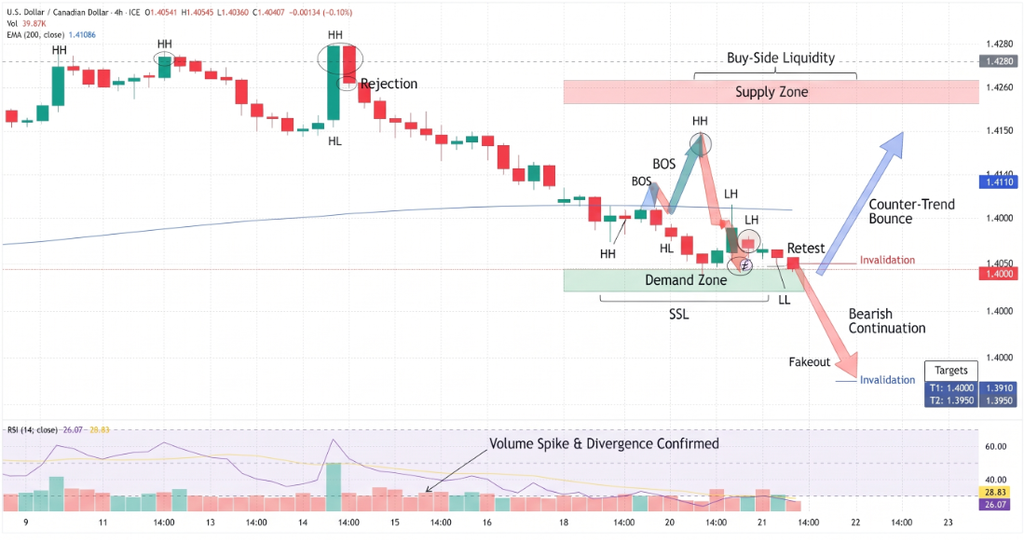
USD/CAD Price Chart – Source: Tradingview
Conversely, a recovery above 1.4079–1.4096 would challenge the immediate bearish structure. A move toward 1.4175 would suggest a deeper correction, although a sustained advance toward 1.4303 would require stronger buying momentum.
Conclusion
USD/CAD remains vulnerable near 1.4050 as oil prices support the Canadian dollar and technical indicators favor sellers. A confirmed break below 1.4030 would open the way toward 1.3968, while resistance between 1.4079 and 1.4096 remains the first hurdle for a recovery. Traders should monitor crude prices, central-bank decisions and confirmation from price action before committing to a directional view.
Sources & Methodology
Primary-source standard: Market-moving facts should link to original data releases, regulator notices, company filings or official project announcements whenever available. Secondary reporting is used for additional context, not as a substitute for original evidence.
Page last reviewed: