Bitcoin traded below $82,000 on Friday as falling technology stocks and rising oil prices weakened investor appetite for riskier assets. The largest cryptocurrency slipped to $81,781, remaining within a month-long range of $80,000 to $87,000. Concerns about the cost and profitability of artificial intelligence investments have weighed on global markets, while escalating Middle East tensions pushed crude oil to a five-month high. Although spot Bitcoin exchange-traded funds attracted substantial weekly inflows in the latest reported figures, those purchases have not translated into a sustained price recovery.
Bitcoin Faces Pressure From Tech Selloff
Bitcoin fell 0.2% to $81,781 at 05:17 ET on Friday, extending its recent decline. The cryptocurrency has struggled to maintain momentum after approaching $85,000 earlier in the week, leaving the $80,000 threshold as an important near-term reference point.
The pressure reflects a broader shift in market sentiment. On Thursday, the Nasdaq Composite dropped 2.6%, while the S&P 500 lost approximately 1.2%, as investors reassessed the outlook for artificial intelligence spending and technology-sector valuations.
Concerns about whether substantial AI investments will generate sufficient returns have affected semiconductor companies and other technology businesses. Higher borrowing costs could add to the pressure by making speculative investments less attractive.
Bitcoin often trades alongside growth-oriented technology assets when investors reduce exposure to risk. Rising crude oil prices have added another concern, as more expensive energy can intensify inflation pressures and complicate central-bank interest-rate decisions.
Brent crude briefly reached $114.72 a barrel on Friday amid escalating Middle East tensions and concerns about possible disruptions to energy supplies. Investors are also preparing for major central-bank decisions and additional technology earnings, potentially limiting demand for volatile assets.
Bitcoin ETF Flows Offer Mixed Signals
Institutional investment flows provide a more complicated picture. According to the figures reported in the source article, US spot Bitcoin ETFs attracted $442.7 million in net inflows during the week through October 22, ending two consecutive weeks of withdrawals.
These exchange-traded funds allow investors to gain exposure to Bitcoin through traditional brokerage accounts without directly holding the cryptocurrency. Sustained inflows can support demand, but they do not guarantee higher prices when broader selling pressure remains strong.
More recent reporting, however, indicates that spot Bitcoin ETFs experienced approximately $635 million in net outflows on October 22, highlighting how quickly daily flows can reverse.
For traders, the key figures to monitor are:
- $80,000: Lower boundary of Bitcoin’s recent trading range.
- $82,000: Immediate psychological threshold.
- $85,000: Recent recovery area that Bitcoin struggled to maintain.
- $87,000: Upper boundary of the month-long range.
Altcoins Remain Under Pressure
The wider cryptocurrency market also showed limited momentum on Friday. Ether traded around $2,406.84, while XRP edged lower. Solana was broadly flat, Cardano recorded a modest gain in the original market snapshot, and BNB outperformed several major tokens.
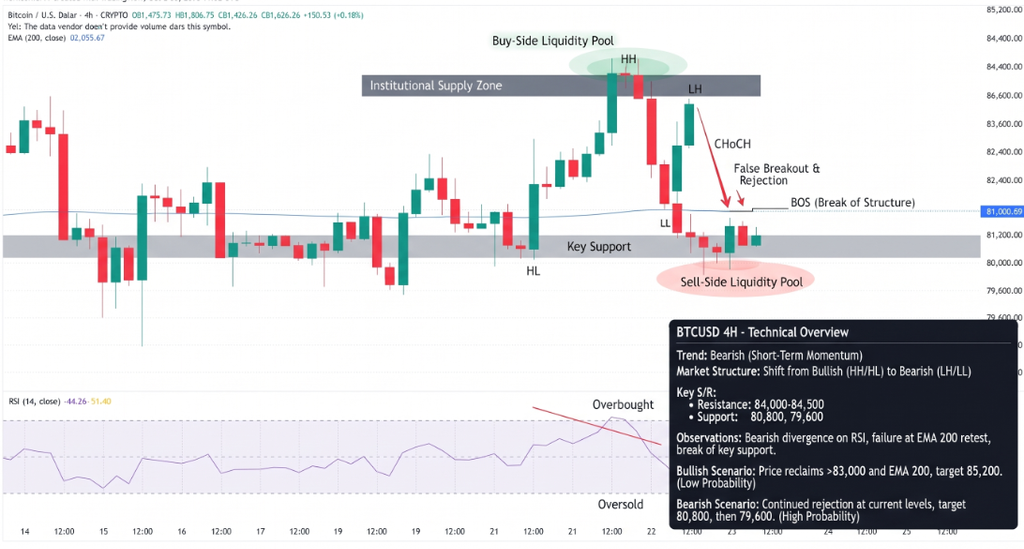
Bitcoin Price Chart – Source: Tradingview
Meme coins Dogecoin and $TRUMP also showed pockets of strength, although isolated gains did little to change the cautious market tone.
Conclusion
Bitcoin remains vulnerable while technology shares weaken and oil prices sustain inflation concerns. ETF demand may provide support, but conflicting daily flows underline the uncertainty surrounding institutional appetite. A move below $80,000 would challenge the current trading range, while a sustained recovery above $85,000 would offer stronger evidence that buyers are regaining control.
Sources & Methodology
Primary-source standard: Market-moving facts should link to original data releases, regulator notices, company filings or official project announcements whenever available. Secondary reporting is used for additional context, not as a substitute for original evidence.
Page last reviewed: