
The AUD/USD pair remained above the key 0.7000 psychological level on Tuesday, but gains were limited by resistance near its 100-day Simple Moving Average (SMA). The Australian dollar is approaching a pivotal period, with September inflation data from Australia and the Federal Reserve’s policy decision scheduled for Wednesday, October 28. The Australian Bureau of Statistics is due to publish its latest Consumer Price Index (CPI) report, while the Fed is widely expected to leave US interest rates unchanged. The results could reshape expectations for both currencies and determine whether the pair can break above resistance.
Inflation and Fed Policy in Focus
Australia’s inflation report could influence expectations for the Reserve Bank of Australia (RBA), which uses interest rates to control inflation and maintain economic stability. The latest available monthly data showed annual CPI inflation at 4.0% in August, up from 3.5% in July, while trimmed-mean inflation remained at 3.6%. The September release will help investors assess whether domestic price pressures are continuing to build.
Stronger-than-expected inflation could support the Australian dollar if markets anticipate a more restrictive RBA policy. A softer reading could have the opposite effect by reducing expectations for further tightening.
The US side of the equation remains equally important. The FOMC concludes its two-day meeting on October 28. Investors will focus on the policy statement and Chair Kevin Warsh’s press conference for clues about the future path of interest rates.
On Thursday, October 29, the US advance third-quarter GDP report and September Personal Consumption Expenditures (PCE) price index will provide further evidence about economic growth and inflation. Elevated energy prices and geopolitical uncertainty may reinforce demand for the US dollar, particularly if investors expect US rates to remain high for longer. <Cite refs={[“turn406313news35″,”turn406313search5”]}/>
AUD/USD Technical Levels to Watch
The supplied technical setup shows the pair struggling around the 100-day SMA, with the 38.2% Fibonacci retracement at 0.7025 acting as an immediate hurdle. The Relative Strength Index (RSI) near 51 indicates broadly neutral momentum, while the Moving Average Convergence Divergence (MACD) remains above zero and is rising. These signals suggest a tentative recovery, not a confirmed bullish breakout.
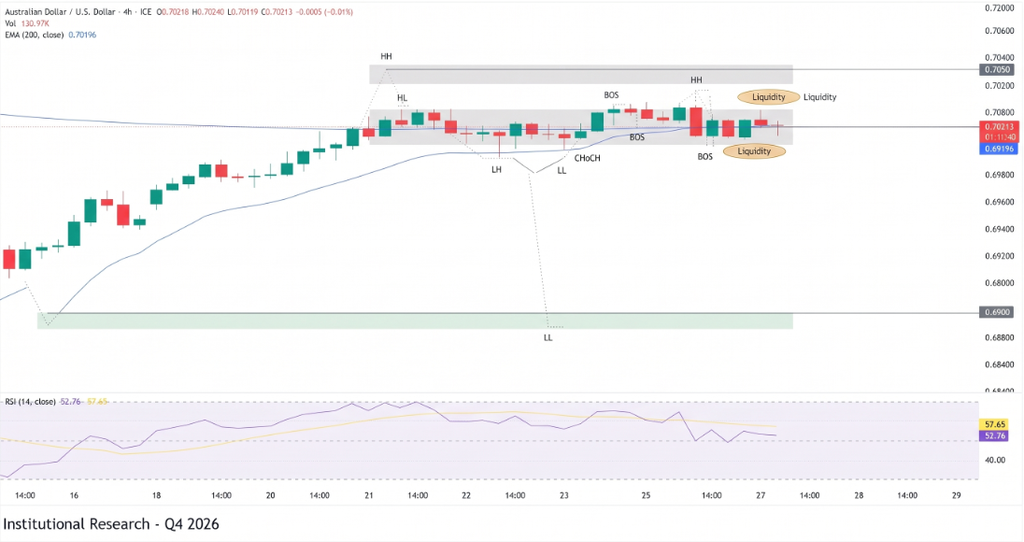
Key levels from the supplied chart analysis include:
- Immediate resistance: 0.7025.
- Next upside targets: 0.7065 and 0.7105.
- Higher resistance: 0.7162.
- Initial support: 0.6976.
- Major downside level: 0.6895.
A sustained daily close above 0.7025 would strengthen the recovery case and expose 0.7065, followed by 0.7105. Failure to clear resistance could keep the pair in consolidation. A break below 0.6976 would weaken the short-term outlook, while a move under 0.6895 would threaten the broader recovery structure.
Conclusion
AUD/USD is caught between support from expectations for Australian monetary policy and pressure from a firm US dollar. Wednesday’s Australian inflation report and Fed decision could determine the next directional move. Holding above 0.7000 keeps a recovery possible, but bulls need a convincing break above 0.7025 and the 100-day SMA to improve the technical outlook. A decline through 0.6976 would instead shift attention toward lower support levels.
Sources & Methodology
Primary-source standard: Market-moving facts should link to original data releases, regulator notices, company filings or official project announcements whenever available. Secondary reporting is used for additional context, not as a substitute for original evidence.
Page last reviewed: