
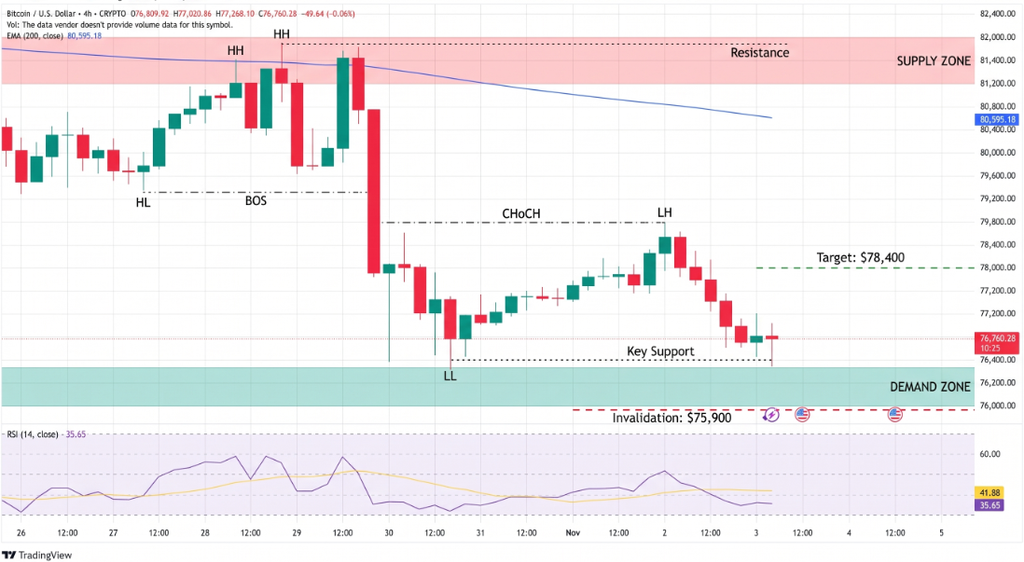
Bitcoin dropped to a more than one-month low on Tuesday as investors reduced exposure to digital assets ahead of the US midterm elections. The decline came amid uncertainty over future cryptocurrency regulation, fallout from a reported $6.3 billion security breach at Binance and substantial withdrawals from US-listed spot Bitcoin exchange-traded funds (ETFs). Bitcoin fell 2% to $76,565.90 by 01:25 ET (06:25 GMT), its weakest level since early September. The move extended a difficult period for the market after Bitcoin lost more than 6% in October.
US midterms cloud crypto regulation outlook
The US midterm elections have become a central concern for cryptocurrency investors because the outcome could influence Congress’s approach to digital-asset regulation during the remainder of President Donald Trump’s term.
A change in congressional control could affect the prospects for legislation designed to establish clearer rules for crypto exchanges, token issuers and market participants. The Digital Asset Market Clarity Act, a major industry-backed market-structure proposal, failed to advance in a Senate procedural vote on September 15. It received 50 votes in favor and 49 against, falling short of the 60 votes required to proceed.
The bill’s stalled progress has increased attention on the role of federal regulators, including the Securities and Exchange Commission and the Commodity Futures Trading Commission. While agencies can shape enforcement and regulatory policy, legislation would provide a more durable framework.
Investors are therefore watching whether the election produces a political environment more favorable to renewed negotiations or creates additional obstacles for crypto legislation. The outcome could influence sentiment, although it will not determine Bitcoin’s price direction on its own.
Binance breach triggers institutional caution
The regulatory uncertainty comes as the industry assesses the consequences of Binance’s reported $6.3 billion security breach. The exchange gradually restored withdrawals after the incident and said it would cover customer losses. It also reported replacing approximately 95% of the stolen assets from its own reserves.
The incident nevertheless unsettled investors. Customers withdrew a net $3.64 billion from Binance during the initial period after withdrawals reopened, highlighting concerns about exchange security and the safety of assets held on centralized platforms.
Institutional demand also weakened. US spot Bitcoin ETFs recorded $643.3 million in net outflows on Friday, October 30, their largest single-day withdrawal since June 25. The redemptions followed the Binance breach and reversed much of the funds’ recent inflow momentum.
A separate technology-stock selloff added pressure. The Nasdaq Composite fell 1.1% on Monday as investors reassessed valuations and spending tied to artificial intelligence, reducing appetite for risk-sensitive assets such as cryptocurrencies.
Bitcoin decline spreads across altcoins
Bitcoin’s weakness extended across major digital assets, although individual tokens recorded different losses during Tuesday’s session.
- Ether (ETH): Down 1.4% to $2,253.
- XRP: Little changed during the reported session.
- Solana (SOL): Fell 2.7%.
- Cardano (ADA): Declined 1.5%.
- BNB: Lost 1.7%.
- Dogecoin (DOGE): Dropped 2%.
- Official Trump (TRUMP): Fell 5.5%.
The figures show that selling pressure was broad but uneven, with some smaller tokens experiencing steeper declines than Bitcoin.
Conclusion
Bitcoin’s fall to $76,565 reflects a combination of regulatory uncertainty, institutional fund withdrawals and concerns following Binance’s security breach. The US midterm results may shape the next phase of crypto policy, but market confidence will also depend on ETF demand, exchange stability and broader investor appetite for risk. Until those pressures ease, a sustained recovery in Bitcoin and major altcoins may remain difficult.
Sources & Methodology
Primary-source standard: Market-moving facts should link to original data releases, regulator notices, company filings or official project announcements whenever available. Secondary reporting is used for additional context, not as a substitute for original evidence.
Page last reviewed: