
The EUR/USD pair advanced to around 1.1235 in Wednesday’s European session, extending its recovery as the US Dollar weakened following early results from the US midterm elections. The political shift raised expectations of tighter limits on President Donald Trump’s fiscal agenda, adding pressure to the greenback. At the same time, hawkish comments from European Central Bank policymaker Joachim Nagel strengthened the Euro’s interest-rate outlook. Despite the rebound, the pair remains below its 100-day simple moving average, leaving the broader technical picture short of a confirmed bullish reversal.
Dollar weakens as election results emerge
Early election returns pointed to significant Democratic gains in both chambers of Congress, putting control of the House and Senate in focus. Investors may interpret a Democratic-controlled Congress as a constraint on the administration’s spending plans and policy agenda, potentially reducing support for the US Dollar.
Currency strategist Carol Kong of Commonwealth Bank of Australia said a Democratic sweep could prompt further dollar weakness because it would limit government spending during Trump’s term. However, election counts remain subject to updates, and preliminary seat totals should not be treated as final results. Decision Desk HQ’s live tracker distinguishes between called races and seats still being counted.
The dollar’s direction will also depend on whether political developments translate into changes in fiscal expectations and Treasury yields. A weaker dollar generally supports EUR/USD because the pair measures how many dollars one euro can buy.
Nagel’s warning supports Euro demand
The Euro received an additional boost from Bundesbank President Joachim Nagel, who said a December ECB rate increase was very likely to be necessary unless the inflation outlook improved significantly. He warned that repeated energy-price increases could spread into broader prices and eventually influence wage demands.
The comments matter because higher interest rates can make a currency more attractive to investors seeking better returns. The ECB left rates unchanged at its latest meeting, but Nagel’s remarks suggest policymakers remain concerned about persistent inflation. A December increase is his assessment, not a confirmed decision by the Governing Council.
United Overseas Bank (UOB) also sees scope for further Euro gains. Its analysts identify 1.1250 as the next important resistance, with a sustained close above that level potentially opening the way toward 1.1280. They place stronger support at 1.1160.
EUR/USD technical outlook remains mixed
On the daily chart, EUR/USD has moved above the middle line of its 20-day Bollinger Bands, located near 1.1195. This suggests the short-term recovery is gaining traction. However, the pair remains below its 100-day simple moving average near 1.1420, which continues to limit the broader upside outlook.
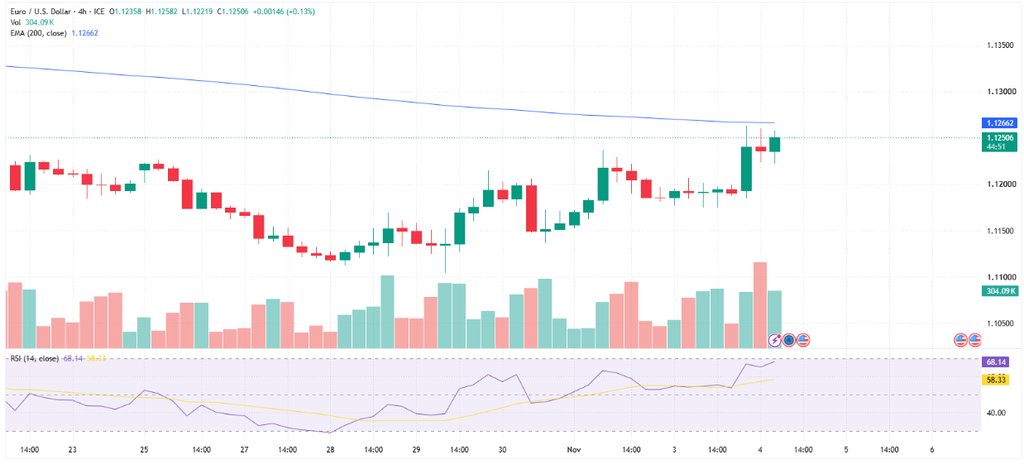
The Relative Strength Index stands at 48.9, just below the neutral 50 mark. This indicates that bearish momentum has eased, but buyers have yet to establish clear control.
Key levels traders are monitoring include:
- Resistance: 1.1255, 1.1325 and 1.1420.
- Support: 1.1195, 1.1132, 1.1100 and 1.0951.
Conclusion
EUR/USD has gained support from political uncertainty in the United States and expectations of tighter ECB policy. A break above 1.1250 would strengthen the recovery and put 1.1280 in focus. However, failure to clear nearby resistance, followed by a move below 1.1195, could expose lower support. The 100-day average at 1.1420 remains the more significant test for a broader trend reversal.
EUR/USD has gained support from political uncertainty in the United States and expectations of tighter ECB policy. A break above 1.1250 would strengthen the recovery and put 1.1280 in focus. However, failure to clear nearby resistance, followed by a move below 1.1195, could expose lower support. The 100-day average at 1.1420 remains the more significant test for a broader trend reversal.
Sources & Methodology
Primary-source standard: Market-moving facts should link to original data releases, regulator notices, company filings or official project announcements whenever available. Secondary reporting is used for additional context, not as a substitute for original evidence.
Page last reviewed: