
Dogecoin (DOGE) extended its recovery for a second consecutive session on Thursday, November 5, trading above $0.0770 as buyers attempted to regain control of the market. The rebound comes despite weakening institutional interest and declining futures Open Interest, suggesting that traders remain cautious about committing fresh capital. From a technical perspective, DOGE is approaching a descending resistance trendline near $0.0786 on the four-hour chart. A confirmed breakout could open the way toward $0.0806, although limited derivatives participation raises questions about the sustainability of the recovery.
DOGE recovery faces weak investor demand
The Dogecoin price recovered above $0.0770 after gaining more than 2% in the preceding session. However, the improvement in spot prices has not been accompanied by stronger participation from leveraged traders.
According to CoinGlass, Dogecoin futures Open Interest (OI) declined to approximately 13.62 billion DOGE from 14.52 billion on Monday. Open Interest measures the total value or number of outstanding derivatives contracts that have not been settled or closed.
The decline indicates that traders have been reducing existing positions rather than aggressively establishing new exposure during the price recovery. This divergence between rising spot prices and falling Open Interest suggests that the latest advance may lack strong derivatives-market confirmation.
Institutional demand also remains subdued. Dogecoin-focused exchange-traded funds (ETFs) have recorded little fresh capital activity, with available flow data showing no reported net inflows in recent trading sessions. This contrasts with periods when institutional participation helped strengthen demand for major cryptocurrencies.
Nevertheless, a sustained recovery could encourage traders to rebuild positions if broader cryptocurrency market sentiment continues improving.
Dogecoin ETFs and derivatives remain subdued
The lack of ETF activity highlights the challenges facing Dogecoin as investors reassess exposure to speculative digital assets.
Available Dogecoin ETF flow data showed no net flows on November 3, based on the reporting available from two of three funds. The broader data also indicates limited activity since October 14, although incomplete daily reporting should be distinguished from confirmed full-market outflows.
Several indicators will be important for assessing whether demand is returning:
- Futures Open Interest: Whether outstanding contracts begin increasing alongside prices.
- ETF flows: Whether institutional products attract fresh capital.
- Spot trading volume: Whether buyers provide stronger confirmation of the rebound.
- Broader crypto sentiment: Whether improving risk appetite supports speculative assets.
Without stronger participation, DOGE could struggle to maintain its upward momentum near resistance.
$0.0786 breakout determines bullish outlook
On the four-hour chart, Dogecoin has reclaimed its 50-period Exponential Moving Average (EMA) at $0.0762, improving its immediate technical structure. However, the cryptocurrency remains below a descending resistance trendline connecting the October 8 and October 29 highs, currently positioned near $0.0786.
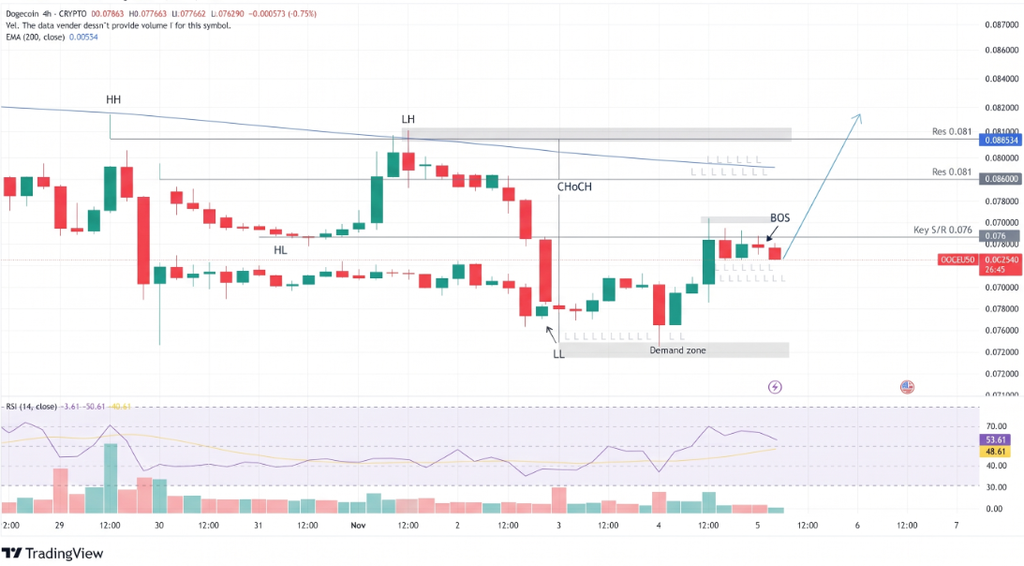
The Relative Strength Index (RSI) stands near 58, indicating positive momentum without entering overbought territory. Meanwhile, the Moving Average Convergence Divergence (MACD) line remains marginally positive, supporting the possibility of additional gains.
A confirmed breakout above $0.0786 could expose the 200-period EMA and horizontal resistance near $0.0806.
On the downside, the 50-period EMA at $0.0762 represents immediate support. A sustained decline below this level could expose $0.0723, followed by deeper support near $0.0677.
Conclusion
Dogecoin’s two-day recovery has improved its short-term technical outlook, but declining Open Interest and limited ETF activity suggest that investor conviction remains weak. A decisive break above $0.0786 could extend gains toward $0.0806. Conversely, failure to overcome resistance could trigger another decline toward $0.0762 and $0.0723. Stronger spot demand and renewed derivatives participation will be essential to sustain a broader bullish reversal.
Sources & Methodology
Primary-source standard: Market-moving facts should link to original data releases, regulator notices, company filings or official project announcements whenever available. Secondary reporting is used for additional context, not as a substitute for original evidence.
Page last reviewed: