Gold prices extended their decline on Thursday, falling below the psychologically important $4,000-an-ounce threshold as persistent U.S. inflation and hawkish Federal Reserve commentary strengthened expectations of another interest-rate increase in December.
At 00:16 ET (05:16 GMT), spot gold fell 0.4% to $3,973.13 an ounce, while U.S. gold futures dropped 0.6% to $3,978.57. A stronger dollar and rising Treasury yields added to the pressure, making bullion less attractive to investors.
Gold slides as Fed tightening bets rise
The latest decline followed a previous-session sell-off, with bullion trading near $3,970 as investors reassessed the outlook for U.S. monetary policy. Markets were pricing in a 25-basis-point rate increase in December, while the possibility of a larger 50-basis-point move also entered investor calculations.
A basis point equals 0.01 percentage point, making a 25-basis-point increase equivalent to a quarter of a percentage point. Although market pricing reflects traders’ expectations, it does not guarantee the Federal Reserve’s eventual decision.
Inflation concerns intensified after Chicago Fed President Austan Goolsbee described October’s inflation report as “borderline disturbing.” Fellow policymaker Anna Paulson also warned that elevated price pressures were not simply the result of temporary factors.
The latest U.S. inflation figures reinforced those concerns. Consumer prices increased 0.4% month over month in October, exceeding economists’ 0.3% forecast, while core inflation rose 0.3% for a third consecutive month. The data strengthened expectations that policymakers may need to maintain or increase borrowing costs to contain inflation.
Dollar and Treasury yields pressure bullion
Currency and bond markets reflected the shift in expectations. The U.S. Dollar Index edged 0.1% higher to 102.98, while two-year Treasury yields jumped 18 basis points on Tuesday. These short-term government yields are particularly sensitive to expectations for Federal Reserve policy.
Gold faces a difficult environment when interest rates and bond yields rise because the metal does not generate interest income. Investors may instead favour assets offering higher returns. A stronger dollar adds another obstacle by increasing the cost of dollar-priced bullion for buyers using other currencies.
Other precious metals also weakened during Thursday’s session:
- Silver fell 0.6% to $51.3605 an ounce.
- Platinum declined 0.2% to $1,535.84.
- Spot palladium gained 0.1% to $1,034.06.
- Palladium futures advanced 0.1% to $1,031.25.
The mixed palladium performance showed that selling pressure was not uniform across the precious-metals complex.
Gold outlook hinges on December Fed decision
ANZ analysts said stronger-than-expected inflation and resilient economic activity had increased the likelihood of a more aggressive Federal Reserve response. They highlighted the possibility of a 50-basis-point increase in December, alongside the pressure that higher Treasury yields and dollar strength could place on gold.
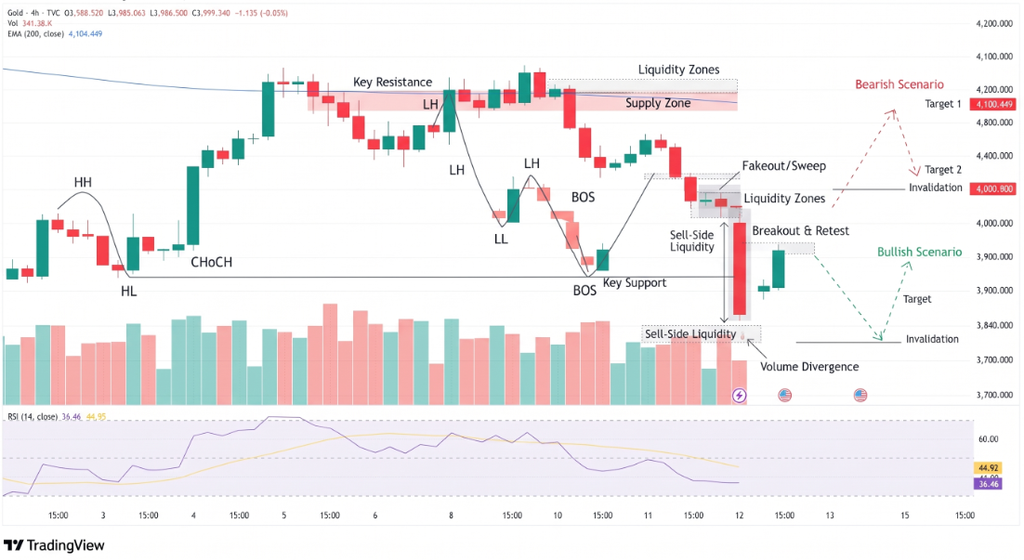
Investors will therefore monitor upcoming inflation releases, economic activity data and further comments from Fed officials for clues about the policy outlook. Softer readings could reduce expectations for additional tightening and help bullion recover, while persistent price pressures could extend the decline.
Conclusion
Gold’s break below $4,000 leaves the metal vulnerable while markets anticipate tighter U.S. monetary policy. A sustained recovery will likely require easing inflation concerns, lower Treasury yields or a weaker dollar. Until those conditions emerge, the $4,000 level remains an important benchmark for assessing whether buyers can regain control.
Sources & Methodology
Primary-source standard: Market-moving facts should link to original data releases, regulator notices, company filings or official project announcements whenever available. Secondary reporting is used for additional context, not as a substitute for original evidence.
Page last reviewed: