Gold prices remained close to $4,130 an ounce on Tuesday as declining oil prices and improving prospects for a U.S.-Iran peace agreement eased inflation concerns. However, expectations of another Federal Reserve interest-rate increase in December continued to restrict bullion’s gains.
Spot gold fell 0.4% to $4,126.72 an ounce at 19:48 ET (00:48 GMT), while U.S. gold futures rose 0.5% to $4,135.95. The contrasting moves reflected shifting investor expectations as markets weighed geopolitical developments against the outlook for U.S. monetary policy.
Gold Rally Gains Support From Oil
Gold advanced 1.7% on Monday and recorded gains of approximately 5% last week, bringing prices close to the $4,130 threshold. The latest advance was supported by falling crude prices and reduced concerns that higher energy costs would intensify inflation.
Brent crude declined to approximately $92 a barrel as investors grew more optimistic about progress in U.S.-Iran peace negotiations. Political developments following last week’s U.S. midterm elections also contributed to changing market expectations, with Democrats securing control of Congress.
Oil prices are particularly important for gold because higher energy costs can increase inflation across the economy. Persistent inflation may encourage central banks to maintain elevated interest rates or introduce additional increases, making non-yielding assets such as gold less attractive.
The recent retreat in crude prices has therefore reduced one of the major obstacles facing bullion. Lower energy costs could ease inflationary pressure and eventually give central banks more flexibility in setting monetary policy.
Dollar and Precious Metals Under Pressure
The U.S. Dollar Index edged 0.1% higher to 101.74, limiting some of gold’s potential upside. Nevertheless, the dollar’s broader movements remain an important factor for international bullion demand because gold is priced in U.S. dollars.
Other precious metals also traded lower on Tuesday:
- Silver declined 0.4% to $53.2100 an ounce.
- Platinum slipped 0.4% to $1,573.36.
- Spot palladium dropped 0.4% to $1,036.49.
- Palladium futures lost 0.6% to $1,031.75.
A stronger dollar generally makes dollar-denominated commodities more expensive for buyers using other currencies, potentially reducing international demand. This relationship has kept currency-market movements firmly in focus for precious-metals investors.
Fed Rate Expectations Limit Gold Gains
Despite improving geopolitical conditions and lower oil prices, the Federal Reserve inflation concerns remain a significant challenge for gold.
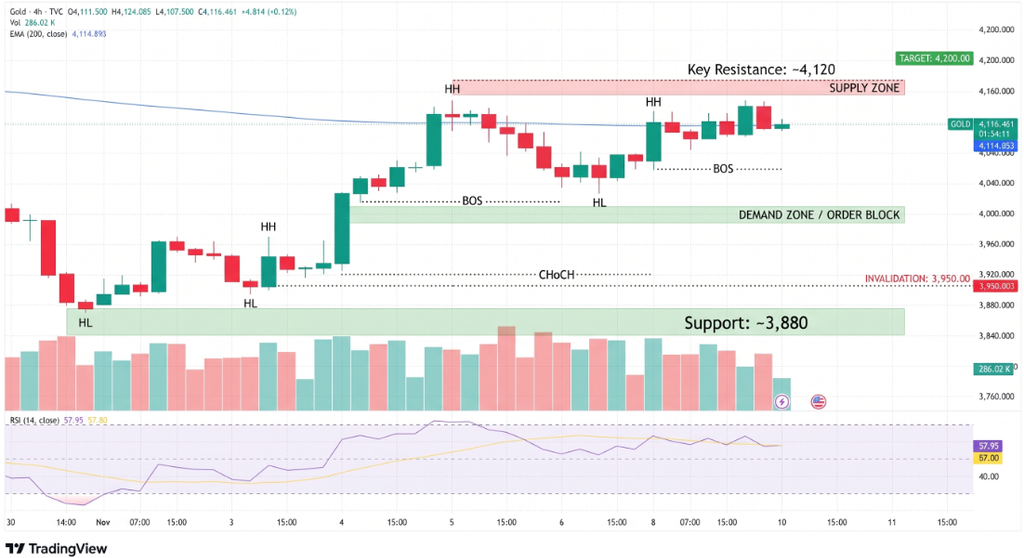
Fed officials have continued emphasizing the importance of controlling persistent price pressures. Traders are assigning a high probability to another interest-rate increase in December, suggesting that monetary policy could remain restrictive for longer.
Richmond Fed President Tom Barkin and Chicago Fed President Austan Goolsbee have both pointed to the resilience of the U.S. economy and continuing inflation risks. Their assessments reinforce expectations that policymakers may need to maintain current borrowing costs or tighten monetary conditions further.
Higher interest rates typically weigh on gold because bullion does not generate interest or dividend income. Consequently, investors may prefer interest-bearing assets when yields rise.
Conclusion
Gold’s ability to remain above $4,100 will depend on the balance between easing geopolitical and energy-related inflation risks and the Federal Reserve’s increasingly cautious policy outlook. A sustained decline in oil prices and a weaker dollar could support another advance, but stronger U.S. economic data and additional rate-hike expectations may prevent bullion from extending its recent rally.
Sources & Methodology
Primary-source standard: Market-moving facts should link to original data releases, regulator notices, company filings or official project announcements whenever available. Secondary reporting is used for additional context, not as a substitute for original evidence.
Page last reviewed: