
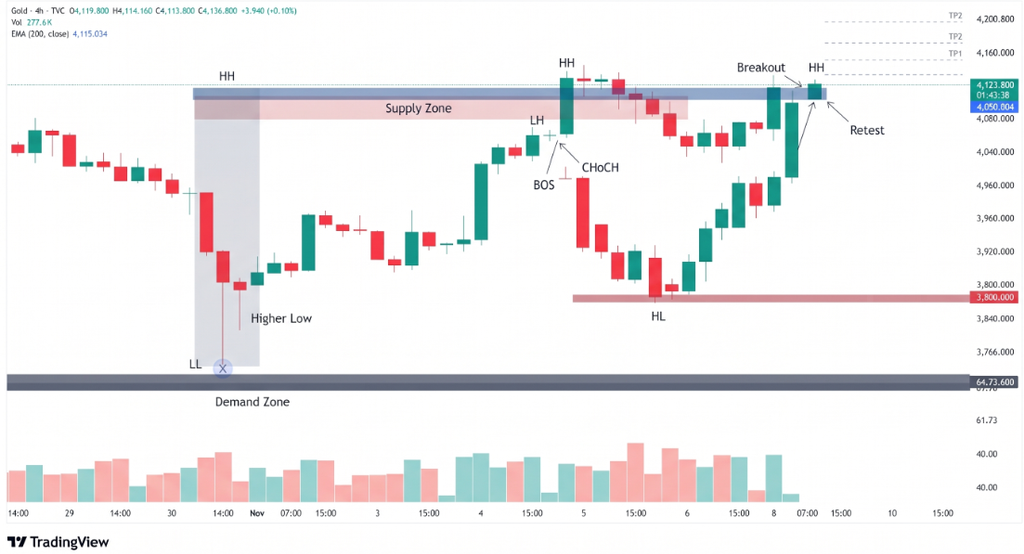
Gold prices climbed above $4,100 an ounce on Monday as precious metals extended their recovery following last week’s volatility. Investors weighed stronger-than-expected U.S. employment figures against easing geopolitical concerns and expectations surrounding the Federal Reserve’s next interest rate decision.
At 23:51 ET (04:51 GMT), spot gold advanced 0.8% to $4,123.60 an ounce, while U.S. gold futures gained 0.9% to $4,132.26. Silver rose 1.6% to $52.7890, and platinum added 1.2% to $1,557.25. Palladium climbed 2.4% to $1,048.14, while the U.S. Dollar Index slipped 0.1% to 102.14.
Strong US Jobs Data Weighs on Gold
Gold declined 0.4% on Friday, trading around $4,070 an ounce after the latest U.S. employment report showed that employers added 165,000 jobs in October, significantly exceeding the average monthly increase of 48,000 recorded over the previous 12 months.
According to the U.S. Bureau of Labor Statistics, the unemployment rate edged down to 4.1% from 4.2% in September. Meanwhile, average hourly earnings increased 0.4% to $38.00, highlighting continued resilience in the American labor market.
The stronger employment figures raised concerns that the Federal Reserve could maintain restrictive monetary policy for longer or consider additional interest rate increases to control inflation.
Higher borrowing costs typically pressure gold because the precious metal does not generate interest income. Consequently, investors may favor interest-bearing assets when expectations for tighter monetary policy increase.
Additional economic developments include:
- October payrolls increased by 165,000.
- Unemployment declined to 4.1%.
- Average hourly earnings advanced 0.4%.
- The U.S. Dollar Index traded near 102.14.
Midterm Elections Support Precious Metals
Gold previously recovered above $4,000 following the U.S. midterm elections as declining Treasury yields and crude oil prices improved market sentiment.
Investors anticipated that divided government could restrict additional federal spending and borrowing, potentially easing concerns about the country’s fiscal outlook.
Meanwhile, expectations of diplomatic progress toward ending the U.S.-Iran conflict contributed to lower oil prices. Cheaper energy can reduce inflationary pressure and weaken expectations that interest rates will remain elevated.
However, the recovery remains incomplete. Gold is still approximately 20% below its pre-conflict level, reflecting the substantial volatility experienced across financial markets.
ANZ analysts described bullion as volatile last week, citing uncertainty surrounding economic conditions, geopolitical developments and monetary policy.
US CPI Report Becomes Next Major Catalyst
Market attention is now shifting toward Tuesday’s U.S. Consumer Price Index (CPI) report for October. The inflation figures could provide important clues about the Federal Reserve’s December policy decision.
The Bureau of Labor Statistics has scheduled the October CPI release for November 10. Investors will examine whether persistent energy costs continue contributing to inflationary pressures.
Before its December meeting, the Federal Reserve will also receive another employment report, giving policymakers additional information about labor-market conditions and price stability.
The upcoming economic releases could influence gold through several channels:
- Softer inflation: Could reduce expectations of further rate increases and support bullion.
- Stronger inflation: Could strengthen the dollar and Treasury yields, creating pressure on gold.
- Weaker employment: Could increase expectations of monetary easing and improve demand for non-yielding assets.
Conclusion
Gold’s recovery above $4,100 represents an important development, but its sustainability will depend heavily on incoming U.S. economic data. Tuesday’s CPI report is the immediate catalyst, with softer inflation potentially extending the precious metals rebound. Conversely, stronger price pressures could revive expectations of tighter Federal Reserve policy, limiting further gains in gold.
Sources & Methodology
Primary-source standard: Market-moving facts should link to original data releases, regulator notices, company filings or official project announcements whenever available. Secondary reporting is used for additional context, not as a substitute for original evidence.
Page last reviewed: