
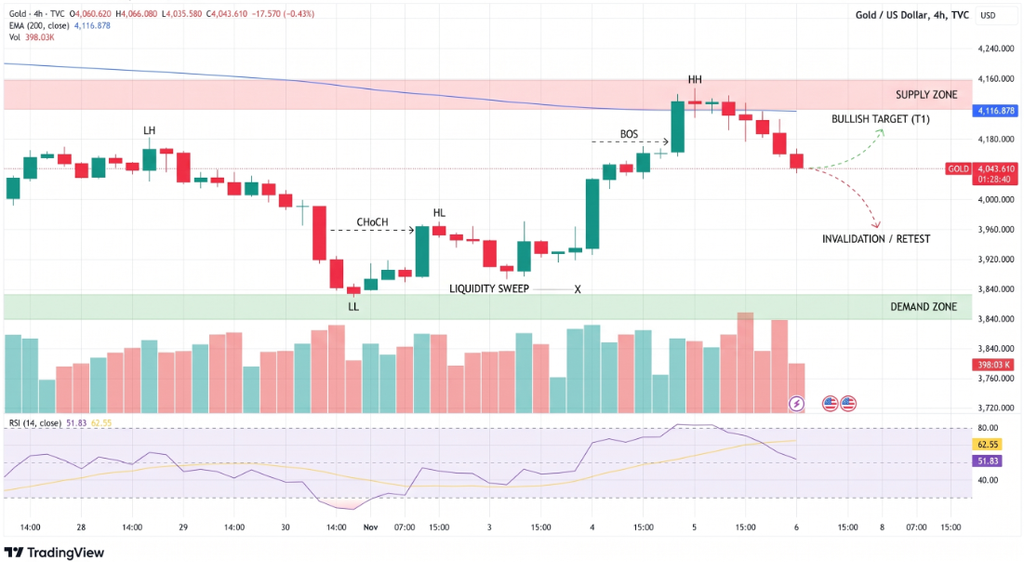
Gold prices edged lower on Friday but remained on track for their strongest weekly performance since August, with bullion gaining more than 5% as Democrats’ sweeping U.S. midterm election victory weakened the dollar and Treasury yields. Investors also assessed technology-stock losses, shifting fiscal expectations and persistent demand from central banks. Although the latest retreat reflected some profit-taking and currency-related pressure, gold continued to benefit from expectations that political changes in Washington could influence government borrowing and monetary policy.
Gold Holds Above $4,080 After Rally
At 20:22 ET, spot gold slipped 0.1% to $4,083.31 an ounce, while U.S. gold futures declined 0.5% to $4,092.67. The broader precious-metals market delivered a mixed performance:
- Silver: Rose 0.1% to $51.8615 an ounce.
- Platinum: Fell 0.2% to $1,517.17.
- Palladium: Dropped 0.9% to $1,025.28.
- U.S. Dollar Index: Advanced 0.1% to 101.62.
Despite Friday’s modest decline, gold had advanced more than 5% during the week, marking its strongest weekly gain since August.
The rally followed Democrats securing control of both chambers of Congress in the November 3 midterm elections. Investors interpreted the result as potentially limiting President Donald Trump’s ability to advance additional fiscal spending and major policy initiatives without congressional support.
The resulting decline in U.S. Treasury yields reduced the opportunity cost of holding non-yielding assets such as gold. A weaker dollar also made bullion less expensive for international buyers, supporting demand.
Treasury Yields and Stocks Shape Outlook
Gold’s advance faced competing pressures as technology shares extended their losses for a third consecutive session on Friday. Investors were concerned that Democratic control of Congress could increase regulatory scrutiny of artificial intelligence companies, particularly businesses expanding energy-intensive data centres.
The resulting uncertainty encouraged investors to move toward U.S. government bonds, lifting Treasury prices and pushing yields to their lowest levels since early September. The dollar subsequently recovered slightly, limiting gold’s gains.
ANZ analysts noted that expectations of tighter fiscal constraints under Democratic congressional control had contributed to lower Treasury yields. However, they also highlighted a potential longer-term complication: reduced government borrowing could limit Treasury issuance and weaken one source of demand for gold-related portfolio diversification.
The relationship remains dependent on policy decisions rather than election results alone. Congressional negotiations over spending, borrowing and regulation will determine whether the initial market reaction develops into a lasting trend.
Central Banks Support Gold Demand
Institutional purchases continue to provide an important foundation for the precious-metals market. According to the World Gold Council, central banks added a net 321 tonnes to reserves during the third quarter of 2026, representing a 42% increase from the same period last year.
The buying was the strongest quarterly accumulation since late 2024, reflecting continued diversification and risk-management strategies.
Other important developments included:
- Year-to-date central-bank purchases reached 675 tonnes, up 6% year over year.
- Gold-backed exchange-traded funds attracted 211 tonnes during the third quarter.
- Global gold ETF holdings climbed to a record 4,256 tonnes.
These figures demonstrate that institutional interest remains significant despite fluctuations in prices. However, weaker jewellery and physical investment demand indicate that higher prices continue to challenge some traditional buyers.
Conclusion
Gold’s weekly advance reflects a combination of political uncertainty, falling Treasury yields and sustained central-bank accumulation. Friday’s U.S. nonfarm payrolls report could provide another catalyst by influencing expectations for Federal Reserve interest-rate decisions. Softer employment data could reinforce the case for lower yields and support bullion, while stronger figures could strengthen the dollar and restrict further gains. The $4,080 area and the broader $4,000 level remain important reference points as traders assess whether gold can extend its recovery.
Sources & Methodology
Primary-source standard: Market-moving facts should link to original data releases, regulator notices, company filings or official project announcements whenever available. Secondary reporting is used for additional context, not as a substitute for original evidence.
Page last reviewed: