
The USD/JPY pair struggled to extend its recovery on Friday, November 6, remaining below the psychologically important 158.00 level as investors waited for the latest US employment figures. The pair rebounded from a weekly low near 157.25, but uncertainty over the Federal Reserve’s December policy decision and support for the Japanese yen from the Bank of Japan (BoJ) limited buying interest. The October US Nonfarm Payrolls (NFP) report is expected to provide the next major catalyst for the currency pair.
US Jobs Data Puts Dollar in Focus
Economists expect the US economy to have added 65,000 jobs in October, following September’s increase of 29,000. The unemployment rate is forecast to remain at 4.2%, while average hourly earnings are expected to rise by 0.3% month over month. The figures will help investors assess whether the US labour market is resilient enough to influence the Federal Reserve’s next policy move.
A stronger-than-expected report could reinforce expectations of tighter monetary policy and support the US dollar by pushing Treasury yields higher. Conversely, weaker payroll growth or softer wage figures could reduce the appeal of the dollar and increase pressure on USD/JPY.
Markets are also weighing expectations for a possible December rate increase. However, the dollar faces competing forces: demand for safe-haven assets has offered support amid global equity-market weakness, while falling US Treasury yields have limited its advance.
BoJ Policy and Intervention Risks Support Yen
The Japanese yen has drawn support from expectations that the Bank of Japan could maintain a more hawkish policy stance. A shift toward higher Japanese interest rates would narrow the policy gap between Japan and the United States, potentially making the yen more attractive to investors.
The risk of official intervention also discourages aggressive yen selling. Japanese authorities have repeatedly warned against excessive currency moves, keeping traders cautious when USD/JPY approaches elevated levels.
The pair’s recent movement within a broad range over roughly seven weeks reinforces the case for waiting for a confirmed breakout. Neither currency currently has an unchallenged advantage, leaving employment data and central-bank expectations central to the next move.
USD/JPY Forecast: Key Levels to Watch
Technically, the short-term bias remains cautious to bearish while prices trade below the 100-day Simple Moving Average (SMA) at 159.09 and the 50% Fibonacci retracement at 158.44. The Relative Strength Index (RSI) near 49.37 signals neutral momentum, while the MACD histogram has flattened just above zero, suggesting selling pressure is easing without confirming a bullish reversal.
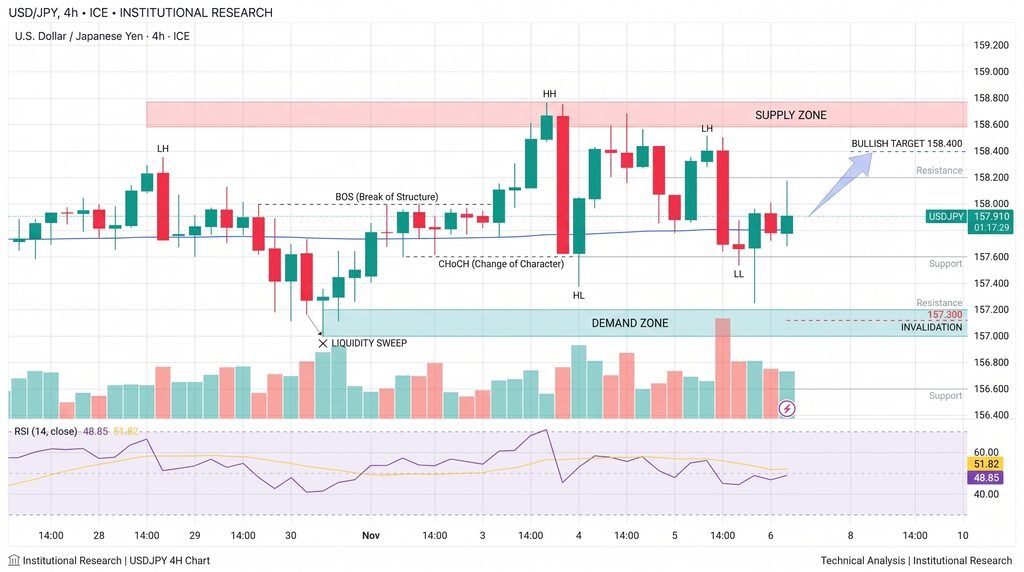
Key price levels include:
- Resistance: 158.44, 159.09 and 159.76.
- Higher resistance: 161.65, followed by the cycle high near 164.05.
- Support: 157.12, then the range floor around 156.65.
- Lower targets: 155.48 and the cycle low near 152.83.
A sustained move above 158.44 would improve the recovery outlook, while a break below 157.12 could expose the lower range boundary.
Conclusion
USD/JPY remains caught between support for the US dollar from interest-rate expectations and yen demand driven by the BoJ’s policy outlook and intervention concerns. The October employment report could determine which side gains the upper hand. Until the pair breaks decisively above 158.44 or falls below 157.12, the broader consolidation remains intact, making confirmation of direction more important than short-term price fluctuations.
Sources & Methodology
Primary-source standard: Market-moving facts should link to original data releases, regulator notices, company filings or official project announcements whenever available. Secondary reporting is used for additional context, not as a substitute for original evidence.
Page last reviewed: