
The Australian Dollar fell more than 1% against the U.S. Dollar on Thursday as a sharp selloff in technology stocks weakened global risk appetite and stronger U.S. labor-market data supported the Greenback. The AUD/USD pair dropped to 0.6931 after reaching 0.7024, breaking below the psychologically important 0.7000 and 0.6950 levels. Investors also assessed hawkish Federal Reserve commentary and expectations that the Reserve Bank of Australia may pause further interest-rate increases. Attention now turns to Friday’s U.S. employment report for fresh direction.
Nasdaq Selloff Pressures Australian Dollar
Market sentiment deteriorated as the Nasdaq 100 plunged more than 5.52%, extending losses across U.S. technology shares. The decline reflected growing concerns about artificial intelligence regulation following the Democrats’ congressional gains, alongside uncertainty over the expansion of energy-intensive data centres.
The selloff encouraged investors to reduce exposure to risk-sensitive currencies such as the Australian Dollar, which often moves with global equity-market sentiment and demand for commodities.
U.S. economic figures provided additional support to the Dollar. Initial Jobless Claims declined to 189,000 for the week ending October 31, below market expectations of 196,000, indicating continued resilience in the labor market.
October’s Challenger job-cut report showed announced layoffs of 43,994, compared with 43,281 in the previous month. Meanwhile, employers announced plans to hire more than 444,692 workers, representing a 57% increase from the corresponding 2025 figure.
Hawkish comments from Federal Reserve officials reinforced demand for the Greenback. Cleveland Fed President Beth Hammack argued that policymakers should maintain a gradual approach to interest-rate adjustments, emphasizing that inflation still requires attention. Richmond Fed President Thomas Barkin similarly warned that broad-based inflation remained elevated.
Fed and RBA Rate Expectations Shift
Interest-rate expectations remain an important driver of AUD/USD movements. According to CME FedWatch, traders reduced the probability of a 25-basis-point Federal Reserve rate hike in December to 66%, down from 82% a day earlier.
In Australia, expectations of additional monetary tightening have also weakened. Investors increasingly anticipate that the Reserve Bank of Australia will maintain its current policy rate through at least its June 22, 2027 meeting, according to Prime Terminal.
The divergence between economic expectations in the two countries could continue influencing capital flows and the Australian Dollar’s performance.
Key developments for currency traders include:
- U.S. October nonfarm payrolls and unemployment data.
- The University of Michigan Consumer Sentiment Index.
- Further Federal Reserve commentary on inflation and interest rates.
- Changing expectations surrounding the RBA’s next policy decision.
AUD/USD Forecast: 0.6900 in Focus
The daily technical outlook remains bearish, with AUD/USD trading near 0.6928 and below its clustered simple moving averages around 0.7050. This positioning indicates that sellers retain control of the broader short-term trend.
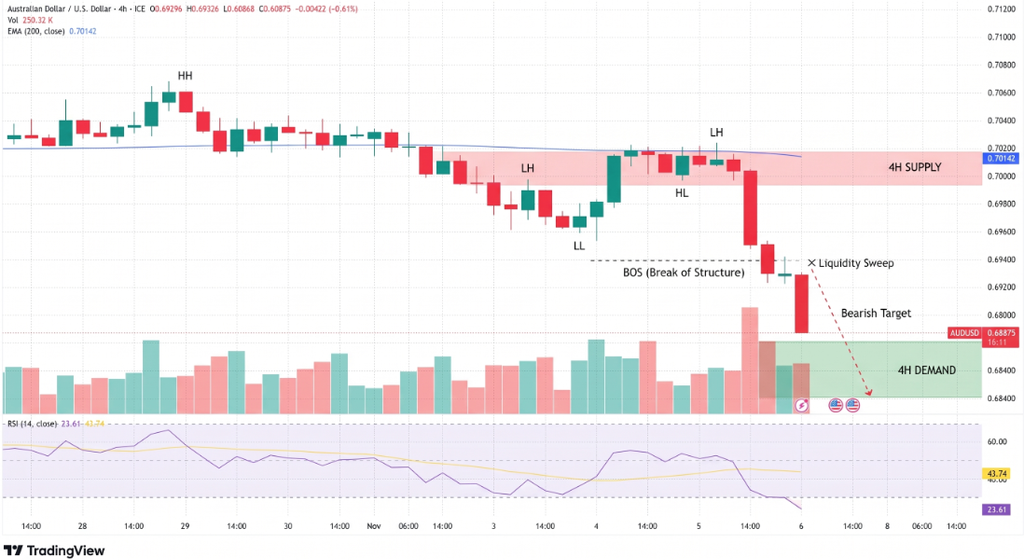
The 14-day Relative Strength Index (RSI) stands near 39, reflecting negative momentum, although the indicator suggests selling pressure has moderated.
On the upside, initial resistance stands around 0.7050, where the moving averages converge. Additional barriers appear near 0.7123 and 0.7198. A sustained daily close above these levels would improve the recovery outlook.
On the downside, immediate support emerges around 0.6923, followed by the psychologically important 0.6900 level. A decisive break below 0.6900 could expose the pair to further losses, while a recovery above 0.6950 would provide an initial sign of stabilization.
Conclusion
AUD/USD remains under pressure as technology-stock losses, resilient U.S. employment figures and uncertainty surrounding Australian interest rates weigh on sentiment. The 0.6900 support level is the immediate downside threshold. Friday’s nonfarm payrolls report could determine whether the Australian Dollar extends its decline or stages a recovery.
Sources & Methodology
Primary-source standard: Market-moving facts should link to original data releases, regulator notices, company filings or official project announcements whenever available. Secondary reporting is used for additional context, not as a substitute for original evidence.
Page last reviewed: