
The EUR/USD pair extended its decline on Friday, trading near 1.1195 during early European hours as investors positioned themselves ahead of key economic releases from Europe and the United States. Weak sentiment across global equity markets supported demand for the U.S. Dollar, while uncertainty surrounding Federal Reserve interest-rate policy limited the currency’s broader recovery. Investors also assessed rising Eurozone inflation and comments from European Central Bank President Christine Lagarde. With October’s U.S. employment report approaching, the currency pair remained vulnerable below the psychologically important 1.1200 level.
US Jobs Data and Dollar Demand Pressure Euro
The EUR/USD exchange rate traded around 1.1195 as traders awaited German Industrial Production, Eurozone Retail Sales and U.S. employment figures. The selloff in artificial intelligence-related stocks encouraged investors to seek defensive assets, supporting the U.S. Dollar against the Euro.
Dilin Wu, research strategist at Pepperstone, highlighted the role of safe-haven demand in supporting the Greenback.
However, expectations surrounding Federal Reserve policy have become less hawkish following the Democratic victory in the U.S. midterm elections. According to the CME FedWatch Tool, the probability of a 25-basis-point rate increase in December declined to approximately 70.9%, compared with more than 82.7% on Wednesday.
The October Nonfarm Payrolls report is expected to show 65,000 additional jobs, recovering from September’s 29,000 increase. The unemployment rate is forecast to remain unchanged at 4.2%.
Stronger employment and wage figures could reinforce expectations of tighter monetary policy, while weaker results could pressure the Dollar.
Eurozone Inflation and ECB Policy Outlook
Eurozone inflation remains an important consideration for the European Central Bank. According to Eurostat, headline inflation accelerated to 4.0% in October from 3.8% in September, reaching its highest level in three years. Core inflation remained at 2.5%.
Deutsche Bank analysts highlighted significant movements in European bond yields following the inflation release. German 10-year Bund yields declined 5.8 basis points to 3.27%, while French 10-year OAT yields dropped 17.6 basis points to 4.77%.
Meanwhile, ECB President Christine Lagarde maintained that policymakers must remain alert to persistent inflation risks, particularly those associated with energy costs and supply-side disruptions.
Her comments suggest that the European Central Bank is unlikely to make monetary policy decisions without assessing incoming economic indicators. Uncertainty surrounding U.S. tariffs and geopolitical developments could further complicate the Eurozone’s inflation and growth outlook.
EUR/USD Forecast: 1.1132 Support in Focus
The daily technical outlook remains bearish as EUR/USD trades below its 100-day Simple Moving Average (SMA). The 14-day Relative Strength Index (RSI) stands near 44, below the neutral 50 threshold, indicating limited bullish momentum.
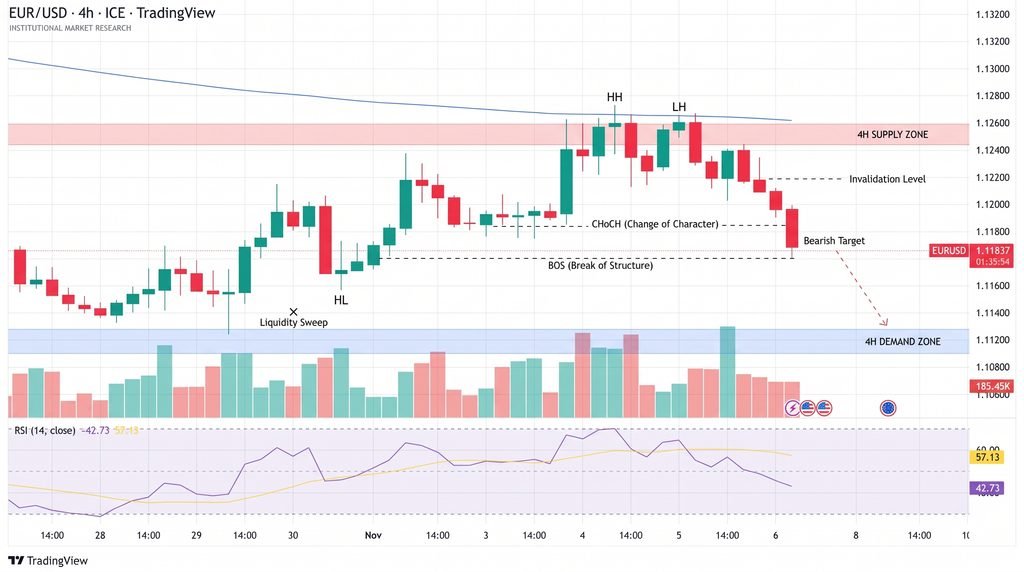
The pair is hovering around its 20-day Bollinger middle band, suggesting some underlying demand but insufficient strength to confirm a sustained recovery.
Important technical levels include:
- 1.1255: Upper Bollinger Band and immediate resistance.
- 1.1353: July 28 swing-low resistance.
- 1.1415: 100-day SMA and major resistance.
- 1.1132: Lower Bollinger Band and immediate support.
- 1.1100: Psychological support.
- 1.0951: May 12, 2025, low.
A sustained move below 1.1132 could expose 1.1100 and subsequently 1.0951. Conversely, a recovery above 1.1255 could improve the short-term outlook, although the 1.1415 moving average remains a significant obstacle.
Conclusion
EUR/USD remains under pressure as safe-haven demand supports the Dollar and technical indicators signal weak recovery momentum. Friday’s U.S. employment report could determine the next directional move. Strong payroll growth may reinforce bearish pressure toward 1.1132, while weaker figures could help the Euro reclaim 1.1255 and challenge the prevailing downward trend.
Sources & Methodology
Primary-source standard: Market-moving facts should link to original data releases, regulator notices, company filings or official project announcements whenever available. Secondary reporting is used for additional context, not as a substitute for original evidence.
Page last reviewed: