
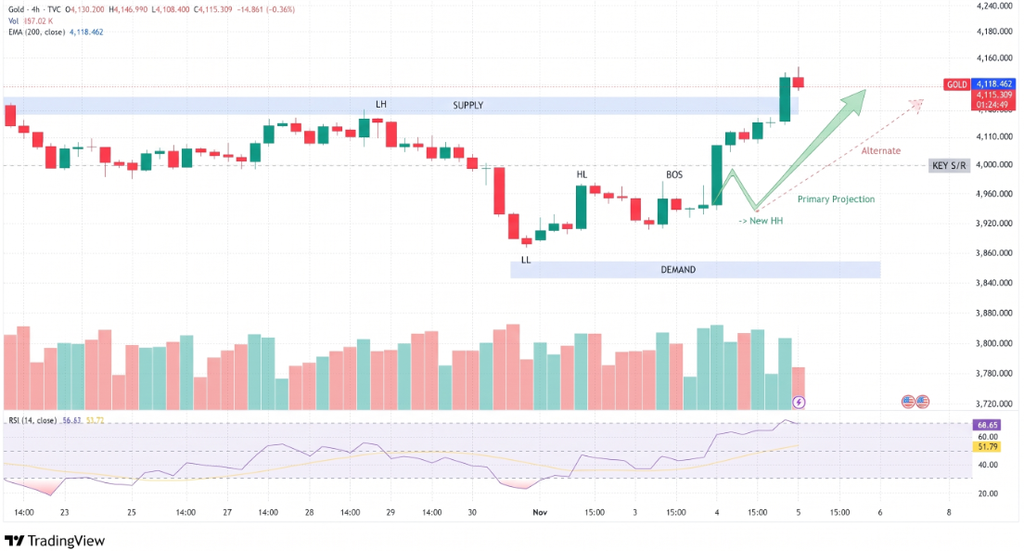
Gold prices climbed above $4,130 an ounce on Thursday, extending a powerful recovery after Democrats secured control of both chambers of the U.S. Congress in the midterm elections. The political shift weakened the U.S. dollar and pushed Treasury yields lower, improving demand for the non-yielding precious metal. Expectations that a Democratic-controlled Congress could restrict President Donald Trump’s fiscal agenda, alongside easing concerns about further military escalation with Iran, also supported bullion. Investors are now turning their attention to Friday’s U.S. employment report for fresh signals about the Federal Reserve’s monetary policy.
Gold extends gains above $4,130
Spot gold advanced 1.8% to $4,132.36 an ounce in Thursday’s Asian trading session, according to market data reported by Investing.com. U.S. gold futures for December delivery gained 1.7% to $4,141.40. The latest advance followed a rally of approximately 3.4% on Wednesday, marking bullion’s strongest daily performance since August 19.
The recovery reflects a significant shift in financial market conditions following the Democratic election victory. Democrats secured majorities in both the Senate and House of Representatives, raising expectations of legislative gridlock between Congress and the Republican-led White House.
The political outcome contributed to declining U.S. Treasury yields across maturities, while the U.S. Dollar Index weakened. The dollar fell 0.4% during the previous session before extending its losses.
These movements generally benefit gold for two reasons:
- Lower Treasury yields reduce the opportunity cost of holding gold, which does not generate interest.
- A weaker dollar makes dollar-denominated bullion less expensive for international investors.
Dollar weakness and oil support bullion
The election outcome also prompted investors to reassess the outlook for government spending and borrowing. ANZ analysts noted that expectations of tighter congressional oversight could limit Trump’s proposed tax reductions and spending initiatives, supporting U.S. government bonds.
However, the implications for gold are more complicated. Government borrowing and concerns about rising public debt have helped strengthen bullion’s appeal as a long-term store of value. If congressional restrictions reduce expectations of additional fiscal expansion, one source of structural support for gold could weaken.
Meanwhile, falling energy prices have improved the broader inflation outlook. Brent crude dropped below $100 a barrel on Wednesday for the first time since early October, following Trump’s comments that played down the prospect of renewed military strikes against Iran.
The decline in oil prices has eased concerns about further energy supply disruptions and inflationary pressure. Nevertheless, gold remains more than 20% below its levels before the U.S.-Iran conflict erupted in late February, when surging energy costs contributed to expectations of tighter monetary policy.
US payrolls become the next catalyst
Investors are now preparing for Friday’s October nonfarm payrolls report, scheduled for November 6 at 8:30 a.m. Eastern Time, according to the U.S. Bureau of Labor Statistics.
The report will provide important evidence about employment conditions and help shape expectations for future Federal Reserve decisions. Strong employment growth could reinforce expectations of restrictive monetary policy, while weaker figures could strengthen arguments for easing.
Key developments to monitor include:
- Nonfarm payroll employment growth and revisions to previous readings.
- The unemployment rate and average hourly earnings.
- Treasury yields and movements in the U.S. Dollar Index.
Conclusion
Gold’s move above $4,130 highlights the influence of political developments, currency movements and interest-rate expectations on precious metals. Lower Treasury yields and a weaker dollar have provided immediate support, while falling oil prices have eased inflation concerns. However, uncertainty surrounding government borrowing and Federal Reserve policy could limit further gains. Friday’s employment report will be an important test of whether bullion can sustain its recovery above $4,100 and extend its advance toward higher price levels.
Sources & Methodology
Primary-source standard: Market-moving facts should link to original data releases, regulator notices, company filings or official project announcements whenever available. Secondary reporting is used for additional context, not as a substitute for original evidence.
Page last reviewed: