
The Japanese Yen could strengthen against the US Dollar if Japan’s economy delivers stronger-than-expected growth, according to ING’s global head of research, Chris Turner. In a November 10 market assessment, Turner identified Japan’s semiconductor supply chain and expansionary fiscal policy as potential drivers of an economic improvement. The outlook draws comparisons with South Korea, where booming chip exports have prompted a substantial upgrade to growth forecasts. If stronger activity encourages the Bank of Japan (BoJ) to accelerate interest-rate increases, USD/JPY could face renewed downward pressure.
Japan Could Follow South Korea’s Lead
Turner sees South Korea’s semiconductor-driven expansion as a possible model for Japan. The Bank of Korea raised its 2026 economic growth forecast to 3.3%, citing strong semiconductor exports supported by demand for artificial intelligence infrastructure. That compares with a 1.8% forecast at the beginning of the year, according to the ING assessment.
The improvement demonstrates how demand for advanced chips can benefit more than technology manufacturers. Higher exports can increase factory investment, support industrial production and generate additional demand across suppliers and related industries.
Japan occupies an important position in this supply chain. Its manufacturers produce semiconductor equipment, precision machinery and materials used in chip fabrication. As global investment in artificial intelligence infrastructure expands, Japanese industrial companies could benefit from stronger orders and increased production.
The semiconductor industry therefore represents a potential source of additional economic momentum, particularly if stronger overseas demand spreads into domestic investment and employment.
Fiscal Policy and BoJ Rate Expectations
Turner also points to Japan’s expansionary fiscal policy as a potential source of stronger growth. Government spending and other support measures can stimulate domestic demand, encourage business investment and improve household purchasing power.
A stronger economy could also influence the Bank of Japan’s monetary policy. If economic activity improves alongside wages and underlying inflation, policymakers may have greater justification to raise borrowing costs.
The BoJ held its policy rate at 1.25% following its October 29-30 meeting. However, the meeting’s summary revealed differing views among policymakers, with some favouring a faster pace of tightening. That debate has strengthened expectations of another rate increase, potentially as soon as December.
The main developments to monitor include:
- Chip exports: Stronger global demand could lift Japanese manufacturing orders.
- Fiscal support: Government spending may reinforce domestic economic activity.
- Wage growth: Sustained income gains could support consumption and inflation.
- BoJ policy: A faster tightening path could improve the Yen’s interest-rate appeal.
USD/JPY Faces Downside Growth Risk
Currency movements depend partly on the difference between interest rates in two economies. If Japanese rates rise while US rates remain comparatively elevated but stable, the interest-rate advantage supporting the Dollar could narrow.
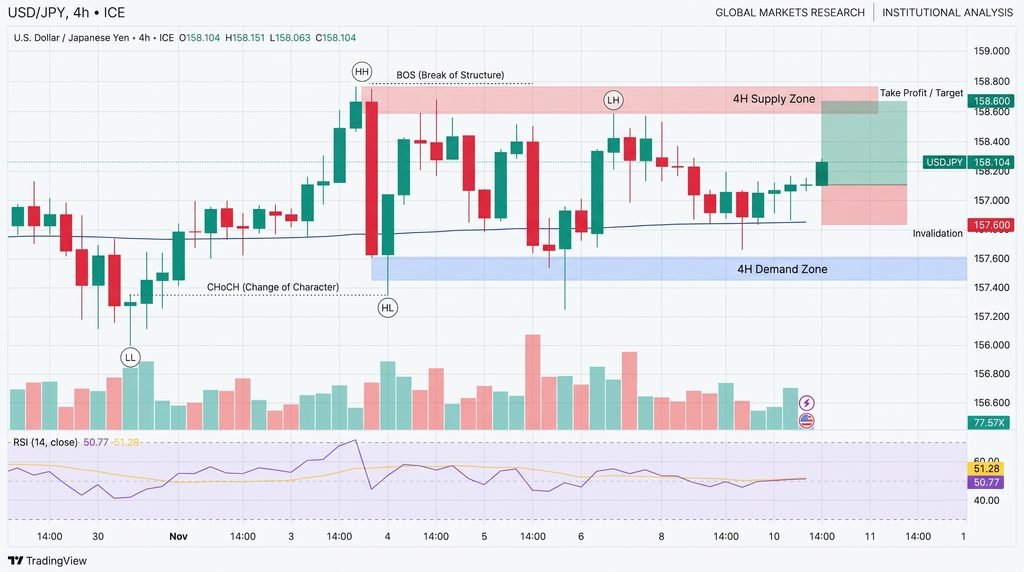
That shift may encourage investors to reduce holdings of USD/JPY, putting downward pressure on the currency pair. However, stronger Japanese growth alone would not guarantee a stronger Yen. Inflation trends, wage negotiations, US economic data and Federal Reserve policy will also influence the exchange rate.
Conclusion
ING’s Chris Turner identifies Japan’s semiconductor industry and fiscal support as potential catalysts for an upside growth surprise. If stronger activity leads the BoJ toward faster rate increases, the Yen could gain ground and USD/JPY could weaken. The key test will be whether industrial momentum translates into sustained domestic growth, higher wages and persistent inflation.
Sources & Methodology
Primary-source standard: Market-moving facts should link to original data releases, regulator notices, company filings or official project announcements whenever available. Secondary reporting is used for additional context, not as a substitute for original evidence.
Page last reviewed: