The Euro is gaining ground against the British Pound, bringing EUR/GBP closer to the upper boundary of its recent trading range at 0.8360. The pair was trading around 0.8358 on Tuesday as falling oil prices improved the outlook for energy-importing Eurozone economies and lifted market sentiment. However, the Pound retains support from the Bank of England’s recent interest-rate increase. With UK economic data due Thursday, traders are watching whether buyers can push EUR/GBP above resistance and extend its recovery.
Falling Oil Prices Support the Euro
The Euro has gained a modest advantage over Sterling as energy prices retreat. Brent crude has fallen sharply, easing pressure on European economies that rely heavily on imported energy. The European Union imported approximately 57% of its energy in 2024, leaving the region exposed to swings in international fuel prices.
Recent market developments have reinforced the move. Brent crude fell below $90 a barrel on Tuesday after renewed diplomatic efforts raised hopes of easing tensions in the Middle East. The benchmark has declined more than 23% in November, according to market reports.
Lower oil prices can benefit the Eurozone by reducing energy-import costs and easing inflationary pressure. That may give the European Central Bank more room to manage monetary policy without facing another significant energy-driven price shock.
The Euro and Pound have both strengthened against the US Dollar in recent sessions, but the Euro has shown relative resilience as energy-market conditions improve.
BoE Rate Hike Keeps Sterling Supported
Sterling continues to draw support from the Bank of England, which raised its benchmark Bank Rate by 25 basis points to 4% on November 5. The Monetary Policy Committee voted 8-1 in favour of the increase, with one member preferring a larger 50-basis-point move.
The decision reflects persistent inflation concerns. UK consumer-price inflation reached 3.5% in September, while the central bank warned that rising energy costs could push inflation towards 5% by the middle of 2027.
Investors will now assess whether economic activity supports the prospect of further tightening. The UK’s September GDP figures and industrial production data are scheduled for Thursday, November 12, according to the Office for National Statistics.
These releases could influence Sterling by changing expectations for the BoE’s next policy decisions.
EUR/GBP Forecast: 0.8360 Is Key
EUR/GBP trades near 0.8358, approaching resistance at 0.8360-0.8365. On the four-hour chart, the Relative Strength Index (RSI) is just below 60, while the Moving Average Convergence Divergence (MACD) indicator remains slightly above zero. Both signals point to improving short-term momentum.
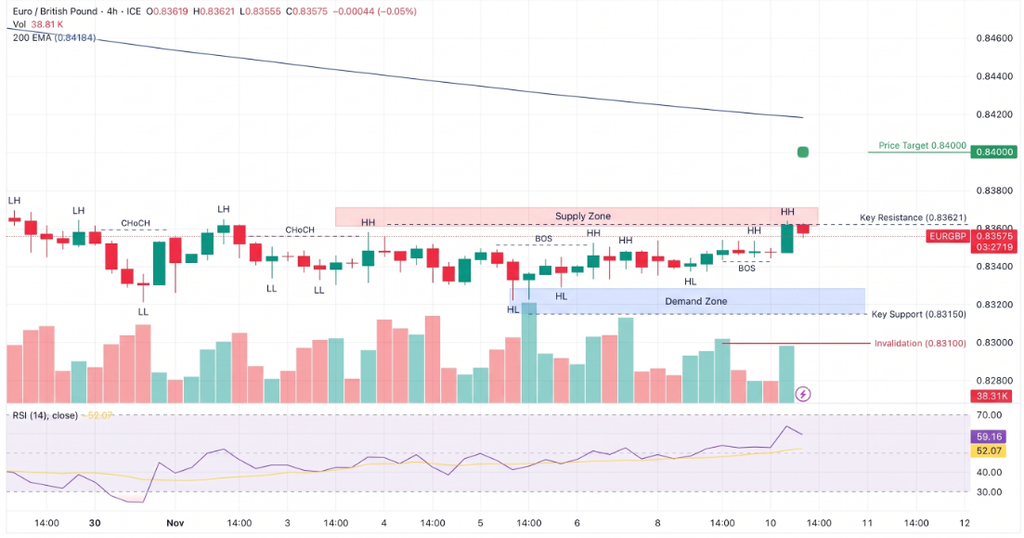
A sustained break above 0.8365 could strengthen the recovery and bring the following levels into focus:
- First resistance: 0.8360-0.8365.
- Next upside target: 0.8400, near the October 26 high.
- Further resistance: 0.8430, around the October 19-20 highs.
- Immediate support: 0.8320, the recent range floor.
- Lower support: Above 0.8300, followed by 0.8246.
A move below 0.8320 would weaken the bullish setup and expose the pair to further downside.
Conclusion
EUR/GBP is testing a significant resistance zone as improving market sentiment and cheaper oil support the Euro. A confirmed break above 0.8365 could open the way towards 0.8400 and potentially 0.8430. However, the BoE’s restrictive stance and Thursday’s UK economic releases remain important risks. Unless buyers secure a clear breakout, the pair may continue trading within its 0.8320-0.8360 range.
Sources & Methodology
Primary-source standard: Market-moving facts should link to original data releases, regulator notices, company filings or official project announcements whenever available. Secondary reporting is used for additional context, not as a substitute for original evidence.
Page last reviewed: