
The EUR/USD pair held near 1.1222 during Tuesday’s Asian session, maintaining gains from the previous day as falling oil prices weakened the U.S. dollar. The Dollar Index (DXY) traded around 101.67, while West Texas Intermediate (WTI) crude remained close to $84.65, its lowest level in more than two months. Optimism over a possible U.S.-Iran agreement has eased concerns about prolonged energy supply disruptions. However, investors remain cautious ahead of October’s U.S. Consumer Price Index (CPI), which could influence Federal Reserve policy expectations and determine the euro’s next move.
Falling Oil Prices Weigh on US Dollar
The EUR/USD exchange rate has benefited from renewed pressure on the Greenback as declining crude prices reduce concerns about another inflation shock. The DXY, which measures the dollar against six major currencies, remained near 101.67 after extending losses from Monday.
WTI crude traded close to $84.65, its weakest level in more than two months. The decline reflects growing market optimism that diplomatic negotiations between Washington and Tehran could help bring the conflict to an end and reduce the risk of further disruptions to energy supplies.
Analysts at MUFG have highlighted the relationship between lower oil prices and weaker dollar demand. A shorter energy-price shock could ease inflation concerns and reduce the need for the Federal Reserve to maintain restrictive monetary policy for an extended period.
The Eurozone may also benefit from cheaper energy. As a major energy importer, the region is exposed to higher oil and gas costs, meaning a sustained decline in crude prices could reduce pressure on businesses and consumers.
Nevertheless, the euro’s gains remain dependent on developments in the United States, particularly the direction of inflation and interest rates.
US CPI Data Puts EUR/USD in Focus
Investors are awaiting October’s U.S. Consumer Price Index, scheduled for release at 13:30 GMT. Forecasts in the supplied market snapshot point to headline annual inflation rising to 3.9% from 3.7%, while core inflation is expected to increase to 2.8% from 2.6%.
Core CPI excludes food and energy prices, providing a measure of underlying inflation trends. A stronger-than-expected reading could revive expectations of prolonged Federal Reserve tightening and support the dollar. Conversely, softer inflation could reinforce the recent decline in the Greenback.
The release is therefore a major event for currency traders, particularly as markets reassess the outlook for U.S. interest rates.
EUR/USD Technical Analysis: Key Levels
On the daily chart, EUR/USD trades near 1.1223, close to its 20-day exponential moving average (EMA) at 1.1212. The Relative Strength Index (RSI) stands at 48.97, indicating balanced momentum rather than a clear bullish or bearish trend.
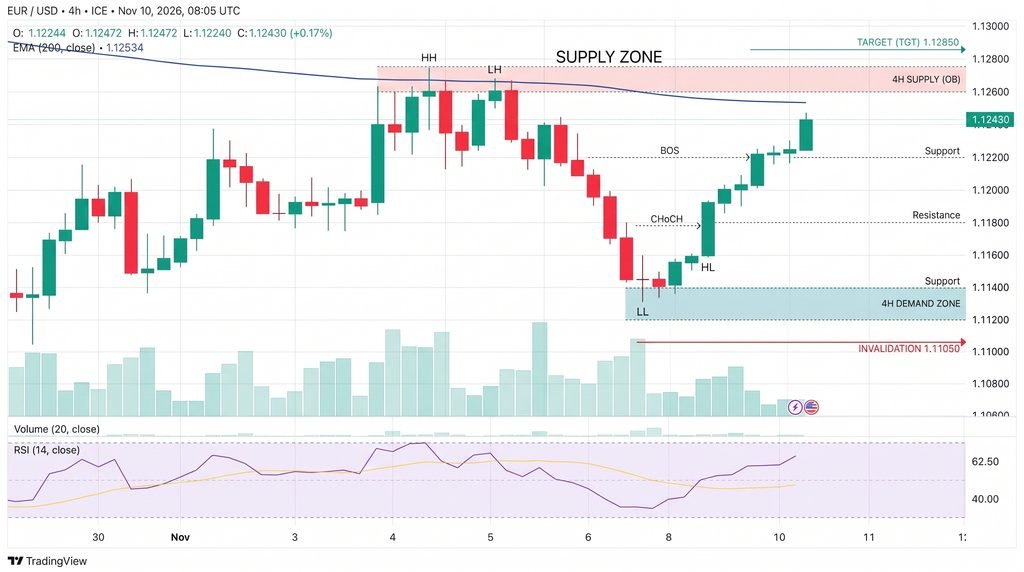
Key technical levels include:
- Immediate support: 1.1138, Monday’s low.
- Major support: 1.1104, near the 1.1100 threshold.
- Downside target: 1.1000 if major support breaks.
- Immediate resistance: 1.1273, the November 4 high.
- Trend reference: 20-day EMA at 1.1212.
Conclusion
EUR/USD remains supported near 1.1222 as falling oil prices and hopes for a U.S.-Iran agreement weigh on the dollar. However, the pair lacks strong directional momentum, leaving the upcoming U.S. CPI report as its main near-term catalyst. A break below 1.1104 could expose 1.1000, while a move above 1.1273 would strengthen the recovery. Until either level gives way, the pair’s outlook remains broadly neutral, with inflation data likely to determine its next direction.
Sources & Methodology
Primary-source standard: Market-moving facts should link to original data releases, regulator notices, company filings or official project announcements whenever available. Secondary reporting is used for additional context, not as a substitute for original evidence.
Page last reviewed: