
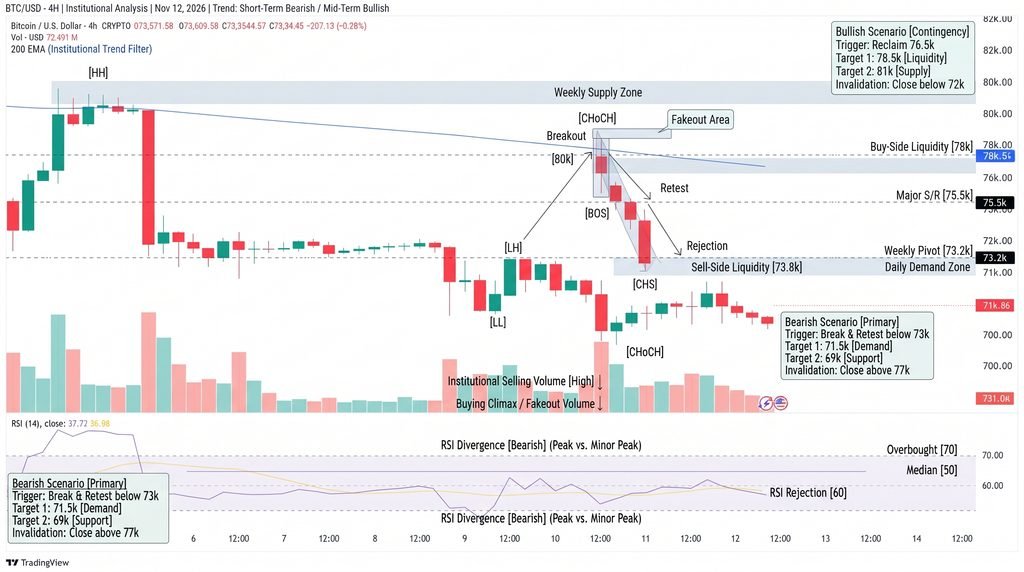
Bitcoin edged lower on Thursday, trading near $73,507 as investors weighed expectations of higher US interest rates against growing institutional risks for the cryptocurrency sector. Strategy shares also came under pressure after index provider MSCI confirmed their removal from several benchmarks, raising concerns about potential selling by passive investment funds. The decision adds another challenge for the company, whose business model relies heavily on raising capital to accumulate Bitcoin. Meanwhile, broader cryptocurrency markets remained subdued as investors assessed inflation, monetary policy and regulatory uncertainty.
Fed Rate Bets Keep Bitcoin Under Pressure
Bitcoin fell 0.7% to $73,507 by 05:34 ET (10:34 GMT), extending a period of weakness that followed sharp declines through October and early November. The world’s largest cryptocurrency has struggled to attract sustained buying as investors reassess the outlook for US monetary policy.
Stronger-than-expected October inflation figures have reinforced expectations that the Federal Reserve could raise interest rates in December. Governor Christopher Waller has supported further tightening, while indicating that a larger increase could be considered if inflation remains elevated.
Higher borrowing costs generally weigh on assets that do not generate income, including Bitcoin. Rising Treasury yields can also make traditional fixed-income investments more attractive relative to speculative assets.
Political developments have added another source of uncertainty. The Democratic Party’s gains in the US midterm elections have raised questions about the future direction of cryptocurrency legislation and the possibility of greater congressional scrutiny. Investors are therefore monitoring both monetary policy and regulatory developments before increasing exposure.
MSCI Decision Puts Strategy Under Pressure
Shares of Strategy fell more than 4% in premarket trading, according to the supplied market report, after MSCI confirmed that the company would be removed from several of its equity benchmarks. The changes are scheduled to take effect after the market closes on November 30, with the revised indexes effective December 1.
MSCI’s decision follows a review of companies it considers closer to investment funds or non-operating businesses than conventional operating companies. The policy affects digital-asset treasury firms whose balance sheets are heavily concentrated in investment holdings. Japan-based Metaplanet, another major corporate Bitcoin holder, is also among the companies facing removal.
Strategy previously warned that exclusion could lead to approximately $2.8 billion in stock selling. JPMorgan has estimated that potential outflows could reach $8.8 billion if other index providers adopt similar restrictions. These estimates represent possible pressure on Strategy shares, not automatic sales of the company’s Bitcoin holdings. Reuters reported that passive funds tracking affected benchmarks may need to adjust their positions.
Strategy’s financing model has relied heavily on issuing equity and debt to purchase Bitcoin. Reduced institutional demand for its shares could make future fundraising more difficult, particularly if Bitcoin prices remain weak.
Altcoins Struggle as Risk Appetite Fades
Most major cryptocurrencies also traded lower, reflecting limited appetite for risk across the market. Ether declined 0.5% to $2,049.96, while XRP lost 0.8%.
Other major tokens recorded similar losses:
Conclusion
Bitcoin’s decline toward $73,500 reflects more than short-term market volatility. Higher US rate expectations, regulatory uncertainty and MSCI’s decision affecting Strategy have created additional obstacles for institutional cryptocurrency exposure. The index removal does not directly force Strategy to sell Bitcoin, but weaker demand for its shares could complicate its capital-raising strategy. Until inflation pressures ease and institutional confidence improves, the broader crypto market may remain vulnerable to further selling.
Sources & Methodology
Primary-source standard: Market-moving facts should link to original data releases, regulator notices, company filings or official project announcements whenever available. Secondary reporting is used for additional context, not as a substitute for original evidence.
Page last reviewed: