
The Australian dollar weakened against the US dollar on Thursday, trading around 0.6833 as uncertainty over the Reserve Bank of Australia’s next policy move and renewed Federal Reserve rate-hike expectations weighed on the currency. The pair remains vulnerable after breaking below a key Head and Shoulders chart pattern, while a stronger US dollar adds to the pressure. With AUD/USD trading beneath its short-term moving average, investors are watching whether sellers can push the exchange rate toward 0.6800 or whether buyers can reclaim the former pattern neckline.
RBA Outlook Clouds Australian Dollar
The Australian dollar has struggled as analysts reassess the likelihood of further monetary tightening by the Reserve Bank of Australia. OCBC Group Research argues that the central bank’s latest policy communication contained conflicting signals about the economic outlook.
The RBA raised its cash rate by 25 basis points to 4.85% on November 3, its latest increase in a tightening cycle aimed at containing persistent inflation. Governor Michele Bullock said inflation remained too high and was expected to stay elevated for longer. However, the bank also acknowledged that higher borrowing costs were tightening financial conditions and weighing on parts of the economy.
OCBC interprets those pressures, together with softer forward guidance, as reasons to expect no further increases during the current cycle. The bank anticipates that the next policy move could eventually be a rate cut. That remains an analyst forecast rather than an announced RBA decision.
Investors will look for additional guidance on November 17, when the RBA publishes the minutes of its November policy meeting. Governor Bullock is also scheduled to participate in an ASIC forum that day.
Fed Rate Bets Strengthen US Dollar
The US dollar’s strength has created another obstacle for AUD/USD. The US Dollar Index (DXY) traded near 102.86 after reaching 103.08, its highest level in 18 months, according to the supplied market snapshot.
Stronger US inflation has encouraged investors to anticipate additional Federal Reserve tightening. Governor Christopher Waller said on November 10 that he would support a 25-basis-point increase in December under his baseline outlook, while arguing that a 50-basis-point move should be considered if October inflation remained particularly strong.
Analysts at MUFG say higher rate expectations have lifted US Treasury yields, with the two-year yield gaining approximately 33 basis points from its late-week low. The bank sees the possibility of consecutive increases in December and January as supportive of the dollar. These expectations remain market pricing, not confirmed Fed decisions.
AUD/USD Technical Outlook: 0.6800
On the daily chart, AUD/USD trades around 0.6835, below its 20-period Exponential Moving Average at 0.6947. The breakdown from the Head and Shoulders pattern, with its neckline near 0.6900, reinforces the bearish near-term structure.
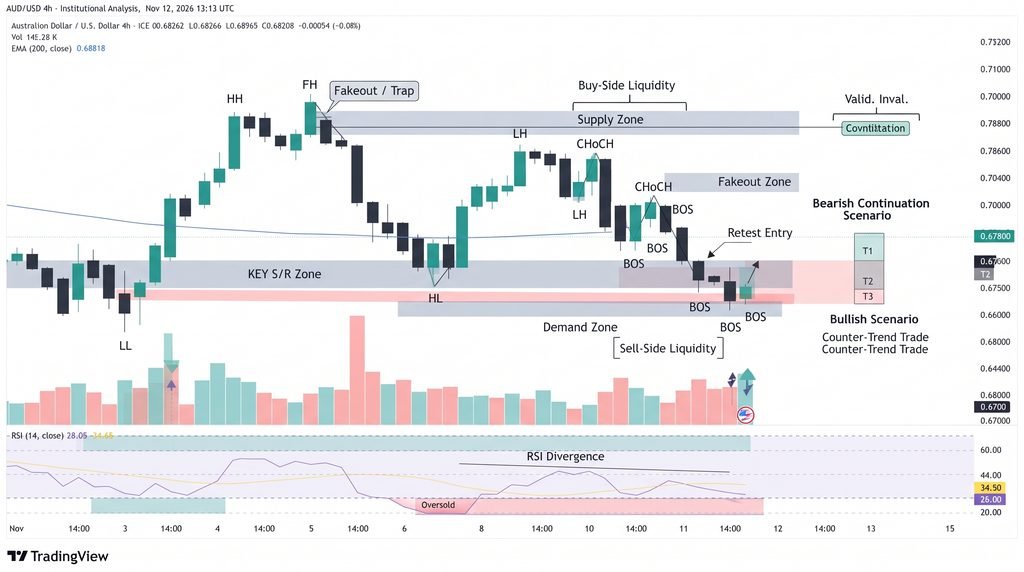
The Relative Strength Index (RSI) stands near 35, indicating weak momentum but not an established oversold condition.
Key levels include:
- Immediate support: 0.6800.
- Initial resistance: 0.6900, the former neckline.
- Major resistance: 0.6947, the 20-period EMA.
Conclusion
AUD/USD remains under pressure as diverging central-bank expectations favor the US dollar. A sustained move below 0.6800 could extend the decline, while a recovery above 0.6900 would weaken the immediate bearish signal. The November 17 RBA minutes and Governor Bullock’s comments may provide the next catalyst for the Australian currency.
Sources & Methodology
Primary-source standard: Market-moving facts should link to original data releases, regulator notices, company filings or official project announcements whenever available. Secondary reporting is used for additional context, not as a substitute for original evidence.
Page last reviewed: