
The U.S. dollar eased against the Swiss franc on Thursday, retreating from a one-month high after gaining approximately 1.7% over the previous two sessions. USD/CHF traded around 0.8320 after encountering resistance near 0.8340, with sellers testing support between 0.8310 and 0.8315. Despite the pullback, the broader outlook remains supportive of the dollar as stronger U.S. inflation and employment data have reinforced expectations of another Federal Reserve interest-rate increase in December.
Fed rate expectations support the dollar
The recent dollar rally has been driven largely by changing expectations for U.S. monetary policy. October’s hotter-than-expected consumer inflation figures, combined with a strong employment report released the previous week, have strengthened the case for further Federal Reserve tightening.
Higher U.S. interest rates can support the dollar by increasing the potential returns available on dollar-denominated assets. This can attract international capital, particularly when other central banks are expected to maintain more cautious policies.
Several Fed officials have expressed concern about persistent inflation. Chicago Fed President Austan Goolsbee and San Francisco Fed President Mary Daly highlighted the risks posed by continuing price pressures. New York Fed President John Williams has also indicated that another rate increase before the end of the year remains possible.
Further comments from policymakers could influence currency-market positioning on Thursday. If officials maintain a hawkish tone, expectations of higher U.S. borrowing costs may limit the dollar’s downside against the Swiss franc.
However, the prospect of additional tightening is not guaranteed. Future policy decisions will depend on incoming inflation, employment and economic activity data.
USD/CHF technical analysis: 0.8315 in focus
The pair’s recent advance encountered resistance around the 78.6% Fibonacci retracement of the October-November decline, near 0.8337. The subsequent retreat suggests that buyers are taking profits after the sharp two-day rally.
On the four-hour chart, the Relative Strength Index (RSI) stands near 67, close to the commonly watched overbought threshold of 70. This indicates strong recent momentum but also leaves room for a corrective move.
The Moving Average Convergence Divergence (MACD) remains in positive territory, suggesting that bullish momentum has not disappeared despite the latest decline. Together, these indicators point to a market experiencing a short-term correction rather than a confirmed bearish reversal.
The 0.8310–0.8315 zone is the immediate technical test. It previously acted as resistance and could now provide support if buyers defend the breakout area.
Key USD/CHF support and resistance levels
A sustained move below 0.8310 would weaken the immediate bullish structure and bring the November 10 high near 0.8270 into focus. A deeper decline could indicate that the recent dollar rally is losing strength.
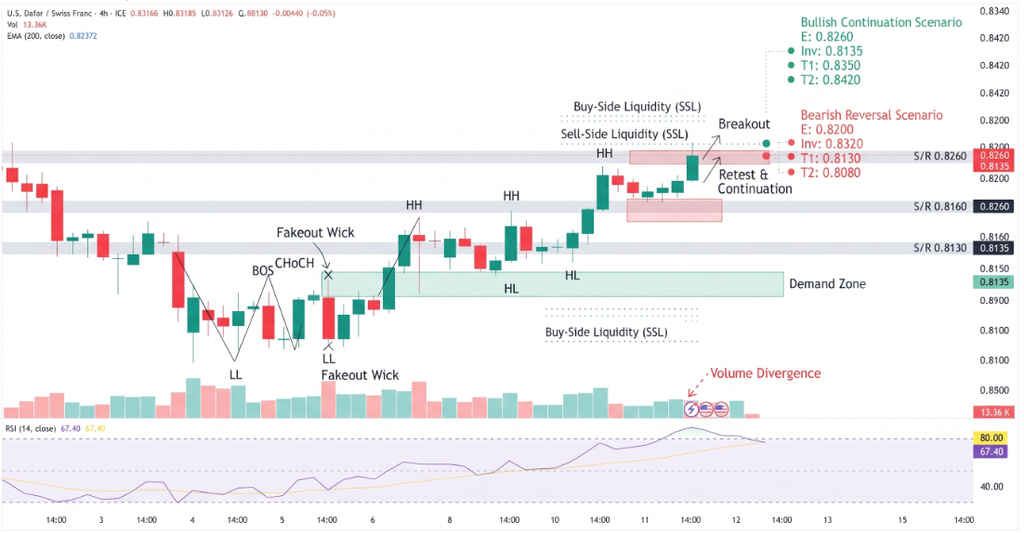
On the upside, buyers need to overcome the Fibonacci resistance near 0.8337 before challenging the recent peak and higher technical barriers.
Important levels from the supplied chart analysis include:
- Immediate support: 0.8310–0.8315.
- Next downside reference: 0.8270, near the November 10 high.
- Initial resistance: 0.8337, the 78.6% Fibonacci retracement.
- Major resistance: 0.8395, the October 14 high.
- Recent peak: Around 0.8340.
Conclusion
USD/CHF remains supported by expectations of further Federal Reserve tightening, although its rapid 1.7% advance has left short-term momentum stretched. Holding above 0.8310–0.8315 would preserve the immediate bullish outlook and keep 0.8337 in focus. A decisive break below support, however, could expose 0.8270 and signal a deeper correction.
Sources & Methodology
Primary-source standard: Market-moving facts should link to original data releases, regulator notices, company filings or official project announcements whenever available. Secondary reporting is used for additional context, not as a substitute for original evidence.
Page last reviewed: