
EUR/GBP struggled to extend its recovery on Wednesday, trading near 0.8330 after touching 0.8319 a day earlier, its lowest level since March 2025. Sterling remained relatively resilient despite a mixed UK inflation report, while the Euro faced pressure from concerns over the region’s economic and fiscal outlook. With the pair hovering close to a major technical support zone, traders are assessing whether sellers can push the exchange rate below 0.8320 or whether buyers will attempt another rebound.
UK inflation and policy outlook support GBP
The UK’s October inflation report delivered a mixed signal for the Bank of England (BoE). Headline Consumer Price Index (CPI) inflation increased to 3.6% annually from 3.5% in September, but remained below the 3.7% forecast. Core inflation held at 2.8%, while services inflation was unchanged at 3.7%.
The softer underlying figures reduced expectations for an immediate rate increase. Reuters reported that market-implied odds of a December BoE hike fell to around 80%, from approximately 90% before the release. Nevertheless, investors continue to anticipate tighter policy over the coming months, keeping the interest-rate outlook supportive of sterling relative to the Euro.
The European Central Bank (ECB) faces a different challenge. Eurostat reported that eurozone annual inflation accelerated to 4.0% in October from 3.8% in September. Higher inflation could complicate the ECB’s policy decisions, particularly as concerns about regional growth and fiscal stability continue to weigh on investor confidence.
Strategists at ING forecast EUR/GBP at 0.83 by year-end. They argue that a relatively more hawkish BoE compared with the ECB could keep the currency pair under pressure. ING also identifies political developments and closer UK-European relations as factors influencing the outlook.
EUR/GBP technical outlook remains bearish
The four-hour chart shows the pair trading near 0.8330, close to the lower boundary of its recent range. The Relative Strength Index (RSI) remains below the neutral 50 threshold, indicating that sellers retain control of momentum. Meanwhile, the Moving Average Convergence Divergence (MACD) remains slightly negative, offering little evidence of a sustained bullish reversal.
The 0.8319 low is the immediate support level. A decisive break could expose the 0.8300 area, followed by the 2025 low near 0.8240.
Key support and resistance levels
On the upside, EUR/GBP faces initial resistance around 0.8336. A sustained move above this level could open the way toward 0.8372, the previous week’s high, and then 0.8380, the October 28 peak.
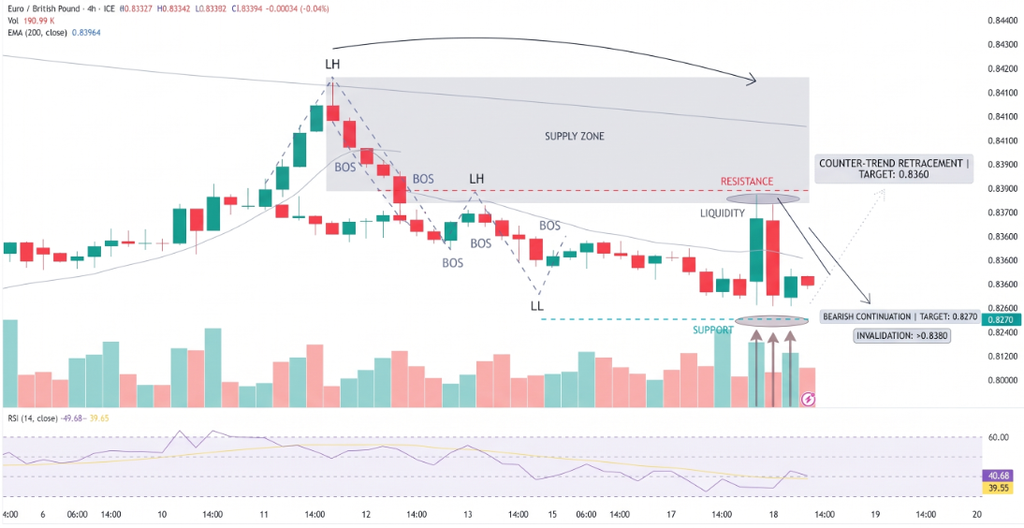
Key levels to monitor include:
- Immediate support: 0.8319–0.8320.
- Next downside levels: 0.8300 and 0.8240.
- Initial resistance: 0.8336.
- Higher resistance: 0.8372 and 0.8380.
Conclusion
EUR/GBP remains vulnerable while it trades near 0.8320, with the relative interest-rate outlook continuing to favour sterling. A break below 0.8319 could accelerate losses toward 0.8300 and 0.8240. However, a sustained recovery above 0.8336 would ease immediate selling pressure and bring higher resistance levels back into focus.
Sources & Methodology
Primary-source standard: Market-moving facts should link to original data releases, regulator notices, company filings or official project announcements whenever available. Secondary reporting is used for additional context, not as a substitute for original evidence.
Page last reviewed: