
The Australian Dollar (AUD) is attempting to recover against the US Dollar (USD) after touching a fresh year-to-date low near 0.6610. The pair rebounds toward 0.6710 as the Greenback retreats from a 19-month high. However, weakening Australian employment conditions and expectations of further Federal Reserve (Fed) rate increases continue to weigh on the currency. Investors are reassessing the Reserve Bank of Australia’s (RBA) policy outlook, with next week’s inflation report emerging as a key event for the AUD/USD pair.
Dollar retreats as Fed tightening bets persist
The US Dollar Index (DXY), which measures the Greenback against six major currencies, falls 0.2% toward 103.60 after reaching approximately 104.00, its highest level in 19 months.
Despite the pullback, the US Dollar’s broader outlook remains supported by expectations of additional monetary tightening. Markets increasingly anticipate consecutive rate increases as policymakers attempt to bring inflation back toward the Federal Reserve’s 2% target.
Analysts at MUFG note that almost all Fed officials consider further rate increases appropriate in the coming months. Market pricing also reflects expectations for a 25-basis-point December hike and three additional quarter-point increases through June next year.
Higher US interest rates generally support the Dollar by increasing the attractiveness of American assets relative to those in countries with lower borrowing costs. This interest-rate differential remains a major headwind for AUD/USD, particularly as Australian monetary policy expectations begin to shift.
Australian jobs data weakens RBA outlook
Australia’s labour market deteriorated more sharply than expected in October, raising doubts about whether the Reserve Bank of Australia will deliver additional rate increases.
Data from the Australian Bureau of Statistics showed employment declined by 43,500 during October, significantly below market expectations for a 25,000 increase. The unemployment rate climbed to 4.9% from 4.7%, reaching its highest level since 2021.
Analysts at Rabobank argue that the weakening employment outlook makes further RBA tightening less likely. However, next week’s October Consumer Price Index (CPI) release could complicate the outlook if headline inflation accelerates.
The latest figures have weakened expectations for another rate hike, reducing the Australian Dollar’s yield advantage and leaving the currency vulnerable to further selling pressure.
AUD/USD technical outlook remains bearish
On the daily chart, AUD/USD trades near 0.6714, remaining below the 20-day Exponential Moving Average (EMA) at 0.6861. The Relative Strength Index (RSI) at approximately 27 indicates oversold conditions, suggesting selling momentum could begin to moderate.
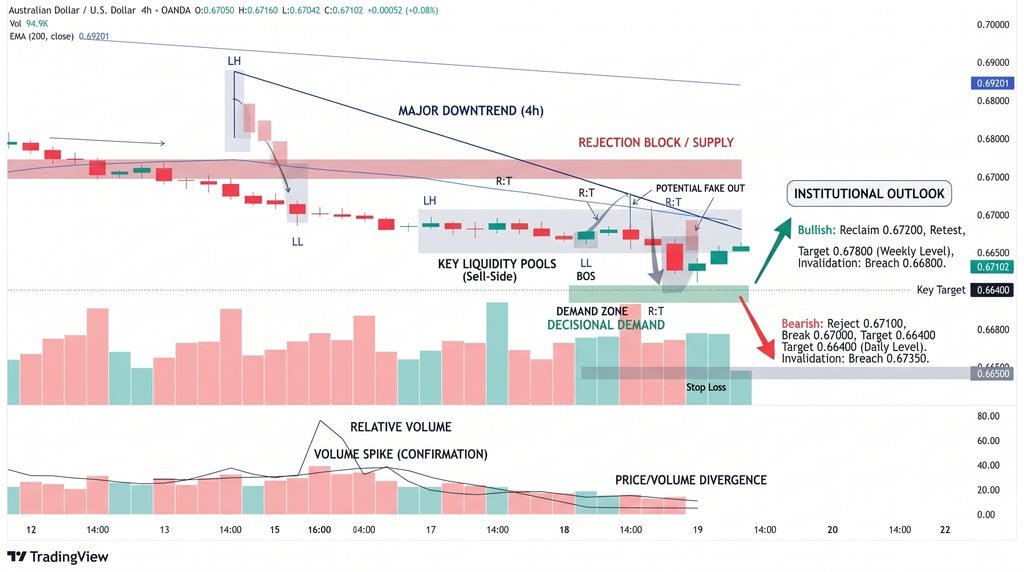
Key technical levels include:
- Immediate support: 0.6662, the intraday low.
- Major downside target: 0.6600, a psychological support level.
- Initial resistance: 0.6861, the 20-day EMA.
- Momentum indicator: RSI near 27, reflecting oversold conditions.
A break below 0.6662 could expose 0.6600, while a sustained recovery above 0.6861 would ease immediate bearish pressure.
Conclusion
AUD/USD remains vulnerable as weak Australian employment data reduces expectations for further RBA tightening, while hawkish Federal Reserve signals support the US Dollar. Although oversold technical conditions could encourage a short-term rebound, the broader bearish trend remains intact below 0.6861. The upcoming Australian inflation report will be crucial in determining whether the pair stabilizes or extends its decline toward 0.6600.
Sources & Methodology
Primary-source standard: Market-moving facts should link to original data releases, regulator notices, company filings or official project announcements whenever available. Secondary reporting is used for additional context, not as a substitute for original evidence.
Page last reviewed: