
The AUD/USD pair fell 0.7% toward 0.6920 on Thursday as Australia’s weaker September employment report reduced expectations for another near-term interest-rate increase. The Australian Dollar came under pressure after the economy unexpectedly shed nearly 40,000 jobs, raising concerns about labour-market strength and the outlook for monetary policy. The Reserve Bank of Australia (RBA) must now balance persistent inflation against signs of slowing employment. Meanwhile, traders are watching upcoming US producer-price data for fresh clues about the Federal Reserve’s policy path and the direction of the US Dollar.
Australian Jobs Data Weakens RBA Outlook
The Australian Bureau of Statistics reported that employment declined by 39,300 people in September, a monthly fall of 0.3%. The seasonally adjusted unemployment rate rose to 4.7% from 4.6% in August, while the trend unemployment rate remained at 4.6%.
The composition of the employment decline also matters. Full-time employment increased by 34,400, but part-time employment dropped by 73,700, more than offsetting those gains. The participation rate fell to 66.8%, while underemployment increased to 6.3%, pointing to some weakening in labour-market conditions.
The figures complicate the RBA’s policy outlook. Higher interest rates can help restrain inflation, but further tightening may put additional pressure on employment and economic activity.
Strategists at ANZ have maintained a forecast for another 25-basis-point rate increase in November, according to the supplied report, while acknowledging that the decision will depend on inflation and economic activity. A basis point equals 0.01 percentage point, making a 25-basis-point move equivalent to 0.25 percentage point.
The latest employment figures do not rule out another hike, but they make the timing less certain.
US Inflation Data Adds to Market Uncertainty
The US Dollar also faces uncertainty ahead of the September Producer Price Index (PPI), scheduled for release at 12:30 GMT on Thursday. The report measures changes in prices received by domestic producers and can offer an early indication of broader inflation pressures.
A stronger-than-expected reading could support the dollar by reinforcing expectations that the Federal Reserve will maintain restrictive monetary policy. A softer result could weigh on the US currency and help AUD/USD recover, depending on how investors interpret the broader economic outlook.
For the Australian Dollar, the combination of domestic employment weakness and US inflation uncertainty creates competing pressures. Traders will also monitor upcoming Australian inflation figures for evidence of whether price growth remains strong enough to justify further RBA tightening.
AUD/USD Forecast: Key Levels to Watch
On the daily chart, AUD/USD trades near 0.6920 below its 20-day exponential moving average (EMA) at 0.6999. This keeps the near-term technical outlook tilted to the downside. A developing Head and Shoulders pattern also suggests potential weakness if price confirms a bearish breakdown.
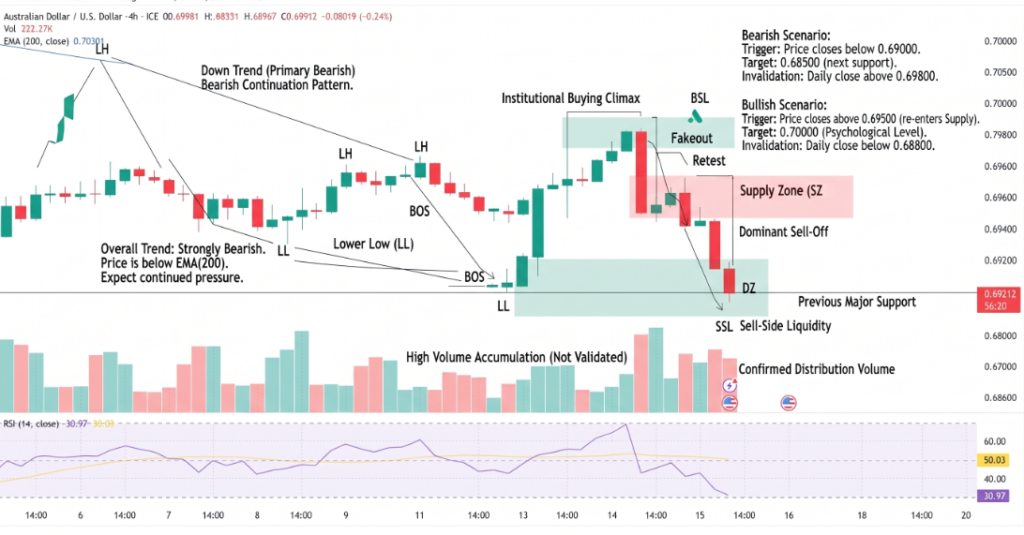
The Relative Strength Index (RSI) is around 34, close to the commonly watched oversold threshold of 30. That indicates substantial selling pressure, although it does not guarantee an immediate rebound.
Key levels include:
- 0.6999 resistance: The 20-day EMA is the first major hurdle for a recovery.
- 0.6900 support: A decisive break could expose the next downside target at 0.6800.
- RSI near 34: Momentum remains weak, but traders should watch for signs of stabilisation.
Conclusion:
AUD/USD remains vulnerable after Australia’s September employment decline weakened the case for an imminent RBA rate hike. A break below 0.6900 could extend losses toward 0.6800, while a move above 0.6999 would improve the near-term outlook. Australian inflation and US producer prices are the next important catalysts.
Sources & Methodology
Primary-source standard: Market-moving facts should link to original data releases, regulator notices, company filings or official project announcements whenever available. Secondary reporting is used for additional context, not as a substitute for original evidence.
Page last reviewed: