
The EUR/USD pair climbed 0.5% to approximately 1.1220 during early European trading on Thursday, extending its recovery as the US Dollar weakened alongside Treasury yields. The move followed September’s US inflation report, which showed consumer prices rising faster than expected. However, the Euro’s advance faces domestic headwinds, particularly concerns over France’s public finances. Technically, the pair remains below its 20-day exponential moving average (EMA), leaving the broader short-term outlook cautious despite the latest rebound.
US Inflation Fails to Lift the Dollar
The US Dollar Index (DXY) fell 0.6% to around 101.90, while the 10-year US Treasury yield retreated toward 5.10%, according to the supplied market figures. Lower yields can weigh on the dollar by reducing the relative return investors receive from US government debt.
Data from the US Bureau of Labor Statistics showed that headline Consumer Price Index (CPI) inflation accelerated to 3.7% year over year in September, up from 3.4% in August. Monthly inflation reached 0.6%, compared with 0.4% previously.
Core CPI, which excludes food and energy, increased 2.6% annually, following 2.4% in August. It also rose 0.3% month over month. Gasoline prices jumped 9.1% during September, accounting for more than half of the monthly increase in headline inflation.
Despite the stronger figures, the dollar did not sustain a rally. Market expectations for a Federal Reserve rate increase remained sensitive to changing economic data and Treasury-market movements. The CME FedWatch tool tracks futures-based estimates of upcoming policy decisions, although these probabilities can change rapidly.
French Debt Limits Euro Recovery
The Euro’s gains may prove difficult to extend while investors assess France’s fiscal outlook. Elevated government borrowing and political uncertainty have increased scrutiny of the country’s ability to manage its public finances.
French 10-year bond yields were reported near 4.86%, close to the 5% level reached earlier in October. Higher yields can reflect increased compensation demanded by investors for holding government debt, although they do not by themselves establish a sovereign-debt crisis.
For EUR/USD traders, the competing forces are clear: falling US yields may support the Euro, but concerns about French debt could restrain demand for the single currency. The pair’s next move will depend partly on whether dollar weakness persists and whether European fiscal risks intensify.
EUR/USD Forecast: Key Levels to Watch
On the daily chart, EUR/USD trades near 1.1220, below its 20-day EMA at 1.1290. The pair has retreated from the 1.16 region, indicating that the recent rebound has not yet reversed the broader decline.
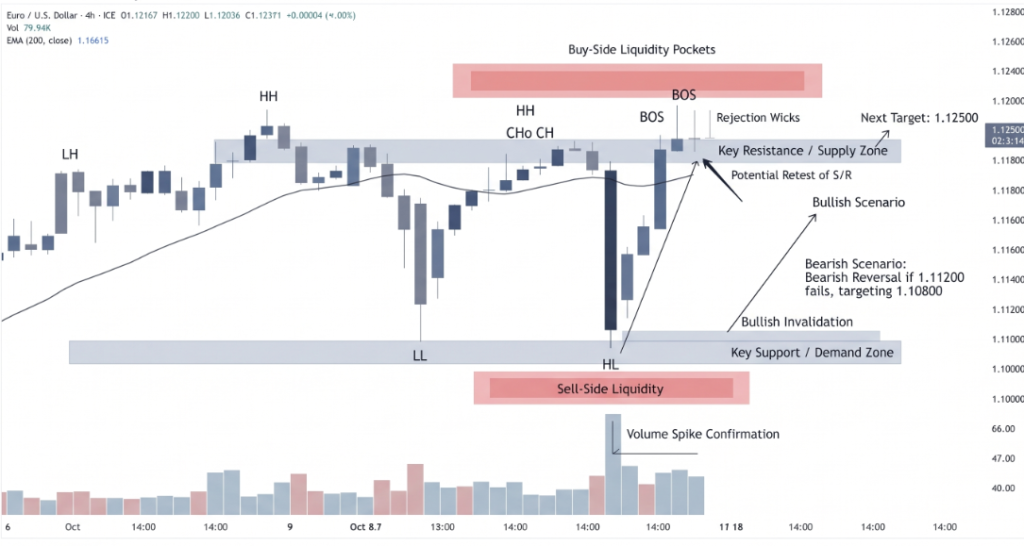
The Relative Strength Index (RSI) has recovered to around 36. That reading points to weak momentum, although it also suggests the pair has improved from more deeply oversold conditions.
Key technical levels include:
- Resistance: 1.1290, the 20-day EMA; a sustained move above it could ease near-term selling pressure.
- Support: 1.1114, the October 14 low; a break below this level could expose the psychological 1.1000 mark.
- Momentum: RSI near 36 signals that buyers have yet to establish strong control.
Conclusion:
EUR/USD has recovered above 1.1200 as weaker US yields pressure the dollar, but the rebound remains vulnerable. A sustained break above 1.1290 would strengthen the recovery case. Failure to hold 1.1114, meanwhile, could bring 1.1000 into view. Inflation developments, Federal Reserve expectations and France’s fiscal outlook remain key drivers for the pair.
Sources & Methodology
Primary-source standard: Market-moving facts should link to original data releases, regulator notices, company filings or official project announcements whenever available. Secondary reporting is used for additional context, not as a substitute for original evidence.
Page last reviewed: