
The USD/JPY pair slipped toward 158.00 on Thursday as US Treasury yields retreated from elevated levels, reducing support for the dollar. The decline followed a volatile reaction to stronger-than-expected US inflation data, while changing expectations for the Federal Reserve’s next policy move added uncertainty to currency markets. In Japan, mixed economic indicators and calls for further interest-rate increases from Bank of Japan policymakers offered some support to the yen. Technically, the pair’s rejection near 159.00 has weakened bullish momentum, placing the 157.50 support area in focus.
US Yields Retreat as Dollar Momentum Fades
US Treasury yields initially climbed after September’s Consumer Price Index (CPI) report showed annual inflation accelerating to 3.7%, up from 3.4% in August. Core inflation, which excludes food and energy, rose to 2.6% year over year, reinforcing concerns that price pressures remain persistent.
However, the bond-market reaction subsequently reversed. The benchmark 10-year Treasury yield fell toward 5.09%, its lowest level in roughly three weeks, after reaching substantially higher levels during Wednesday’s trading. Lower yields can reduce the dollar’s relative appeal to international investors, helping explain the latest pullback in USD/JPY.
The outlook for US monetary policy remains uncertain. Markets are weighing persistent inflation against concerns about economic growth and financial-market volatility ahead of the Federal Reserve meeting scheduled for October 27–28. The direction of Treasury yields and changing expectations for interest rates could therefore remain important drivers of the currency pair.
Bank of Japan Signals Keep Yen in Focus
Japan’s economic data offered mixed signals. August private-sector machinery orders, excluding volatile orders from shipbuilders and electric-power companies, increased 5.2% month over month, according to the Japanese Cabinet Office. However, total machinery orders fell 3.7%, highlighting uneven conditions across the sector.
Industrial production data also remained a concern after the reported downward revision. Against this backdrop, Bank of Japan board member Junko Koeda joined policymakers advocating further rate increases amid inflation risks.
Higher Japanese interest rates could support the yen by narrowing the interest-rate gap with the United States. Yet the currency’s response will depend on whether the central bank follows its hawkish signals with concrete policy action.
USD/JPY Forecast: Key Levels to Watch
The four-hour chart shows USD/JPY near 157.91 after another rejection around 159.00. Although the broader near-term structure remains constructive, momentum indicators point to a loss of buying strength.
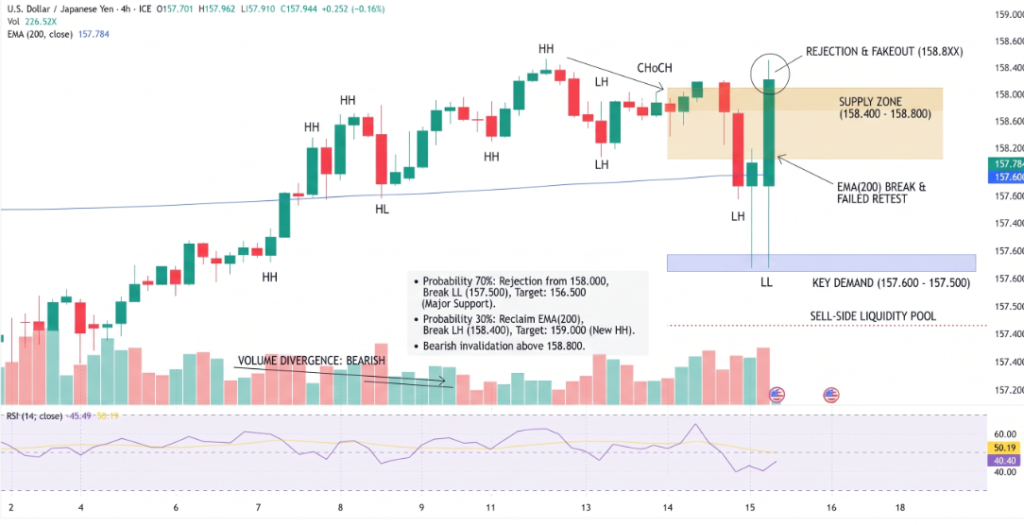
The Relative Strength Index (RSI) has fallen below 50, while the Moving Average Convergence Divergence (MACD) indicator has turned slightly negative. Together, these signals suggest consolidation and increased downside risk rather than confirming a sustained reversal.
Traders are watching three important price areas:
- 157.50 support: A decisive break could open the way toward 156.36.
- 156.36 and 155.35: Further downside levels if selling pressure accelerates.
- 159.00 resistance: A sustained breakout could restore bullish momentum, with 160.00 and 160.40 as subsequent levels.
Conclusion:
USD/JPY’s rejection at 159.00 has weakened its upward momentum as US yields retreat and the Bank of Japan maintains a more hawkish tone. A break below 157.50 would strengthen the bearish case, while a recovery above 159.00 would signal renewed buying interest. Treasury yields and central-bank guidance remain key catalysts.
Sources & Methodology
Primary-source standard: Market-moving facts should link to original data releases, regulator notices, company filings or official project announcements whenever available. Secondary reporting is used for additional context, not as a substitute for original evidence.
Page last reviewed: