
The Australian dollar surrendered its early gains on Monday, trading near 0.6970 against the US dollar as investors reduced risk exposure ahead of key US inflation and Australian employment reports. The US Dollar Index (DXY), which measures the greenback against six major currencies, hovered around 102.20 in the supplied market snapshot. With both economic releases approaching, traders are assessing whether inflation will keep the Federal Reserve cautious or strengthen expectations for tighter monetary policy. AUD/USD remains technically weak, with resistance at 0.7015 and downside support near 0.6900.
US CPI Puts Federal Reserve in Focus
The September US Consumer Price Index (CPI) is scheduled for Wednesday, October 14, according to the Bureau of Labor Statistics. The report measures changes in consumer prices and can influence expectations for the Federal Reserve’s next interest-rate decision.
Markets have increasingly favored the Fed holding rates steady at its October meeting. Analysts at MUFG have argued that a significant upside surprise in underlying inflation would be needed to materially change that outlook.
A stronger-than-expected CPI reading could support the dollar by reinforcing expectations for restrictive monetary policy. Conversely, softer inflation could weaken the greenback if investors anticipate that policymakers will avoid additional tightening.
The US Dollar Index near 102.20 provides an important reference point, although its direction will also depend on bond yields, risk sentiment and other economic releases.
Australian Jobs Data Could Move AUD/USD
Australia’s September employment report is scheduled for Thursday, October 15, according to the Australian Bureau of Statistics. Employment growth, unemployment and labor-force participation will help traders assess the domestic economy and the outlook for Reserve Bank of Australia policy.
Stronger employment figures could support the Australian dollar by sustaining expectations for relatively firm interest rates. Weaker results could have the opposite effect, particularly if US inflation simultaneously boosts demand for the dollar.
The main catalysts this week are:
- Wednesday, October 14: US September CPI report.
- Thursday, October 15: Australian September employment report.
- Throughout the week: Changes in US yields, dollar momentum and broader market risk appetite.
The sequence matters because both reports could shift relative interest-rate expectations, a key driver of the AUD/USD exchange rate.
AUD/USD Technical Levels to Watch
AUD/USD traded around 0.6972 on the daily chart, below its 20-day exponential moving average (EMA) at 0.7015. The EMA tracks recent prices while giving greater weight to newer observations, making it a useful gauge of short-term momentum.
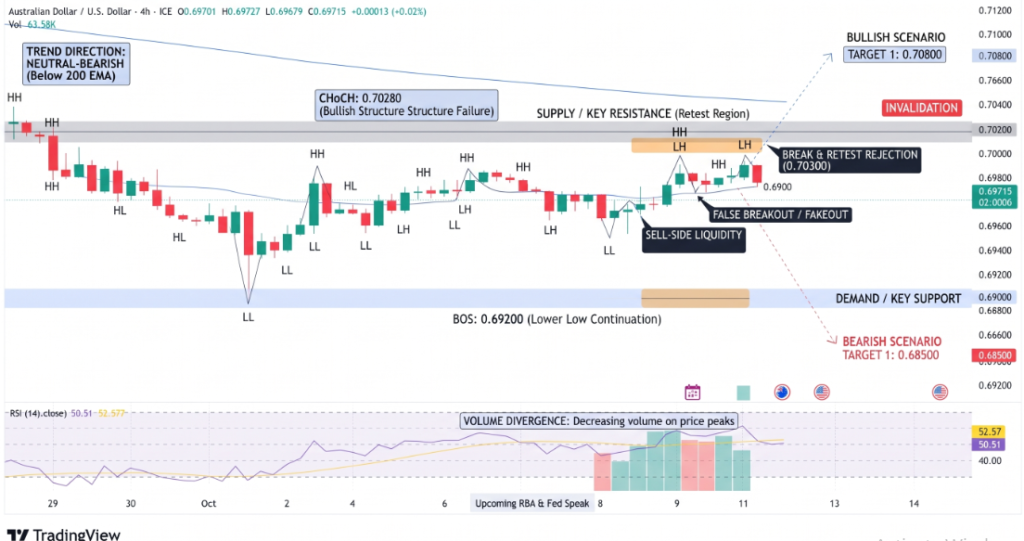
The Relative Strength Index (RSI) stood near 39, indicating bearish momentum without showing an extreme oversold condition. The pair’s inability to recover above the moving average suggests sellers retain the near-term advantage.
Key levels to monitor include:
- Resistance: 0.7015, the 20-day EMA.
- First support: 0.6900, the October 1 low.
- Next support: 0.6865, the June 30 low.
Conclusion
AUD/USD remains vulnerable near 0.6970 as traders await two important economic reports. A sustained move above 0.7015 could improve the recovery outlook, while a break below 0.6900 would expose the 0.6865 support area. US inflation and Australian employment data are likely to determine whether the next decisive move favors the dollar or the Aussie.
Sources & Methodology
Primary-source standard: Market-moving facts should link to original data releases, regulator notices, company filings or official project announcements whenever available. Secondary reporting is used for additional context, not as a substitute for original evidence.
Page last reviewed: