
The USD/CAD currency pair edged lower toward 1.4250 on Monday after reaching 1.4300 on Friday, as thin trading conditions limited price movements. The pair remains within its recent 1.4200–1.4300 range following a strong advance in September. Investors are weighing weak US consumer sentiment against a disappointing Canadian employment report, while upcoming US inflation figures could provide fresh clues about the Federal Reserve’s monetary policy. Energy prices and geopolitical developments are additional factors influencing the Canadian dollar.
US and Canadian Data Shape Outlook
The US dollar faces pressure after the University of Michigan’s preliminary Consumer Sentiment Index fell to 46.3 in October from 48.1 in September, approaching its historical low. The decline reflects concerns about living costs and economic conditions, with elevated energy prices contributing to household frustration. The survey also showed one-year inflation expectations rising to 4.7% from 4.6%. These figures complicate the outlook for the Fed because weaker confidence can signal economic strain, while persistent inflation expectations may discourage policymakers from easing monetary conditions.
Canada’s labor market also delivered disappointing news. The country lost 68,300 jobs in September, while the unemployment rate rose to 6.5% from 6.4% in August. The report weakened expectations for near-term monetary tightening by the Bank of Canada. It also weighed on the Canadian dollar, which often responds to domestic economic conditions and changes in interest-rate expectations.
Inflation Reports Put Dollar in Focus
Markets are turning their attention to the US Consumer Price Index (CPI) and Producer Price Index (PPI), which offer important measures of consumer and wholesale inflation. Stronger-than-expected readings could reinforce expectations that US interest rates will remain elevated, potentially supporting the dollar. Softer data could increase pressure on the currency if traders anticipate a less restrictive policy outlook.
Oil prices add another layer of uncertainty. The Canadian dollar can benefit when crude prices rise because energy exports are an important part of Canada’s economy. However, the relationship is not automatic: changes in global risk appetite, interest rates and the US dollar can offset support from higher oil prices.
With trading activity subdued at the start of the week, incoming data may have a greater influence on the pair once market participation increases.
USD/CAD Forecast: Key Levels to Watch
The four-hour chart indicates limited momentum, with the Relative Strength Index hovering near 50 and the Moving Average Convergence Divergence indicator close to zero. Both readings suggest neither buyers nor sellers currently have a clear advantage.
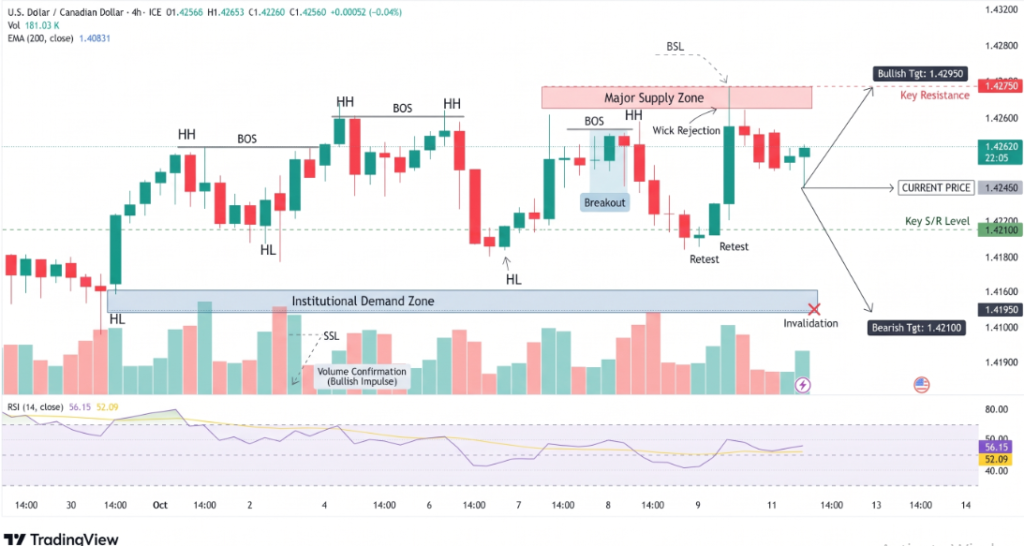
Important technical levels include:
- Resistance: 1.4300, followed by 1.4370 and 1.4410 if bullish momentum strengthens.
- Immediate support: 1.4200, the lower boundary of the recent trading range.
- Lower targets: 1.4155 and approximately 1.4100 if the pair breaks below support.
Conclusion
USD/CAD remains range-bound near 1.4250 as traders balance weak US consumer confidence against Canada’s deteriorating employment figures. A break above 1.4300 could open the way toward 1.4370, while a sustained decline below 1.4200 would expose lower support near 1.4155 and 1.4100. Until inflation data provide a clearer signal, the pair’s next move will likely depend on changing expectations for both the Federal Reserve and the Bank of Canada.
Sources & Methodology
Primary-source standard: Market-moving facts should link to original data releases, regulator notices, company filings or official project announcements whenever available. Secondary reporting is used for additional context, not as a substitute for original evidence.
Page last reviewed: