
The euro weakened against the British pound on Monday, with the EUR/GBP exchange rate approaching its recent 16-month low of 0.8447. The pair has fallen about 1.7% over the past two weeks as French fiscal concerns, political uncertainty and student protests weigh on investor confidence. Sterling, meanwhile, is drawing support from expectations that the Bank of England may need to maintain restrictive monetary policy to contain inflation.
French Debt Weighs on the Euro
France’s deteriorating fiscal outlook remains a central concern for currency traders. The gap between yields on 10-year French government bonds, known as OATs, and comparable German Bunds has widened sharply. The original market report cited a spread of 141 basis points, while a separate FXStreet update on Monday reported 137 basis points. Both figures indicate elevated investor concern about French sovereign debt. French bond yields and German Bund yields are therefore important indicators to monitor.
A wider spread means France must offer investors a higher yield than Germany to compensate for perceived additional risk. The pressure comes as the government faces difficulties securing parliamentary support for major reforms and managing its budget deficit ahead of the 2027 presidential election.
Social unrest is adding to the uncertainty. Reuters reported on October 9 that student protests had entered their third week, with 141 schools still closed. The demonstrations have intensified pressure on a government trying to address public-service concerns while controlling spending.
These factors are discouraging demand for the euro as traders assess whether France’s fiscal challenges could remain a persistent source of risk for the wider eurozone.
Sterling Gains on Rate Expectations
The pound has benefited from the euro’s weakness and expectations surrounding UK monetary policy. Commerzbank analysts have argued that an improved growth outlook could give the Bank of England more room to raise interest rates if inflation remains persistent.
Higher interest rates can support a currency by making its assets more attractive to investors, although the effect depends on market expectations and economic conditions. Traders are also watching upcoming UK economic releases for evidence that growth can withstand restrictive borrowing costs.
Sterling’s strength is not guaranteed. Weaker growth, easing inflation or a shift in the central bank’s guidance could reduce expectations for further tightening. For now, however, the contrast between French political and fiscal uncertainty and the UK rate outlook is helping the pound outperform the euro.
EUR/GBP Technical Levels to Watch
EUR/GBP is trading near 0.8447 after rejecting gains around 0.8490. On the four-hour chart, momentum indicators point to persistent selling pressure, although oversold readings raise the possibility of a short-term rebound.
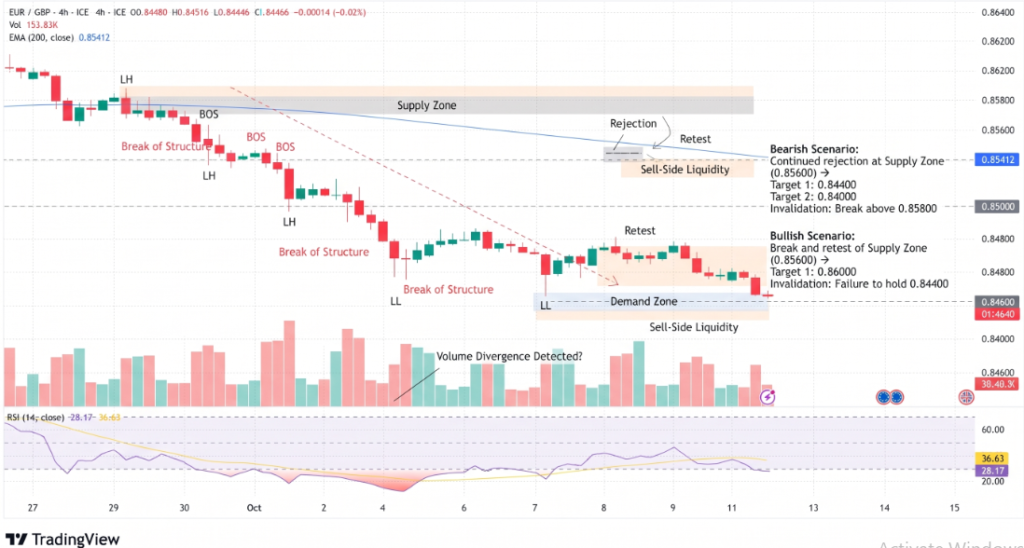
The Relative Strength Index (RSI) has dropped below 30, a conventional oversold threshold. The Moving Average Convergence Divergence (MACD) remains in negative territory, supporting the bearish near-term outlook.
Key technical levels include:
- Immediate support: 0.8447, the October 7 low.
- Lower support: 0.8405–0.8415, followed by 0.8355.
- Initial resistance: 0.8485, near recent session highs.
- Further resistance: 0.8490 and 0.8500.
Conclusion
EUR/GBP remains vulnerable while French debt concerns and political unrest undermine the euro. A decisive break below 0.8447 could open the way toward 0.8415 and potentially 0.8355. However, oversold momentum may trigger a temporary recovery. A sustained move above 0.8500 would weaken the immediate bearish outlook, while upcoming UK data and developments in France are likely to shape the next move.
Sources & Methodology
Primary-source standard: Market-moving facts should link to original data releases, regulator notices, company filings or official project announcements whenever available. Secondary reporting is used for additional context, not as a substitute for original evidence.
Page last reviewed: