
The US Dollar Index (DXY) traded near 102.22 on Monday, consolidating after reaching a fresh 2026 high of 102.54 last week. The pause comes as currency markets prepare for September’s US Consumer Price Index (CPI) report, scheduled for Wednesday, October 14. The inflation figures could influence expectations for the Federal Reserve’s next policy decision. With the dollar holding near its recent peak, traders are assessing whether inflation will sustain the rally or trigger a pullback.
US CPI Puts Dollar in Focus
The September US CPI report is expected to show headline inflation rising to 3.7% year over year, compared with 3.4% in August. Core CPI, which excludes food and energy prices, is forecast to increase to 2.5% from 2.4%, according to market estimates. The figures are scheduled for release at 8:30 a.m. Eastern Time on October 14. Official release information can be used to confirm the publication schedule.
Inflation matters because the Federal Reserve uses interest rates to manage price pressures while supporting employment. If consumer prices rise faster than expected, traders may anticipate that policymakers will keep borrowing costs elevated or consider additional tightening. That outlook could support the dollar by making US assets more attractive.
Conversely, a softer-than-expected reading could reduce expectations for further rate increases and encourage investors to take profits after the dollar’s recent advance.
Analysts at MUFG have cautioned that the CPI report will test market expectations for the Fed to leave rates unchanged this month. Their outlook favors a pause unless underlying inflation delivers a significant upside surprise.
Fed Expectations Drive DXY Momentum
The dollar’s next move will depend not only on headline inflation but also on the details beneath it. Core prices can help traders assess whether inflationary pressure is spreading beyond energy costs.
The US economic calendar is therefore central to this week’s trading outlook. Investors will compare the actual figures with forecasts and assess how the results could affect the Fed’s policy path.
Three scenarios are worth watching:
- Hotter inflation: Could lift rate expectations and strengthen the dollar.
- In-line data: May leave DXY consolidating near its recent highs.
- Softer inflation: Could encourage profit-taking and a deeper correction.
These outcomes are not automatic. Market positioning, Treasury yields and the Fed’s subsequent communications may influence the dollar’s response.
DXY Technical Levels to Watch
On the daily chart, DXY trades at 102.22, above its 20-day exponential moving average (EMA) near 101.35. This gap indicates that the recent uptrend remains intact, although the index could retreat toward its moving average if buying momentum weakens.
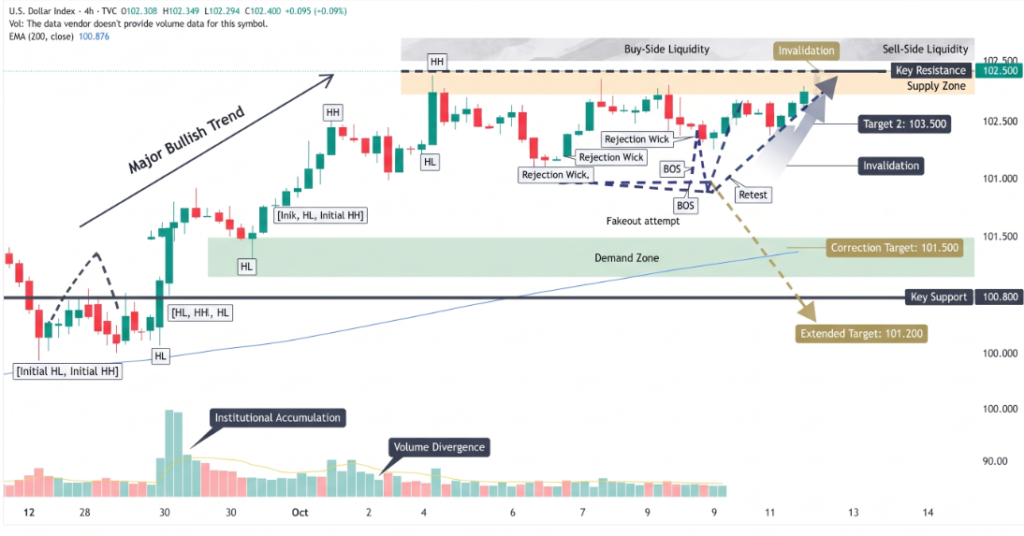
The Relative Strength Index (RSI) stands at 70.65, above the conventional 70 threshold associated with overbought conditions. This signals strong momentum but also raises the risk of consolidation or a short-term pullback.
Key levels include:
- Resistance: 102.54, the recent yearly high.
- Support: 101.35, the 20-day EMA.
- Bullish trigger: A decisive break above 102.54.
- Correction risk: A retreat toward 101.35 if momentum fades.
Conclusion
The US Dollar Index remains supported by its position above the 20-day EMA, but its next direction may depend on Wednesday’s inflation report. A break above 102.54 could extend the advance, while weaker CPI data may prompt a pullback toward 101.35. Until the figures are released, DXY could remain range-bound as traders reassess the Federal Reserve’s rate outlook.
Sources & Methodology
Primary-source standard: Market-moving facts should link to original data releases, regulator notices, company filings or official project announcements whenever available. Secondary reporting is used for additional context, not as a substitute for original evidence.
Page last reviewed: