
The Australian Dollar weakened against the US Dollar on Wednesday, with AUD/USD trading around 0.7100 during early European hours. The pair remains under pressure as the US Dollar Index climbs to its highest level in more than seven weeks, while Federal Reserve officials continue to emphasize inflation risks. At the same time, Australia’s preliminary September business survey showed slower growth, with the Composite PMI falling to 50.8 from 52.7 in August. The combination leaves AUD/USD below a key technical resistance area near 0.7135.
Dollar Strength Weighs on Aussie
The US Dollar has gained support from expectations that the Federal Reserve could maintain a restrictive policy stance. ING analysts identified recent hawkish Fed commentary as an important driver of the dollar’s strength, citing comments from Chicago Fed President Austan Goolsbee and St. Louis Fed President Alberto Musalem about persistent inflation risks.
The dollar’s broader performance is reflected in the DXY, which was around 100.73, up about 0.17% during the European session in the source report. A stronger dollar generally creates downward pressure on AUD/USD because the pair expresses the value of one Australian dollar in US dollars.
Australia’s domestic data also provided limited support for the Aussie. The September S&P Global PMI Composite reading fell to 50.8, remaining above the 50 threshold that separates expansion from contraction but slowing materially from August’s 52.7. Manufacturing declined to 49.3 from 52.0, while services eased to 51.4 from 53.2.
Key data points include:
- 0.7100: AUD/USD trading area
- 100.73: DXY level cited in the source report
- 50.8: September Australian Composite PMI
- 49.3: September Manufacturing PMI
AUD/USD Holds Above 0.7097
On the daily chart, AUD/USD was around 0.7104, slightly above the 38.2% Fibonacci retracement at 0.7097. However, the pair remained below its 20-period EMA at 0.7135, keeping the immediate technical structure constrained.
The Relative Strength Index stood at 44.5, below the neutral 50 mark. That reading indicates that upside momentum has weakened, although it does not by itself establish a sustained bearish trend.
The key technical levels are:
- 0.7097: Immediate Fibonacci support
- 0.7053: 50% Fibonacci retracement
- 0.7009: 61.8% Fibonacci retracement
- 0.7135: 20-day EMA resistance
- 0.7151: 23.6% Fibonacci resistance
- 0.7238: Major cycle-high resistance
A sustained move above 0.7135 would put the 0.7151 level into focus, followed by the broader resistance around 0.7238. Conversely, a decisive break below 0.7097 could expose the 0.7053 and 0.7009 retracement levels.
AUD/USD Outlook Centers on 0.7135
The AUD/USD technical outlook remains closely tied to the interaction between the 20-day EMA and nearby Fibonacci support. The pair has held above 0.7097, but the inability to reclaim 0.7135 leaves the short-term structure vulnerable to further consolidation. Recent market analysis from UOB also identifies the 0.7140 area as an important resistance zone, with AUD/USD recently trading within a narrow range around 0.7105-0.7135.
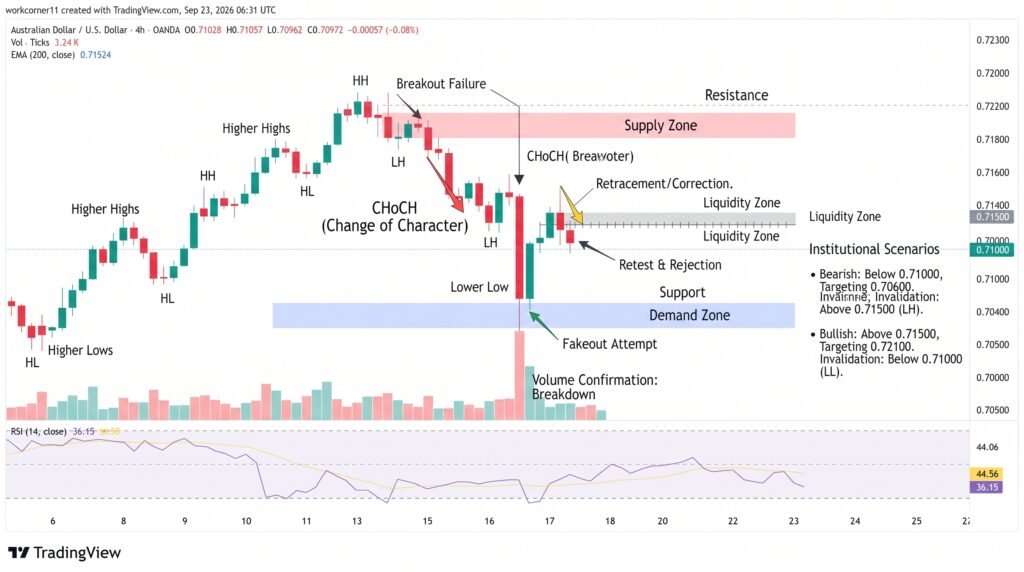
The broader fundamental picture remains mixed. A firm US Dollar and persistent US inflation concerns are weighing on the pair, while Australia’s PMI data points to slower business activity. The Reserve Bank of Australia policy outlook and incoming Australian economic data will remain important for the Australian Dollar.
Conclusion:
AUD/USD is trading near 0.7100 with the 0.7097 Fibonacci retracement providing immediate support and the 0.7135 20-day EMA limiting recovery attempts. Below the pair, 0.7053 and 0.7009 are the next major Fibonacci levels, while a sustained break above 0.7135 would bring 0.7151 and eventually 0.7238 into focus. For now, the pair remains caught between softer Australian activity and continued support for the US Dollar from a firm Federal Reserve policy outlook.
Sources & Methodology
Primary-source standard: Market-moving facts should link to original data releases, regulator notices, company filings or official project announcements whenever available. Secondary reporting is used for additional context, not as a substitute for original evidence.
Page last reviewed: