
EUR/USD remained under pressure around 1.1360 during Tuesday’s European session, with the euro trading near its lowest level since July 28. The decline reflects a stronger U.S. dollar , rising Treasury yields and growing expectations that the Federal Reserve could raise interest rates again in October. The Fed increased its policy rate by 25 basis points in September to a 3.75%-4.00% target range and said inflation remains elevated. Markets are now focused on additional Fed commentary and upcoming U.S. inflation and employment data.
Fed Hike Bets Support the Dollar
The U.S. dollar has gained as investors reassess the U.S. interest-rate outlook. Recent comments from Fed officials have reinforced concerns that inflation could remain above the central bank’s 2% objective for longer than previously expected.
Cleveland Fed President Beth Hammack said inflation had remained above target for an extended period and argued that monetary policy should stay restrictive. Her comments came after the September rate increase, when policymakers also signaled that inflation risks remained significant.
Fed Governor Michael Barr has also said further policy adjustments are likely to be necessary if inflation does not return to target in a timely manner. He pointed to strong economic growth, a solid labor market and inflation that remains above the Fed’s objective.
The latest market pricing places the probability of another quarter-point Fed rate increase in October above 70%, according to market-based measures reported Tuesday. The Dollar Index was around 101.27, close to a two-month high, while the U.S. 10-year Treasury yield climbed above 5.27%.
Dollar Strength Pressures EUR/USD
The euro is facing additional pressure as higher U.S. yields increase the relative return available from dollar-denominated assets. Recent strength in oil prices and uncertainty surrounding the Middle East have also contributed to concerns about inflation and interest rates.
Societe Generale has lowered its EUR/USD projection during the year as the dollar has remained stronger than expected. The bank has cited elevated commodity prices, resilient U.S. economic data and a more cautious global risk environment as factors supporting the greenback.
For EUR/USD, the broader macro backdrop remains centered on the interest-rate differential between the U.S. and euro area. A sustained rise in U.S. yields can make the dollar more attractive, while weaker European growth expectations can limit demand for the euro.
EUR/USD Tests Key Technical Support
On the daily chart, EUR/USD remains below its 100-day simple moving average (SMA) and the Bollinger Bands, keeping the near-term technical structure under pressure. The 14-day Relative Strength Index (RSI) at 25.6 indicates an oversold market, however, which raises the possibility of short-term stabilization even while the broader decline persists.
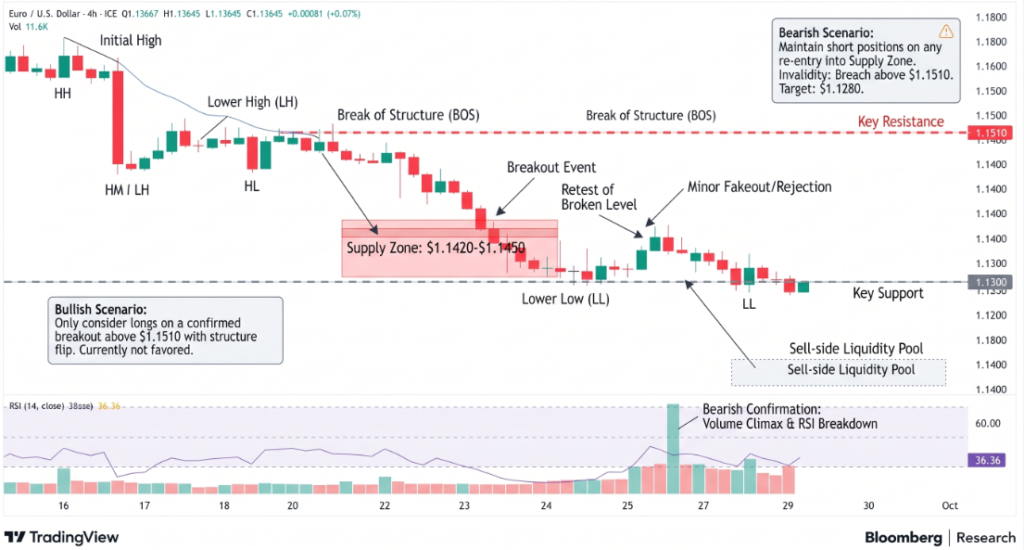
EUR/USD Price Chart – Source: Tradingview
Key levels include:
- Resistance: 1.1411, followed by 1.1510 and 1.1525.
- Higher resistance: 1.1654 and 1.1705.
- Support: 1.1315, followed by 1.1210.
- Major lower level: 1.1050, with 1.0000 as a longer-term psychological reference.
A move above 1.1411 would provide the first indication of improving short-term momentum. Conversely, a sustained break below 1.1315 would expose the 1.1210 area identified in the technical setup.
Conclusion
EUR/USD remains under pressure near 1.1350 as rising U.S. Treasury yields and expectations for another Fed rate increase strengthen the dollar. The pair’s RSI shows oversold conditions, creating scope for temporary rebounds, but the broader technical structure remains below key moving averages. Upcoming U.S. inflation data, employment figures and Fed communication will remain important catalysts for the currency pair as markets reassess the path of U.S. monetary policy.
Sources & Methodology
Primary-source standard: Market-moving facts should link to original data releases, regulator notices, company filings or official project announcements whenever available. Secondary reporting is used for additional context, not as a substitute for original evidence.
Page last reviewed: