
The Canadian Dollar remains under pressure against the US Dollar as the gap between US and Canadian yields continues to widen. Scotiabank analysts say relative central-bank policy remains a key driver for the USD/CAD exchange rate, with tighter Canadian rate expectations providing some support but not fully offsetting the yield disadvantage.
Scotiabank currently places its fair-value estimate for USD/CAD at 1.4068, giving traders a reference point for assessing whether the currency pair is trading above or below its estimated fundamental level.
Yield Gap Weighs on Canadian Dollar
The relative outlook for the Federal Reserve and Bank of Canada remains central to the Canadian Dollar’s performance. According to Scotiabank, the continued widening in US-Canada yield spreads represents a meaningful headwind for the CAD.
Yield spreads matter because investors compare the return available from government bonds and other interest-sensitive assets across countries. When US yields rise relative to Canadian yields, the US Dollar can receive additional demand as investors reassess the relative attractiveness of dollar-denominated assets.
At the same time, expectations for Bank of Canada policy have strengthened. The market was pricing approximately 14 basis points of tightening for October and 37 basis points cumulatively for December, according to Scotiabank’s analysis.
That pricing suggests investors are assigning greater weight to additional Canadian monetary-policy tightening, even as the wider US-Canada yield relationship remains a constraint on the CAD.
- USD/CAD fair value: 1.4068
- October BoC pricing: 14 basis points
- December cumulative pricing: 37 basis points
- Key driver: US-Canada yield spreads
Canada GDP Becomes Next Data Test
Canadian economic data will provide another test of the currency’s outlook. Scotiabank points to the upcoming Canada GDP release for July as the main item on the domestic economic calendar.
The bank expects the monthly figure to show no growth from June, while the annual growth rate is projected to slow from 2.0% to 1.4%. A weaker growth profile could influence expectations for the BoC, particularly if economic momentum deteriorates while inflation remains under consideration.
The GDP report therefore matters beyond the headline number. Investors will examine whether domestic activity is losing momentum and what that could mean for future interest-rate decisions.
For USD/CAD, the interaction between economic growth, inflation and central-bank expectations is likely to remain more important than any single data point.
USD/CAD Tests 1.4068 Fair Value
Scotiabank’s 1.4068 fair-value estimate provides a key reference for the pair as traders balance Canadian rate expectations against the persistent US yield advantage.
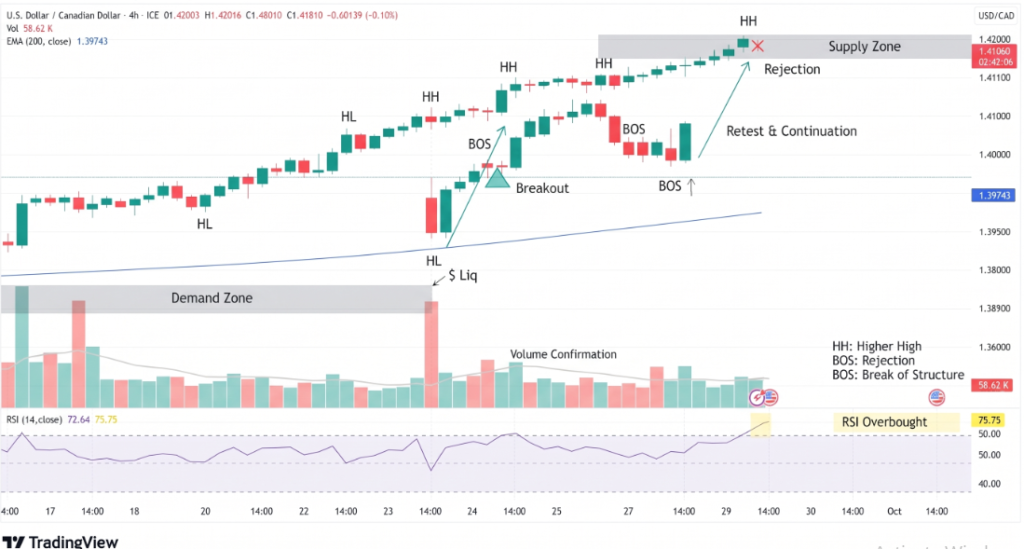
A shift in the yield spread could alter the currency’s valuation quickly. If Canadian yields rise relative to US yields, the CAD could receive additional support. Conversely, a renewed increase in US yields relative to Canadian rates could reinforce demand for USD/CAD.
The broader setup therefore remains closely tied to monetary policy and bond markets rather than technical factors alone.
Key factors to monitor
- 1.4068: Scotiabank fair-value estimate
- 14 bps: October tightening priced by markets
- 37 bps: December cumulative tightening priced
- 1.4%: Expected annual July GDP growth
- US-Canada yields: Major CAD valuation driver
Conclusion
USD/CAD remains sensitive to the widening US-Canada yield differential, while firmer BoC expectations provide an offsetting influence for the Canadian Dollar. Scotiabank’s 1.4068 fair-value estimate places relative interest rates and economic growth at the center of the currency outlook. The July Canada GDP report and changes in market pricing for October and December BoC policy will be important indicators for the next move in the pair.
Sources & Methodology
Primary-source standard: Market-moving facts should link to original data releases, regulator notices, company filings or official project announcements whenever available. Secondary reporting is used for additional context, not as a substitute for original evidence.
Page last reviewed: