
The US Dollar remains firm against its major peers as expectations for additional Federal Reserve tightening continue to support the Greenback. The US Dollar Index (DXY), which measures the dollar against a basket of six major currencies, is around 101.25, close to the two-month high of 101.40 reached last week.
Recent market pricing has strengthened the dollar’s rate advantage. The CME FedWatch tool showed strong expectations for another rate increase in October, while higher Treasury yields have provided an additional source of support for the currency.
Fed Bets Keep Dollar Supported
The CME FedWatch tool tracks rate expectations using 30-day federal funds futures and provides a market-based measure of the probability of upcoming FOMC decisions.
The market’s focus has shifted toward whether persistent inflation and resilient economic activity will require another increase after the Fed’s September move. The central bank raised its target range by 25 basis points to 3.75%-4.00% at its September meeting, and subsequent market commentary has continued to reflect expectations for additional tightening.
TD Securities expects the Fed to raise rates again in October and January, arguing that inflation remains above target while economic activity has remained resilient. The firm also expects incoming inflation and labor-market data to determine how quickly policymakers proceed later in the cycle.
That makes upcoming US economic data particularly important for the dollar.
- October Fed hike pricing: roughly 70%+
- DXY current area: 101.25
- Recent two-month high: 101.40
- September Fed target range: 3.75%-4.00%
JOLTS Data Becomes the Next Test
Investors are also watching the US JOLTS Job Openings report for August. The Bureau of Labor Statistics scheduled the release for September 29 at 10:00 a.m. ET. July job openings were little changed at 7.3 million, making the August report an important indicator of whether labor demand is continuing to stabilize.
The supplied market consensus calls for approximately 7.23 million openings, slightly below July’s 7.271 million figure. A stronger-than-expected reading could reinforce the view that the labor market can withstand tighter monetary policy, while a weaker result could temper expectations for additional increases.
For the dollar, the reaction will depend not only on the headline number but also on what the report signals about labor-market resilience and future inflation pressure.
DXY Technical Levels to Watch
The daily DXY chart retains a bullish near-term structure while price remains above the 20-day EMA at 100.30. However, the RSI at 70.14 indicates an overbought market, raising the possibility of consolidation before another directional move.
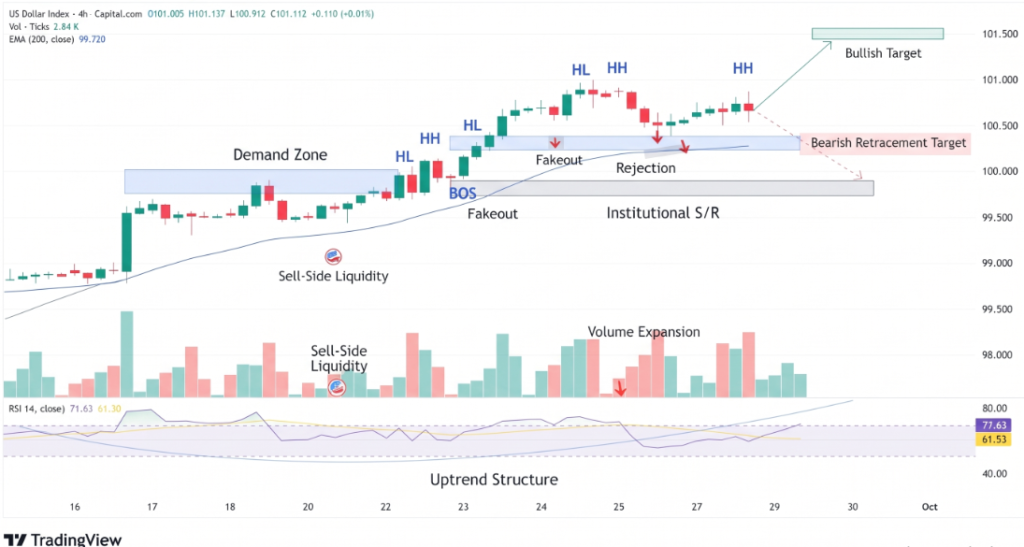
The main technical resistance is the 101.80 yearly high. A sustained move toward that level would put the dollar back at its 2026 peak, while failure to extend higher could bring the moving-average support zone back into focus.
- Resistance: 101.80
- Near-term high: 101.40
- First support: 100.30
- Psychological support: 100.00
Conclusion
The US Dollar Index remains supported by expectations for further Fed tightening, elevated Treasury yields and resilient US economic data. Near 101.25, DXY is approaching the 101.40 two-month high, while the 101.80 yearly peak remains the major upside level. The technical picture is constructive, but an RSI above 70 suggests momentum is stretched. The upcoming JOLTS report and subsequent inflation data could determine whether the dollar extends its advance or pauses near current highs.
Sources & Methodology
Primary-source standard: Market-moving facts should link to original data releases, regulator notices, company filings or official project announcements whenever available. Secondary reporting is used for additional context, not as a substitute for original evidence.
Page last reviewed: