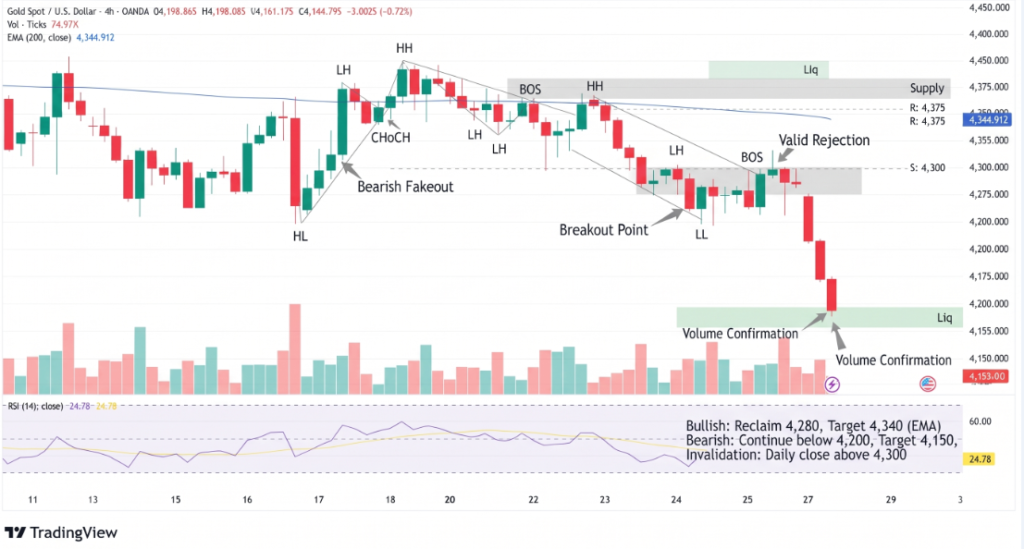
Gold prices extended their decline Monday, with spot gold falling below $4,200 as higher oil prices and expectations for additional Federal Reserve tightening weighed on bullion. At 01:39 ET, XAU/USD was down 2.3% at $4,188.84 an ounce, while gold futures fell 2.3% to $4,221.12. The decline followed a weekly loss of more than 2% and came as investors reassessed the inflation implications of the energy-market shock.
Oil Prices Keep Inflation Risks Elevated
The latest pressure on gold is closely linked to the Strait of Hormuz, where uncertainty over reopening conditions has kept energy markets volatile. Iran has maintained conditions for reopening the waterway after President Donald Trump rejected Tehran’s seven-day proposal, while Trump said negotiations could resume this week. Brent crude was reported to be about 70% higher in 2026.
Higher energy costs can complicate the Federal Reserve’s inflation outlook because oil affects transportation, production and consumer prices. Cleveland Fed President Beth Hammack said long-term Treasury yields have been driven by stronger growth expectations, government-debt concerns and expectations for the future path of monetary policy.
The Fed unanimously raised its policy rate by 25 basis points in September to a 3.75%-4.00% target range. Market pricing subsequently put the probability of another October increase near 65%.
Gold Faces Dollar and Yield Pressure
Higher interest rates and Treasury yields can weigh on gold because bullion does not generate interest income. The U.S. Dollar Index rose 0.1% to 101.11 in the cited session, adding another headwind for dollar-priced bullion.
Gold has also remained below its January record near $5,600. However, investment demand has not disappeared. The World Gold Council reported that global gold-backed ETFs added 121 tonnes in August, taking total holdings to a record 4,189 tonnes.
Other metals also weakened during Monday’s move:
- Silver: $61.65, down 4.1%.
- Platinum: $1,727.90, down 3%.
- Dollar Index: 101.11, up 0.1%.
The combination of firmer yields, a stronger dollar and higher energy costs has created a difficult short-term environment for bullion, even as longer-term investment demand remains substantial.
PCE and Jobs Data Take Center Stage
The next major test for markets comes from U.S. economic data. The Bureau of Economic Analysis is scheduled to release August personal income, outlays and the PCE price index on September 30. The PCE price index rose 3.7% year over year in July.
The Bureau of Labor Statistics will then publish the September employment report on October 2. Those releases could provide fresh evidence on inflation and labor-market conditions as traders assess the possibility of another Fed rate increase.
Conclusion
Gold’s break below $4,200 places monetary policy and energy prices at the center of the near-term outlook. XAU/USD fell to $4,188.84 in the cited session, while the Fed’s 3.75%-4.00% policy range and elevated oil prices continue to support higher-rate expectations. Strong ETF holdings provide a counterweight, but upcoming PCE inflation and employment data are likely to remain important catalysts for gold and Treasury markets.
Sources & Methodology
Primary-source standard: Market-moving facts should link to original data releases, regulator notices, company filings or official project announcements whenever available. Secondary reporting is used for additional context, not as a substitute for original evidence.
Page last reviewed: