
NEAR Protocol (NEAR) is struggling to extend its recovery above $3.50 as weakening institutional participation, declining derivatives activity and subdued U.S. investor demand weigh on its price. The cryptocurrency rebounded from the $3.40 support area on Monday but remained below important technical resistance on Tuesday. Meanwhile, negative Coinbase Premium readings and falling futures open interest suggest that market participants remain cautious. With bearish momentum persisting, traders are watching whether NEAR can defend $3.40 or faces another downward correction toward lower support levels.
NEAR ETF Outflows and Futures Signal Weak Demand
Institutional demand for NEAR remains subdued following two consecutive weeks of ETF withdrawals. According to SoSoValue, NEAR ETFs recorded zero net flows on Monday after investors withdrew $4.38 million and $3.43 million over the preceding two weeks.
Although Monday’s neutral reading indicates a pause in withdrawals, the absence of fresh inflows suggests that institutional investors have yet to regain confidence in the token.
Retail and derivatives activity also indicate reduced participation. Data from CoinGlass shows NEAR futures open interest declining to 230 million NEAR on Tuesday from 318 million NEAR on October 22. Open interest measures the total number of outstanding derivatives contracts and provides insight into market positioning.
The decline suggests traders have reduced their exposure, although falling open interest alone does not establish whether positions are closing on the long or short side.
Additional pressure comes from futures-market flows, where net outflows represented approximately 17% of daily volume. Meanwhile, spot-market inflows absorbed supply equivalent to nearly 10% of daily volume.
The Coinbase Premium Index also remained negative at 0.097%, indicating that NEAR was trading at a discount on Coinbase relative to other exchanges. A shift into positive territory could signal improving U.S. buying interest and potentially strengthen recovery prospects.
NEAR Price Forecast: $3.40 Support in Focus
NEAR traded at approximately $3.6130 on Tuesday, maintaining a bearish short-term structure. On the four-hour chart, the token remained below its 50-period Exponential Moving Average (EMA) at $3.8332 and its 200-period EMA at $4.2614.
Both moving averages indicate that the price remains under pressure, with the longer-term indicator providing a more distant resistance barrier.
The cryptocurrency is trading within a falling wedge formation, with descending resistance near $3.7981 and support around $3.4000. Horizontal support at $3.4030 further strengthens this critical price zone.
A confirmed breakdown below $3.40 could expose NEAR to additional losses:
- $2.9780: First major downside support.
- $2.7280: Secondary support if selling accelerates.
Momentum indicators also favor caution. The Moving Average Convergence Divergence (MACD) line remains below its signal line, while the Relative Strength Index (RSI) stands near 43, indicating negative momentum without reaching oversold territory.
NEAR Recovery Faces Resistance at $3.83
On the upside, NEAR must first break above descending trendline resistance at $3.7981. The 50-period EMA at $3.8332 represents the next obstacle for buyers.
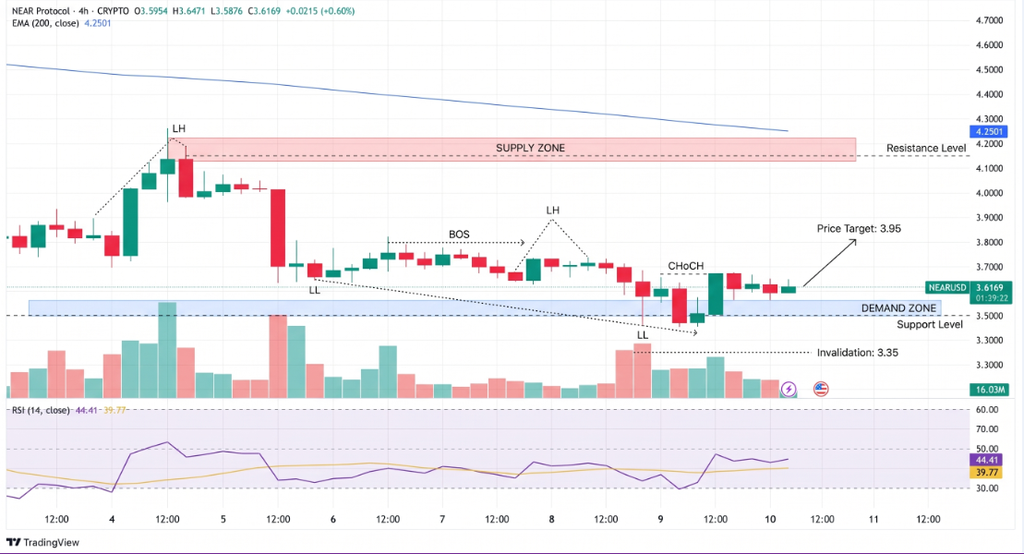
A sustained move above this area could expose the horizontal resistance at $3.9160, followed by the 200-period EMA near $4.2614. A break above these barriers would indicate improving buying pressure and potentially weaken the prevailing bearish structure.
However, failure to overcome the initial resistance zone could leave NEAR vulnerable to renewed selling, particularly if futures outflows continue and institutional demand remains subdued.
Conclusion
NEAR Protocol faces increasing downside risks as institutional flows and derivatives participation remain weak. The $3.40 support level is critical for maintaining the current recovery structure. A confirmed breakdown could open the way toward $2.9780 and $2.7280, while a sustained recovery above $3.83 would provide an initial indication that selling pressure is easing.
Sources & Methodology
Primary-source standard: Market-moving facts should link to original data releases, regulator notices, company filings or official project announcements whenever available. Secondary reporting is used for additional context, not as a substitute for original evidence.
Page last reviewed: