
Strategic Shift Reshapes Tether’s Portfolio
Tether, the issuer behind the world’s largest dollar-backed stablecoin, is closing Alloy by Tether and ending support for aUSDT, a gold-collateralized stablecoin introduced as part of the company’s broader digital asset strategy.
The decision reflects a growing emphasis on products that demonstrate stronger adoption, deeper liquidity, and greater long-term growth potential.
According to Tether, the move follows a detailed review of platform activity and user demand. The company concluded that its resources could generate greater value if directed toward higher-growth areas within its ecosystem, particularly its gold-backed asset XAUT and other core stablecoin offerings.
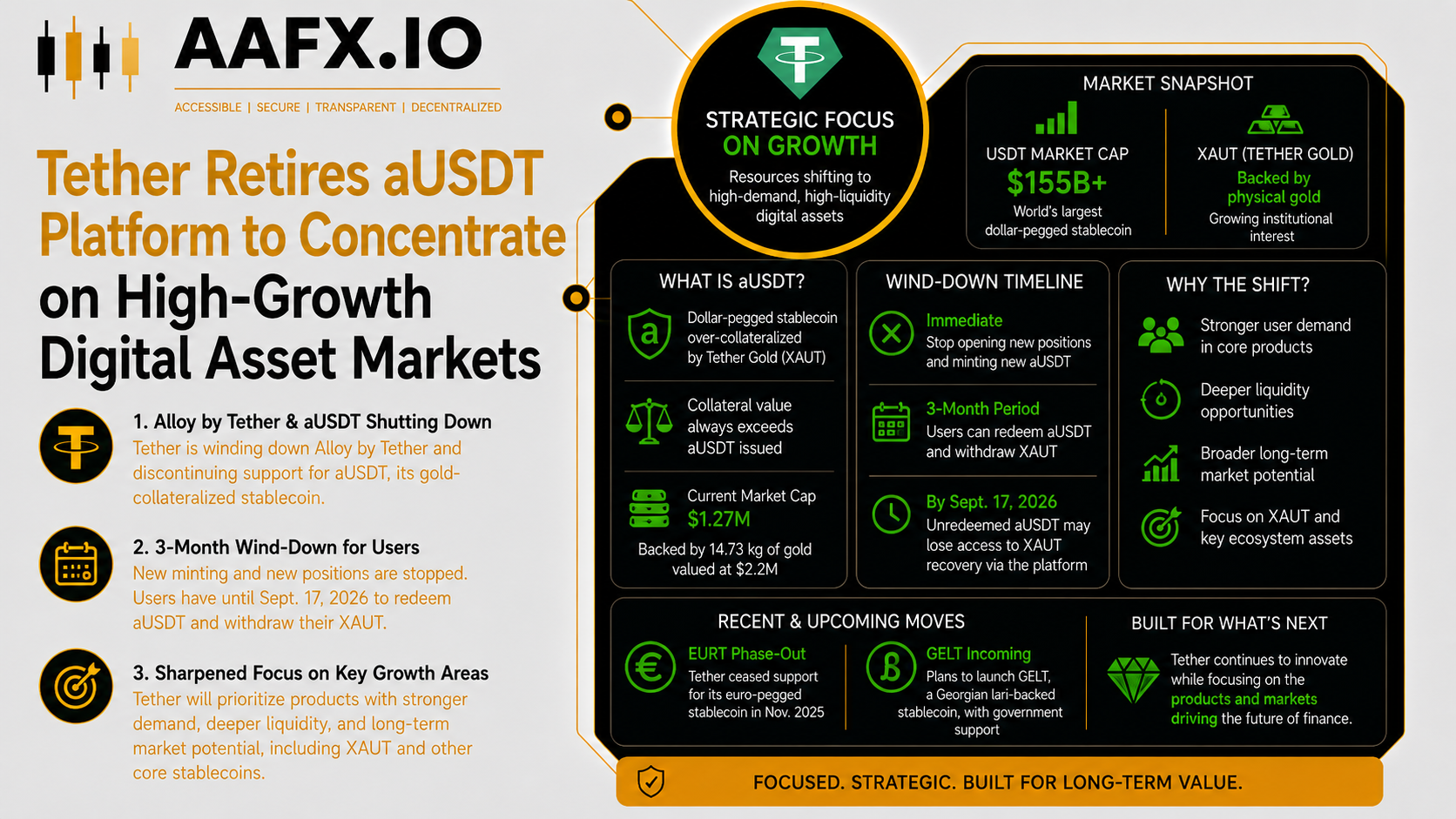
Effective immediately, users can no longer create new positions or mint additional aUSDT. Existing participants, however, will have a three-month transition period to unwind their positions and reclaim the underlying collateral backing their holdings.
The announcement represents another example of how stablecoin issuers are refining product portfolios as competition intensifies and market preferences evolve.
What Happens to Existing Holders?
The closure process has been structured as a phased wind-down rather than an abrupt termination. Tether has provided users with a defined timeline to redeem assets and recover collateral tied to the platform.
Key details include:
- New aUSDT minting has been permanently suspended.
- Opening new positions on Alloy is no longer permitted.
- Users have until September 17, 2026, to redeem aUSDT.
- XAUT collateral can be withdrawn during the transition period.
- Unredeemed positions may lose access to collateral recovery through the platform after the deadline.
Launched in 2024, Alloy by Tether was designed as an open framework for creating digital assets backed by tokenized gold. Its flagship product, aUSDT, maintained a dollar peg through over-collateralization with Tether Gold (XAUT), meaning the value of deposited gold consistently exceeded the value of stablecoins issued.
This structure aimed to combine the price stability of a dollar-pegged asset with the security of physical gold reserves, creating an alternative model within the growing stablecoin sector.
XAUT Becomes a Bigger Priority
The numbers illustrate why Tether may have chosen to redirect resources. According to platform data, aUSDT currently maintains a market capitalization of approximately $1.27 million, supported by 14.73 kilograms of gold valued at roughly $2.2 million.
While adequately collateralized, the product remains relatively small compared with Tether’s flagship offerings.
The decision also aligns with previous strategic actions. In 2025, Tether discontinued support for its euro-backed stablecoin EURT, citing a broader shift in corporate priorities. More recently, the company revealed plans to introduce GELT, a stablecoin linked to the Georgian lari and developed with support from the Georgian government.
Several trends appear to be driving Tether’s evolving strategy:
- Increased focus on products with stronger liquidity.
- Expansion of tokenized real-world assets.
- Growing demand for gold-backed digital instruments.
- Interest in region-specific stablecoin initiatives.
As stablecoin competition accelerates worldwide, Tether’s latest move signals a clear objective: concentrate capital, technology, and operational resources on products with the greatest potential for scale.
While Alloy and aUSDT are nearing the end of their lifecycle, the company’s focus on gold-backed assets and emerging stablecoin markets suggests its expansion strategy remains firmly intact.
