

AI Payments Expand XRP Utility
Predictions surrounding XRP have long sparked debate across the cryptocurrency market. While forecasts suggesting XRP could reach $100 within six months remain highly ambitious, recent developments have renewed interest in Ripple’s ecosystem and the broader XRP Ledger.
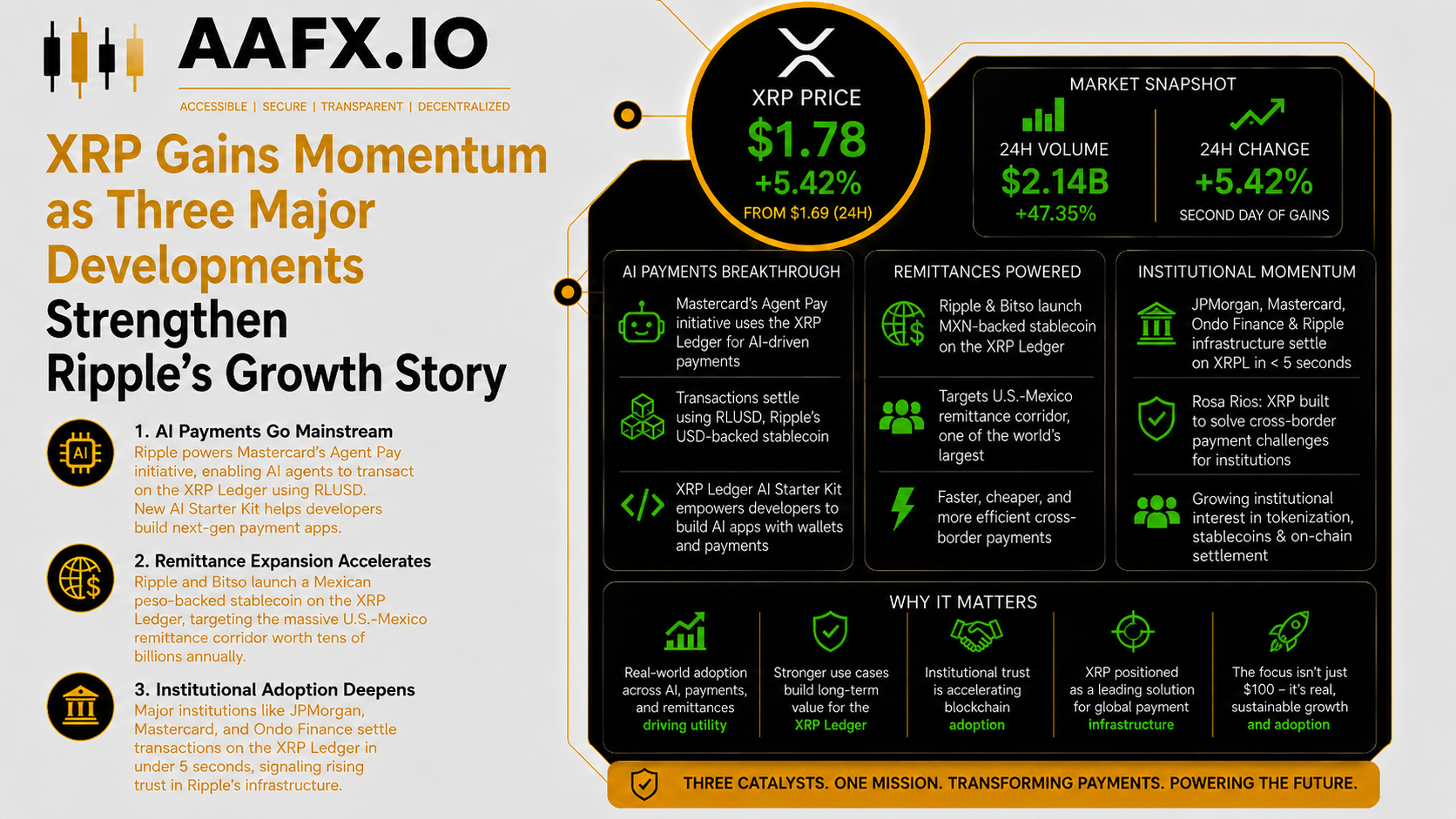
One of the strongest drivers of optimism is Ripple’s growing role in artificial intelligence-powered payments. Mastercard’s Agent Pay initiative recently highlighted this trend by enabling AI agents to conduct transactions through infrastructure connected to the XRP Ledger.
These transactions are designed to settle using RLUSD, Ripple’s U.S. dollar-backed stablecoin.
Ripple has also introduced an XRP Ledger AI Starter Kit, providing developers with tools to build applications capable of creating wallets, initiating payments, and processing transactions using XRP and RLUSD.
As AI-driven commerce continues to evolve, blockchain networks that can support automated financial interactions may gain a competitive advantage.
For XRP supporters, this development represents more than a technical milestone. It demonstrates how blockchain technology can move beyond speculation and into practical business applications.
Ripple Targets Global Remittances
A second catalyst comes from Ripple’s continued expansion in cross-border payments, an area where the company has focused for more than a decade.
Ripple and Bitso recently expanded their collaboration through the launch of a Mexican peso-backed stablecoin on the XRP Ledger. The initiative is aimed at the U.S.-Mexico remittance corridor, one of the largest money-transfer markets in the world.
According to World Bank estimates, annual remittance flows between the two countries exceed tens of billions of dollars, creating substantial demand for efficient payment infrastructure.
Several factors make this development noteworthy:
- Access to one of the world’s busiest remittance corridors.
- Faster transaction settlement compared with traditional systems.
- Reduced costs for cross-border transfers.
- Greater visibility for XRP Ledger technology in real-world finance.
As financial institutions and payment providers seek faster settlement solutions, Ripple’s presence in international money transfers continues to expand.
Institutional Adoption Accelerates
The third and potentially most significant catalyst is the growing involvement of major financial institutions in blockchain-based settlement systems.
Recent reports highlighted a transaction involving JPMorgan, Mastercard, Ondo Finance, and Ripple-related infrastructure that was completed on the XRP Ledger in less than five seconds. The transaction demonstrated the speed and efficiency that distributed ledger technology can offer compared with conventional settlement networks.
Ripple board member Rosa Rios has repeatedly emphasized that XRP was built to address cross-border payment inefficiencies for banks and financial institutions. This mission is becoming increasingly relevant as institutions explore tokenized assets, stablecoins, and blockchain settlement solutions.
Key institutional trends supporting XRP include:
- Rising interest in tokenized financial assets.
- Growing adoption of stablecoins for payments.
- Demand for near-instant settlement.
- Increased exploration of blockchain by global banks.
While a move to $100 within six months remains speculative, the broader narrative surrounding XRP is evolving. Ripple is steadily expanding its footprint across AI payments, remittances, stablecoins, and institutional finance.
For investors, these developments may prove more important than any short-term price target, as they point toward growing real-world adoption in sectors where blockchain technology can deliver measurable value.
