


Uniswap records an 8.4M UNI exchange outflow as whale accumulation grows. Explore how lower exchange supply, token burns, and DeFi activity may impact UNI.
8.4M UNI Leaves Exchanges
Uniswap (UNI) has returned to the spotlight after recording its largest exchange balance decline of 2026. Approximately 8.4 million UNI tokens were withdrawn from centralized trading platforms within just 24 hours, marking the sharpest daily outflow of the year. The move ended several weeks of relatively stable exchange activity and has renewed discussions about the token’s long-term supply dynamics.
Exchange outflows are closely monitored because they often signal that investors are transferring assets into private wallets or decentralized finance (DeFi) protocols. Tokens held outside exchanges are generally less accessible for immediate selling, reducing liquid market supply. While this does not automatically trigger higher prices, it can improve market conditions if buying demand remains steady.
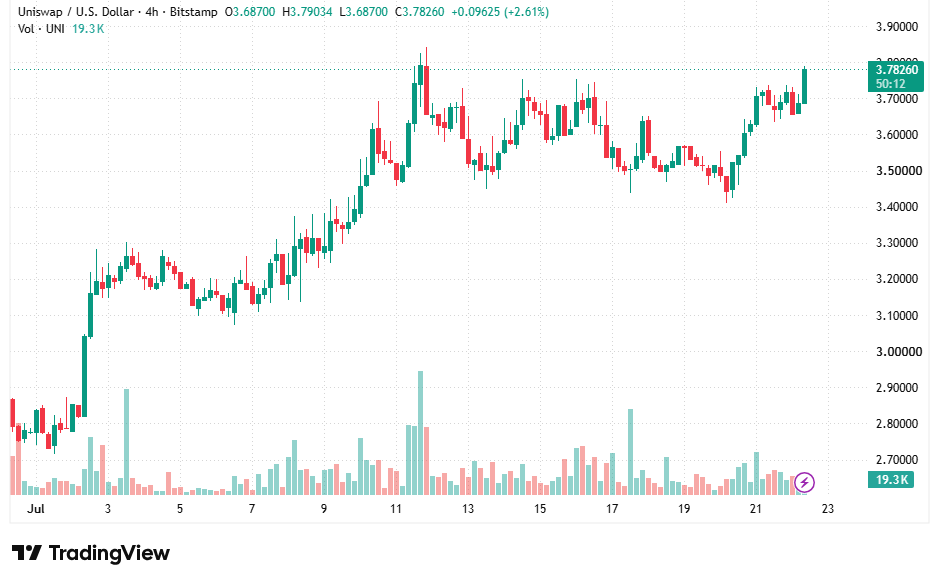
The latest decline in exchange balances also arrives as Uniswap continues expanding its ecosystem. Growing attention around its fee model, ongoing token burn mechanism, Robinhood Chain integration, tokenized asset support, and Spark’s $150 million liquidity migration to Uniswap v4 has strengthened investor interest. Together, these developments reinforce the platform’s position within the decentralized trading landscape.
Whales Add to UNI Positions
Institutional-style accumulation has added another layer of optimism. A wallet that had remained inactive for roughly four years recently accumulated 82,891 UNI, valued at approximately $305,000, through three separate purchases at an average entry price of $3.68 per token.
The timing of this purchase is notable because it occurred during improving market conditions rather than during a prolonged price decline. Such behavior often reflects investor confidence in future network growth instead of short-term speculation.
Still, analysts caution against drawing broad conclusions from a single transaction. Sustainable accumulation is typically confirmed only when multiple long-term holders consistently increase their positions over an extended period. Continued buying from similar wallets would strengthen confidence that UNI is entering a broader accumulation phase.
Key market highlights include:
- 8.4 million UNI exited exchanges in one day.
- A long-term wallet purchased 82,891 UNI worth nearly $305,000.
- Spark continues migrating $150 million in liquidity to Uniswap v4.
- More than 107 million UNI have been burned through protocol activity.
Supply Tightens, Growth Must Follow
Although exchange balances continue to decline, supply reduction alone is unlikely to sustain a price rally without corresponding network growth. Metrics tracking new wallet creation and unique trader participation have moderated compared with earlier periods, suggesting user expansion has slowed despite improving sentiment.
On the other hand, Uniswap’s protocol fundamentals remain constructive. Ongoing fee generation continues supporting the token’s burn mechanism, with more than 107 million UNI permanently removed from circulation. A shrinking token supply can improve scarcity over time, particularly if transaction volumes continue rising.
The next phase for UNI will depend on whether decentralized trading activity keeps expanding alongside lower exchange balances. If additional long-term investors continue accumulating while protocol usage strengthens, the combination of tighter supply, consistent burns, and improving liquidity could support a more durable market trend. However, should exchange inflows resume and trading activity weaken, the recent optimism may prove temporary rather than the beginning of a sustained bullish cycle.
