Silver is testing the $60 area as sellers maintain control of the short-term trend. Spot silver was around $60.60 on October 7, according to Kitco, after briefly falling toward $60.37. The metal remains below several important moving averages, keeping the technical structure weak. The key question is whether buyers can defend $60 or whether a sustained break will expose lower support.
Silver Tests Critical $60 Support
On the five-hour chart, XAG/USD remains trapped between approximately $60.00 and $62.50. The narrow range follows a broader decline and has created a critical decision zone for traders.
Silver is trading below the 50-period simple moving average (SMA) near $62.26 and the 200-period SMA around $65.38 in the supplied setup. The broader market data also confirms that silver remains below major moving averages, reinforcing the negative technical structure.
The $60 level has repeatedly attracted buyers, making it the most important near-term floor. Recent technical analysis has also identified the $60 region as a major support area, with a break potentially opening a path toward $55.
The immediate technical picture remains defined by:
- Primary support: $60.00
- Next downside target: $58.00
- Near resistance: $62.00-$62.50
- Major trend resistance: Around $65.38
Momentum Keeps Silver Under Pressure
The SuperTrend remains bearish near $63.12 in the five-hour setup, while the Ichimoku Cloud between $61.35 and $64.04 leaves price trading below an important resistance region. Together, those signals suggest sellers retain the technical advantage unless silver can reclaim the upper part of the range.
The MACD is becoming less negative, however, indicating that downward momentum may be losing some intensity. A Doji candle around $60.79 also reflects hesitation between buyers and sellers.
The Relative Strength Index (RSI) is another indicator to monitor. A weakening RSI without entering deeply oversold territory would leave room for another decline before stronger buying interest emerges.
The fundamental backdrop is also important. Higher US Treasury yields have pressured precious metals, while markets are waiting for the latest Federal Reserve policy signals. The release of the Fed’s meeting minutes is particularly important because changes in interest-rate expectations can quickly affect non-yielding assets such as silver.
Silver Break Below $60 Could Accelerate
A five-hour close below $60 would represent the clearest bearish signal in the current setup. Because the level has attracted buyers repeatedly, a decisive breakdown accompanied by stronger volume would indicate that demand has failed rather than simply being temporarily tested.
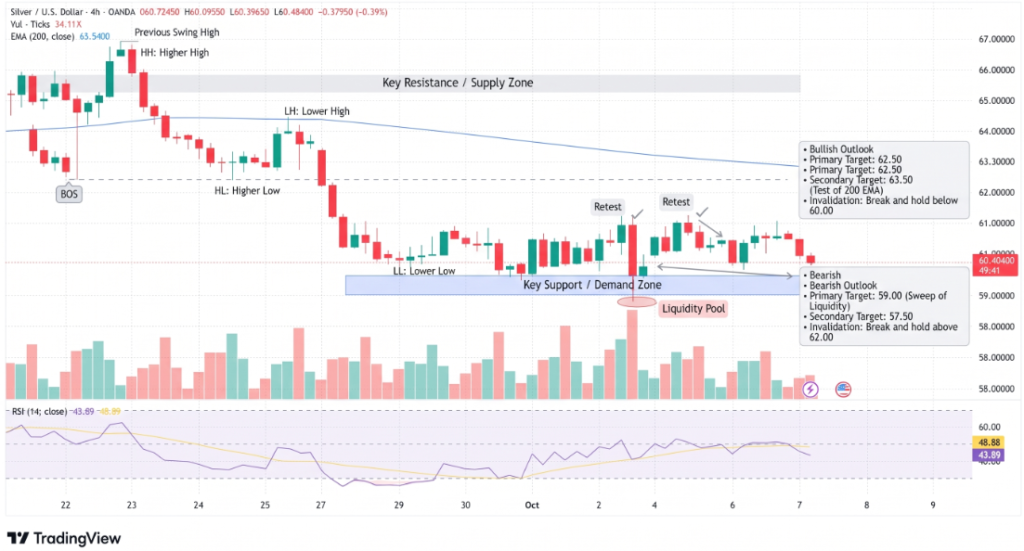
The first downside objective would be around $58.00. If that level also fails, the broader $55 region becomes increasingly relevant, consistent with recent technical forecasts identifying $55 as the next major support below $60.
Conversely, silver would need to reclaim $62.26 to improve the immediate technical picture. A sustained move above $62.50 could then target the $63.12 SuperTrend level and eventually the $65.38 long-term moving average.
Volume will be critical in determining whether either breakout is genuine. Low-volume moves can produce false breaks, while a sharp increase in activity would give greater confirmation of a new directional move.
Conclusion
The Silver Price Forecast remains cautious as XAG/USD holds close to the crucial $60 support zone. A confirmed five-hour break below $60 could expose $58 and potentially the broader $55 support area. Bulls need to recover $62.26-$62.50 before the technical structure begins to improve, with $63.12 and $65.38 representing the next significant hurdles. Until then, silver remains vulnerable to another downside move, particularly if Treasury yields and the US dollar remain firm.
Sources & Methodology
Primary-source standard: Market-moving facts should link to original data releases, regulator notices, company filings or official project announcements whenever available. Secondary reporting is used for additional context, not as a substitute for original evidence.
Page last reviewed: