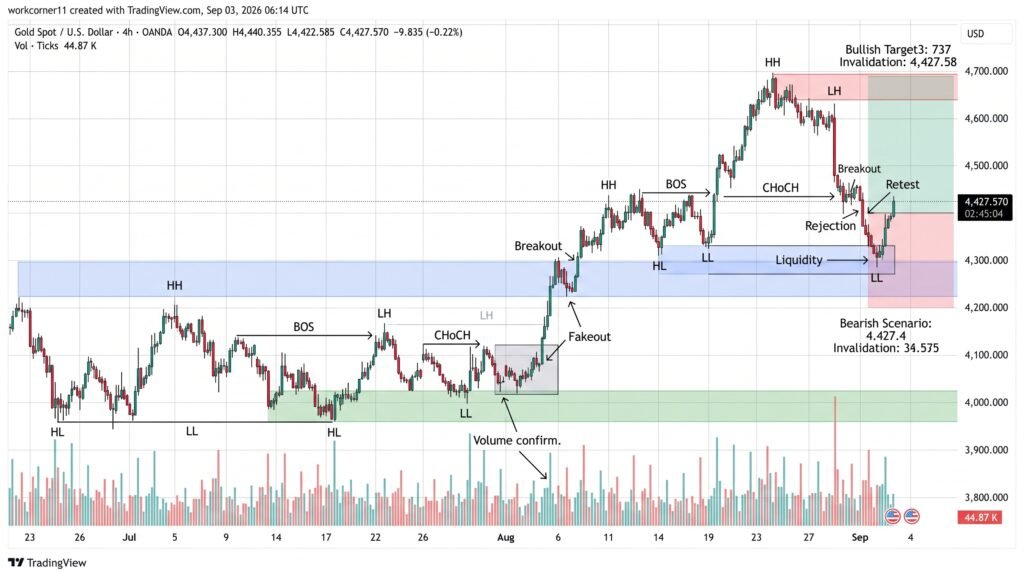
Gold prices held close to $4,400 an ounce on Thursday after rebounding about 1% in the previous session. The recovery came as concerns over energy-driven inflation eased, reducing some of the pressure on the Federal Reserve to maintain a more aggressive interest-rate stance.
Spot gold price / XAU/USD was little changed around $4,384.21 an ounce late Wednesday, while gold futures gained 0.3% to $4,429.21. Silver slipped 0.1% to $65.26 an ounce, while platinum was little changed near $1,760.62. The US Dollar Index stood near 99.57.
Gold’s rebound followed a three-session decline and came as the dollar weakened after a sharp rise in the Japanese yen. A softer U.S. currency tends to support dollar-priced commodities because they become relatively cheaper for international buyers.
The latest move also came ahead of Friday’s U.S. nonfarm payrolls report, which has become a major focus for investors assessing the Federal Reserve’s next policy decision. Reuters reported Thursday that gold climbed more than 1%, with spot prices reaching $4,434.70 as Treasury yields and the dollar eased.
Trump comments ease oil inflation fears
Gold also benefited from changing expectations surrounding the latest U.S.-Iran military escalation. President Donald Trump indicated that the latest strikes against Iran were likely to be short-lived, helping reduce fears of a prolonged conflict and sustained disruption to regional energy supplies.
The comments helped moderate the recent rally in crude oil. Brent remained above $95 a barrel, while U.S. crude traded above $90. Elevated oil prices remain important for financial markets because sustained energy inflation can feed into consumer prices and make monetary policy more restrictive.
For gold, the relationship is particularly significant. The metal does not generate interest income, meaning higher interest rates and Treasury yields can increase the opportunity cost of holding bullion.
- Brent crude remained above $95 a barrel.
- U.S. crude stayed above $90 a barrel.
- Gold recovered more than 1% after three consecutive declining sessions.
A renewed oil surge could therefore create fresh pressure on gold if it strengthens expectations for another Federal Reserve rate increase. Conversely, a sustained moderation in energy prices could reduce inflation concerns and give bullion more room to recover.
Weak jobs data challenges Fed hawks
Federal Reserve Bank of New York President John Williams added to the more balanced inflation outlook. Williams said there were signs that U.S. inflation was continuing to moderate as the effects of tariffs faded. He also indicated that higher energy prices had not yet produced broader inflation across services.
The latest ADP Employment Report provided another softer economic signal. U.S. private employers added just 38,000 jobs in August, below economists’ expectations. July’s increase was revised to 46,000.
The weak hiring figure has increased attention on the official U.S. employment report due Friday. A weaker-than-expected payrolls reading could reduce expectations for a September Fed rate hike and potentially support gold. A stronger report could have the opposite effect by lifting Treasury yields and the dollar.
Markets were pricing roughly a 62% probability of a 25-basis-point Fed rate increase in September, up from about 37% a week earlier.
That leaves gold facing competing monetary-policy signals. Fed Chair Kevin Warsh adopted a more hawkish tone at the Jackson Hole symposium, arguing that inflation remained an important policy concern. His remarks helped push rate-hike expectations higher and contributed to the recent pressure on bullion.
The key drivers for gold now include:
- U.S. jobs: Weak hiring could reduce rate-hike expectations.
- Treasury yields: Lower yields can improve gold’s relative appeal.
- Dollar: Further weakness could support XAU/USD.
- Oil prices: Renewed energy inflation could strengthen the hawkish Fed case.
Conclusion
Gold’s recovery toward $4,400 reflects easing pressure from the dollar, Treasury yields and energy-driven inflation concerns. However, the Federal Reserve remains the key driver for the next major move. Friday’s nonfarm payrolls report could determine whether September rate-hike expectations strengthen or retreat. Weak employment would likely support bullion by reducing pressure for tighter policy, while stronger hiring could lift yields and weigh on gold. For now, investors are balancing softer labor-market signals against persistent inflation and geopolitical risks as gold attempts to establish support around the $4,400 level.
Sources & Methodology
Primary-source standard: Market-moving facts should link to original data releases, regulator notices, company filings or official project announcements whenever available. Secondary reporting is used for additional context, not as a substitute for original evidence.
Page last reviewed: