
Gold is consolidating close to a critical technical floor, with the 5-hour chart showing price around $4,184.15 against support near $4,143. The narrow gap between price and support leaves the market vulnerable to a sharp move if sellers force a decisive break. Recent trading has also kept the broader trend under pressure, with a stronger U.S. dollar and elevated Treasury yields limiting gold’s recovery. Reuters reported spot gold near $4,131.61 earlier Monday as the dollar strengthened.
The immediate battle is between $4,143 support and $4,250 resistance. A break below the lower boundary would strengthen the bearish setup, while a recovery through resistance would challenge the prevailing downtrend.
Gold Holds Near Critical Support
Gold has spent recent sessions consolidating within a broad range between approximately $4,143 and $4,250. The latest 5-hour candle shows a modest recovery toward $4,184.15, but buyers remain close to a technically vulnerable area.
The $4,143 level has become important after repeated tests. Sustained trading above it would keep the consolidation intact, whereas a confirmed breakdown could expose previous swing lows and create room for another leg lower.
The broader market backdrop remains difficult for bullion. The Federal Reserve recently raised its benchmark rate by 25 basis points to 3.75%-4.00%, while the U.S. dollar has strengthened. Higher yields increase the opportunity cost of holding non-yielding gold.
At the same time, weaker U.S. employment data have reduced expectations for an October Fed hike. Reuters reported that markets were pricing only an 18% chance of an October increase, providing some support for gold despite dollar strength.
Bears Target $4,143 Breakdown
The technical setup continues to favor caution. The SuperTrend indicator is positioned around $4,276, well above current price, leaving the dominant trend bearish.
Momentum, however, is no longer accelerating lower. The MACD histogram is mildly positive, while the Relative Strength Index (RSI) stands near 44.06. That RSI reading is below the midpoint but not yet in oversold territory, leaving room for either further selling or a corrective rebound.
Volatility has also contracted. The Average True Range (ATR) is around 0.91% of price, suggesting that the recent consolidation could precede a larger directional move.
- Key support: $4,143
- Immediate resistance: $4,250
- Trend resistance: $4,276
- RSI: 44.06
A decisive 5-hour close below $4,143 would therefore be more significant than a brief intraday dip. It would confirm that sellers have finally overcome the repeated support zone.
$4,250 Break Could Shift Momentum
Bulls still have a path to recovery, but it requires a series of technical improvements. Holding above $4,143 would be the first step, followed by a move back toward $4,250. A sustained break above that ceiling would weaken the immediate bearish structure and bring the $4,276 SuperTrend level into focus.
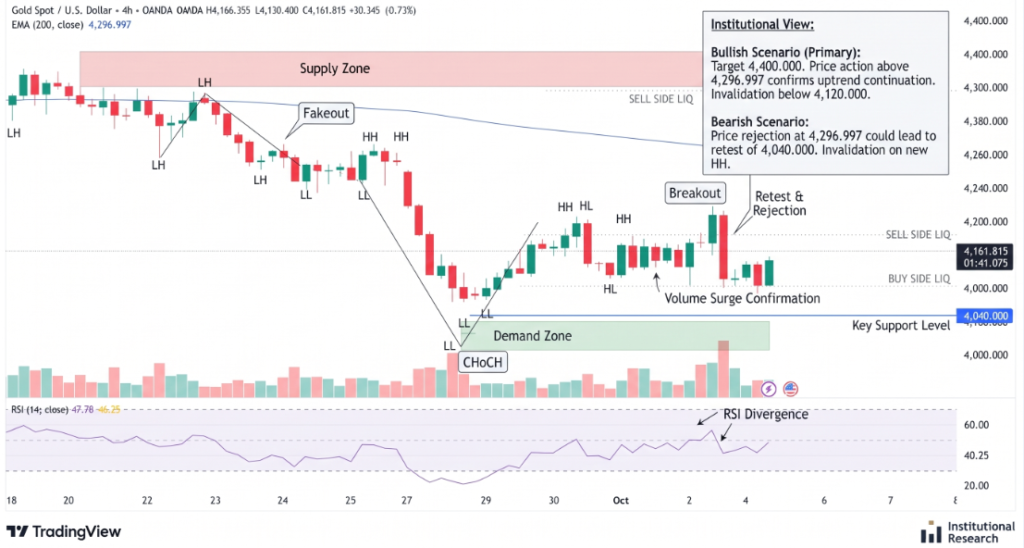
The $4,160 area can also serve as an early recovery checkpoint. If buyers defend that region and build momentum, gold could attempt to retest the upper end of the consolidation range.
A failure to regain $4,250, however, would leave the market vulnerable to another rejection. Traders should also monitor Bollinger Bands, as expanding volatility following the current compression could amplify the next directional move.
Key levels to watch:
- Bearish trigger: Below $4,143
- Recovery level: $4,160
- Range resistance: $4,250
- Bullish confirmation: Above $4,276
Conclusion
Gold remains trapped in a high-risk technical zone near $4,143 support. The broader trend is still bearish, with the SuperTrend at $4,276 and a stronger dollar limiting upside momentum. However, the RSI near 44 and mildly positive MACD histogram show that selling pressure is not accelerating. A confirmed break below $4,143 would strengthen the bearish case, while a recovery through $4,250 and $4,276 would give buyers their first meaningful opportunity to challenge the prevailing downtrend.
Sources & Methodology
Primary-source standard: Market-moving facts should link to original data releases, regulator notices, company filings or official project announcements whenever available. Secondary reporting is used for additional context, not as a substitute for original evidence.
Page last reviewed: