
WTI crude oil is consolidating near $89.81 on the five-hour chart after a sharp retreat from $106.75. The nearly $17 decline has left the U.S. benchmark testing the lower boundary of a developing bear flag, keeping the risk of another breakdown in focus. The setup is occurring against a volatile fundamental backdrop: WTI recently settled near $89.44, while supply concerns tied to Middle East disruptions and shipping risks continue to influence prices.
WTI Bear Flag Tests Key Support
The five-hour structure remains vulnerable as WTI trades below the key moving averages identified in the setup. The 50-period SMA around $91.51 is acting as overhead resistance, while the SuperTrend indicator remains bearish near $93.32.
The bear flag represents a period of consolidation following a steep decline. In this case, the pattern has developed after WTI fell from $106.75, making the $87.19 level the critical trigger for sellers.
A sustained five-hour close below $87.19 would confirm a downside break from the pattern. Traders could then focus on the 61.8% Fibonacci retracement near $84.50, followed by $81.87 and potentially $75.00 if selling pressure accelerates.
The broader oil market remains highly sensitive to supply developments. Reuters reported that WTI rose to around $90 on Wednesday as concerns over Gulf of Mexico weather and escalating Houthi attacks added fresh supply-risk premiums.
WTI Momentum Signals Mixed
Momentum readings provide a less decisive picture. The MACD has turned bullish but remains below the zero line, suggesting that the recent improvement has not yet established a broader upside trend.
The Relative Strength Index (RSI) near 48.4 is close to neutral. That leaves room for either a technical rebound or another wave of selling, depending on how price responds around support.
Trading volume is another important variable. Declining volume during consolidation can signal that traders are waiting for a catalyst before committing to a larger position. A sharp expansion in volume alongside a break of $87.19 would therefore carry greater technical significance.
Current levels to monitor include:
- Support: $87.00-$88.76
- Resistance: $91.50-$93.32
- Bullish invalidation trigger: Above $93.50
- Key downside target: $84.50
WTI Bulls Need $93.50
For buyers to regain control of the five-hour structure, WTI would need to recover the $91.50-$93.32 resistance band and then secure a five-hour close above $93.50. Such a move would invalidate the immediate bear-flag breakdown scenario and shift attention toward higher resistance.
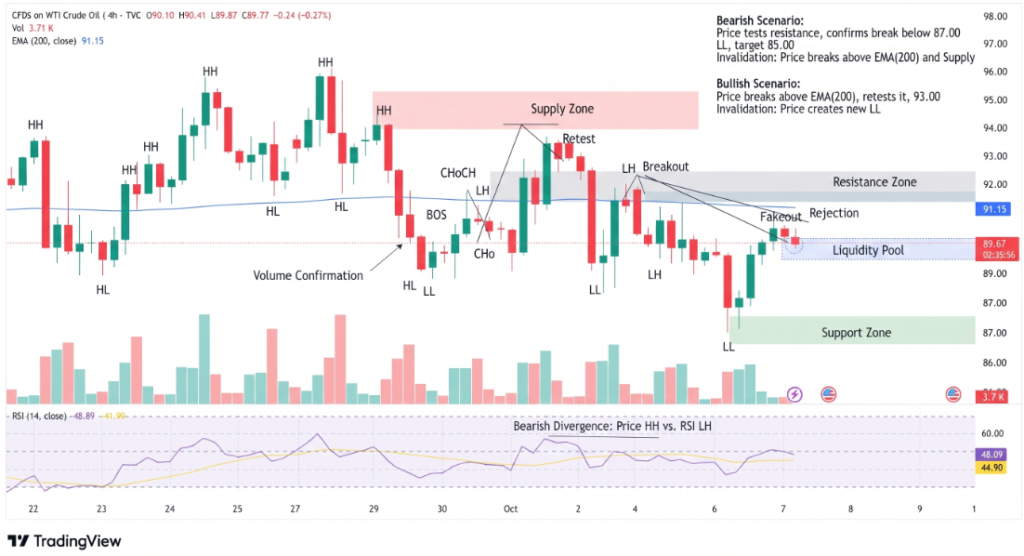
The $88.76 level is particularly important because it represents the 50% Fibonacci retracement in the current setup. A rebound from that zone could produce a false breakdown, especially if volume remains weak.
However, a sustained move below $87.19 would materially strengthen the bearish case. The next technical objective would be $84.50, with $81.87 and $75.00 becoming relevant if the decline develops into a larger correction.
Fundamentals could also determine whether technical support holds. OPEC+ agreed to keep November production targets unchanged, while improving Middle Eastern export flows have eased some supply pressure. At the same time, geopolitical risks around the Strait of Hormuz and Red Sea remain capable of producing sharp price swings.
Conclusion
The WTI crude oil price forecast remains technically fragile near $89.81. The five-hour bear flag keeps $87.19 as the decisive downside trigger, with $84.50 emerging as the first major target below support. A recovery above $91.50 would ease immediate selling pressure, but bulls need a sustained move above $93.50 to invalidate the bearish setup. Until then, WTI remains caught between weakening technical momentum and persistent geopolitical supply risks.
Sources & Methodology
Primary-source standard: Market-moving facts should link to original data releases, regulator notices, company filings or official project announcements whenever available. Secondary reporting is used for additional context, not as a substitute for original evidence.
Page last reviewed: