Quick Answer
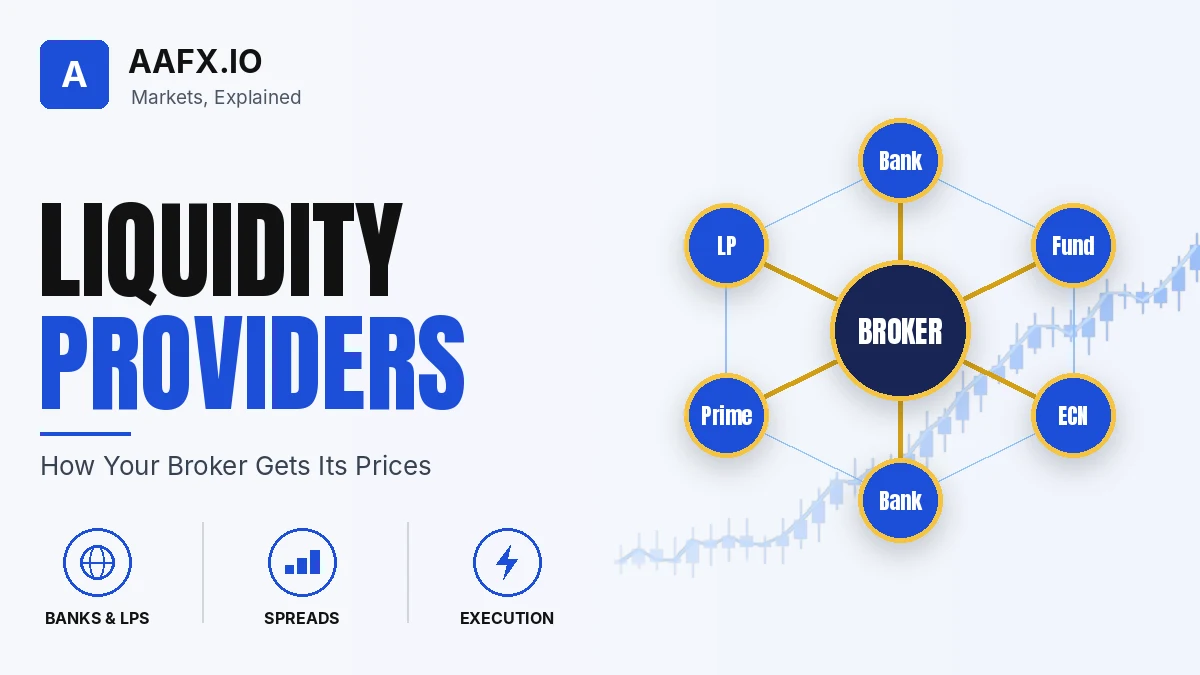
Liquidity providers (LPs) are the banks, non-bank market makers and electronic trading venues that continuously quote buy and sell prices in the forex market. Retail brokers connect to one or more of them to source the prices you see on your platform and, in agency models, to fill your orders. The number and quality of a broker’s liquidity providers affect how tight spreads are, how often you get slippage and how stable pricing stays during news. You never deal with an LP directly as a retail trader, but they shape every quote you trade on.
When readers ask why two brokers show different prices for EUR/USD at the same second, the honest answer usually starts with liquidity. Each broker builds its quotes from its own set of liquidity providers, adds its own markup and applies its own execution rules. Understanding who those providers are, and how pricing flows from them to your screen, makes broker marketing much easier to see through.
This guide explains what liquidity providers are, the main types, how a broker turns their quotes into your price, and what that means for your trading costs. It builds on our comparison of market makers vs ECN brokers.
What Is a Liquidity Provider in Forex?
A liquidity provider is a firm that stands ready to buy or sell a currency pair at quoted prices, in size, throughout the trading day. By doing so it makes the market liquid: other participants can trade without waiting for a natural buyer or seller to appear.
The forex market is enormous. The Bank for International Settlements reported average daily turnover of $9.6tn in April 2025, with sales desks in the UK, US, Singapore and Hong Kong accounting for 75% of trading and the UK alone for 38%. Most of that volume runs through a relatively small group of large dealers and electronic market makers, who act as the wholesale layer of the market. Retail brokers sit one or two layers further out.
Types of Liquidity Providers
Not all liquidity is the same. Brokers typically combine several of the following sources.
| Type | Who they are | What they bring | Watch-outs |
|---|---|---|---|
| Tier-one banks | Large global dealing banks | Deep liquidity, reliable pricing in size | Usually require large volumes and strong credit; often accessed indirectly |
| Non-bank market makers | Specialist electronic trading firms | Very tight, fast streaming prices | Can widen or pull quotes quickly in volatile moments |
| Prime brokers and prime-of-prime firms | Firms that give smaller brokers access to bank and non-bank liquidity under one credit line | Access for brokers that cannot meet bank requirements directly | Adds an intermediary layer and its own costs |
| Electronic communication networks (ECNs) and venues | Platforms that match orders between many participants | Price transparency and depth of market | Liquidity shown can be thin away from peak hours |
| The broker’s own book | Client orders offset internally | Lower costs when buyers and sellers net out | Creates a conflict of interest if the broker keeps client risk |
How Your Broker Builds the Price You See
Every quote on your platform goes through a short chain before it reaches you. The diagram below shows a typical agency-style setup.
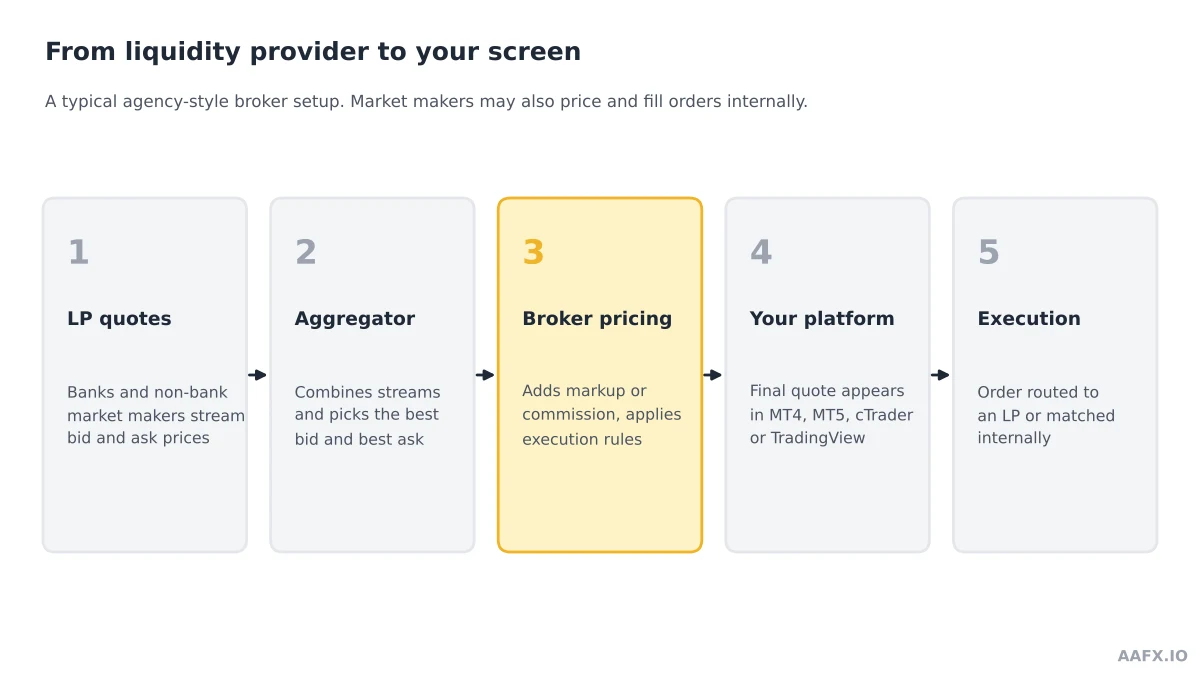
First, several liquidity providers stream bid and ask prices to the broker. An aggregator combines those streams and picks the best available bid and the best available ask at each moment. The broker then applies its pricing model: on a raw spread account that may mean passing the price through with a commission, while on a standard account it usually means adding a markup to the spread. Finally, the price is published to your platform, and when you trade, the order is routed back to a provider or matched internally depending on the broker’s model.
This is why two brokers can show slightly different prices for the same pair at the same moment. Different providers, different aggregation logic and different markups all produce different final quotes.
Why Liquidity Providers Matter to Retail Traders
Spreads
More competing quotes generally mean a tighter best bid and best ask. A broker connected to several strong providers can usually offer lower raw spreads than one relying on a single source.
Slippage and fills
When you place a market order, it is filled at the best available price for your size. If the quoted size at the top of the book is small or disappears as prices move, part of your order may fill at a worse level. That is slippage, and its frequency depends heavily on the depth of the broker’s liquidity.
News and illiquid hours
Liquidity providers widen their spreads or reduce the size they quote around major data releases and during quiet periods such as the hour around the daily rollover. That is not necessarily the broker manipulating prices; it is the wholesale market pulling back. We explain how this creates real losses in our guide to forex trading risks.
Requotes and rejections
If prices move between the moment you click and the moment the order reaches a provider, the order may be rejected or requoted, especially on platforms that do not allow automatic slippage. How a broker handles these situations should be described in its execution policy.
Liquidity Providers vs Market Makers: What Is the Difference?
The terms overlap. Every liquidity provider is, in a sense, a market maker: it quotes two-way prices and takes the other side of trades. In retail forex, though, “market maker” usually refers to the broker acting as counterparty to its own clients, while “liquidity provider” refers to the wholesale firms that stand behind the broker. A broker can be a market maker to you and, at the same time, a client of several liquidity providers that it uses to hedge.
What Is Last Look?
Some liquidity providers apply a practice known as last look: a short window after receiving an order in which the provider can accept or reject it at the quoted price. Providers argue it protects them from being picked off by faster traders when prices are stale. Critics argue it can be used unfairly, for example by rejecting orders only when the market has moved in the client’s favour. The industry’s FX Global Code includes principles on how last look should be applied and disclosed. As a retail trader, you will not see last look directly, but it is one of the reasons orders can be rejected in fast markets.
How to Judge a Broker’s Liquidity
Brokers rarely publish full details of their liquidity setup, but you can still learn a lot:
- Read the order execution policy and look for whether the firm acts as principal or routes orders to third parties.
- Check whether the platform shows depth of market with multiple price levels and sizes.
- Compare typical spreads during the London and New York overlap and during quieter hours.
- Test fills on a small live account around a scheduled release and compare requested and executed prices.
- Be cautious of claims of “tier-one bank liquidity” with no further detail, especially from brokers registered offshore. Our guide to offshore brokers covers this in more detail.
These checks fit into the wider process in our guide on how to choose the right broker, where execution quality is one of the ten core checks. You can also learn how brokers make money from the spread between what they pay liquidity providers and what they charge you.
My View: Liquidity Is Invisible Until It Disappears
My view is that most traders only think about liquidity when it fails them: a stop filled far beyond its level, a spread that jumps tenfold on a data release, an order rejected at the worst moment. A broker’s liquidity setup matters most in exactly those moments, which is why I give more weight to how a broker behaves around news than to its headline spread at a quiet hour. What would change my view of a broker’s liquidity claims is evidence: published execution statistics, visible depth of market and consistent fills during volatile sessions. Without that, “deep liquidity” is just a marketing phrase.
Frequently Asked Questions
What does a liquidity provider do in forex?
A liquidity provider continuously quotes buy and sell prices for currency pairs and stands ready to trade at those prices. Brokers use these quotes to build the prices shown to retail traders and, in agency models, to fill client orders.
Who are the main liquidity providers in forex?
The main sources are large dealing banks, non-bank electronic market makers, prime brokers that provide access to them, and electronic trading venues. Retail brokers usually access them through aggregation technology or a prime-of-prime intermediary.
Why do different brokers show different prices?
Each broker uses its own mix of liquidity providers, its own aggregation logic and its own markup or commission, so the final bid and ask can differ slightly between brokers at the same moment.
Do liquidity providers affect spreads?
Yes. More competing quotes from strong providers usually mean tighter spreads and deeper liquidity. Spreads still widen when providers pull back, such as around major news or during quiet hours.
Can retail traders access liquidity providers directly?
Generally no. Direct relationships with banks and major non-bank market makers require large volumes and institutional credit arrangements. Retail traders access their liquidity indirectly through a broker.
What is last look in forex?
Last look is a short window in which some liquidity providers can accept or reject an order at the quoted price after receiving it. It can lead to rejected orders in fast markets and is covered by principles in the FX Global Code.
Risk warning: Trading forex and CFDs on margin carries a high level of risk and may not be suitable for all investors. You can lose some or all of your capital. This guide is for educational purposes only and is not investment advice.
Sources & Methodology
Primary-source standard: Market-moving facts should link to original data releases, regulator notices, company filings or official project announcements whenever available. Secondary reporting is used for additional context, not as a substitute for original evidence.
Page last reviewed: