Learning how to trade stocks starts with understanding the share, the account and the possible loss before submitting an order. Verify the provider, research the business, calculate costs and position size, and check execution afterward. Tesla, Nvidia and Apple are research examples rather than current trade recommendations.
This guide follows a cash-share workflow and complements the AAFX.IO trading foundations pillar. A stock CFD, margin purchase or borrowed-share short has different terms, even when the company ticker is identical.
Risk warning: Shares can lose substantial value, prices can gap and orders may execute differently from your plan. Borrowing and derivatives add further risks. Hypothetical examples explain arithmetic and do not suggest a suitable position size.
Affiliate disclosure: AAFX.IO may earn a commission through links on this page. This does not change our editorial conclusions.
How do beginners trade stocks?
Begin with the account and product: verify the provider, confirm whether you are buying actual shares and read the costs and order terms. Research the company, write a testable thesis and calculate position size before submitting an order. Check the actual execution afterward. A familiar company name is a research starting point rather than a recommendation.
Are Tesla, Nvidia and Apple automatically good trades?
No. A well-known business can still be overpriced, face changing expectations or experience a sharp share-price decline. Use Tesla, Nvidia and Apple to practise reading official filings and identifying different business drivers. The trade also depends on entry price, holding period, costs and position size. This guide provides a research workflow rather than current buy recommendations.
Stock Trading: Overview
- First decide: actual shares, CFDs or another contract
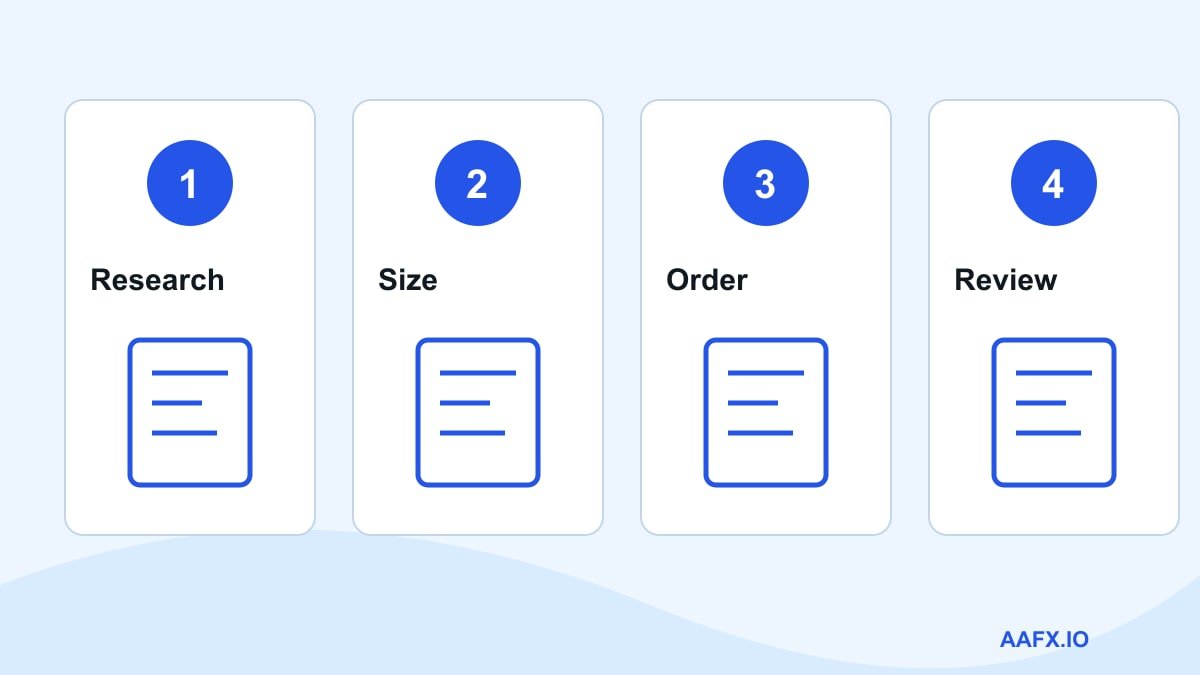
- How to trade stocks in six practical steps
- Tesla, Nvidia and Apple: different research questions
- A hypothetical stock trade: costs and gap risk
- Calculate total costs in the account currency
- Common beginner mistakes to recognise early
- Who should pause before placing a live stock order
- AAFX.IO: use a repeatable stock-research workflow
First decide: actual shares, CFDs or another contract
Actual shares represent an ownership interest in a company. A stock CFD is a contract linked to a share price; it does not make you a shareholder. Options and other derivatives have additional terms, such as an expiry date or exercise price. Similar tickers and charts do not mean identical rights or risks.
Read the instrument description before funding an account. Check the issuer, ticker, exchange, currency and product type. For fractional shares, inspect available order types, transfer restrictions and how the broker handles corporate actions. Our CFD versus stock trading guide explains the main ownership and financing differences.
A cash account ordinarily requires payment for the shares you buy; a margin account can involve borrowing. Borrowing adds interest and the possibility of forced liquidation. The SEC’s margin-account bulletin explains why losses can exceed the amount originally committed in a margin account. This article’s numerical example assumes no borrowing.
How to trade stocks in six practical steps
1. Check the broker and account terms
Identify the legal entity that will hold the account, its permissions for your country and the services it provides. Check custody, execution arrangements, account currency, withdrawal conditions and the complaint process. A brand’s overseas licence does not by itself prove that your account receives the same protections.
Compare the full cost rather than only advertised commission. Spreads, currency conversion, custody charges and transaction-related taxes may matter. If you borrow or sell short, additional financing or stock-borrow costs can apply. Use the broker-selection checklist and broker-fee guide before choosing.
2. Research the business and the upcoming event calendar
Start with the company’s annual report, latest quarterly filing and earnings materials. Separate reported results from management’s forecasts. Look at revenue, profitability, cash generation, debt, dilution and material risks together. A rising revenue number can coexist with deteriorating cash flow or a stretched valuation.
The SEC’s EDGAR research guide explains where filings can be found. A 10-K provides annual information; a 10-Q updates quarterly results and disclosures. Check the reporting period carefully because a company’s fiscal year may differ from the calendar year.
Record the next confirmed earnings event and other material announcements. Do not assume yesterday’s news is still a fresh catalyst. The market’s reaction depends on the difference between the announcement and expectations, not simply whether the headline sounds positive.
3. Write a trade thesis and invalidation condition
A useful thesis is specific enough to test. “I like the product” is not a trading plan. A more useful research question is whether margins, demand or cash flow are improving enough to justify the valuation, and which evidence would disprove that view.
Keep a trading thesis separate from a long-term ownership thesis. An earnings trade measured in days and an investment measured in years need different monitoring and exit rules. Our trading versus investing guide helps distinguish the two. Avoid turning a failed short-term trade into an indefinite holding simply because selling would recognise a loss.
4. Calculate position size before placing the order
Determine the amount of capital exposed and the loss implied by the planned exit. A stop price is not a guarantee: a stock can gap through it, particularly around news or between sessions. Size the position with that possibility in mind, and check the combined exposure of all holdings.
The position-sizing guide develops this calculation. A percentage rule copied from another trader may be unsuitable for your circumstances. Essential savings and near-term spending money should not be treated as a trading budget.
5. Choose and review the order
A market order prioritises execution but does not guarantee price. A limit order sets a price boundary but may remain unfilled. Stop and stop-limit orders have different behaviour after their trigger is reached. The SEC order-types bulletin explains these distinctions.
Before submission, review the ticker, buy or sell direction, quantity, account, order type, limit or stop price, time in force and session eligibility. Extended-hours trading can have different conditions and liquidity. Confirm the broker’s terms rather than assuming every order works in every session.
6. Check execution and keep a record
An accepted order is not necessarily a completed trade. Check the actual fill price, quantity, fees and any remaining open order. Partial fills can leave part of the order active. Keep the confirmation and record why the position was entered, what would change the thesis and when it will be reviewed.
After the exit, compare the result with the original plan. Distinguish a sound decision that lost money from an unplanned gamble that happened to win. A journal is useful only when it records mistakes and costs as well as favourable outcomes.
Tesla, Nvidia and Apple: different research questions
The following checklist is a research framework, not a ranking or forecast. Use current official filings to answer the questions each time. It avoids fixed price targets and quarterly figures that would quickly become stale.
| Company | Questions to investigate | Primary starting point |
|---|---|---|
| Tesla (TSLA) | How do production and deliveries translate into revenue, margins and cash flow? What assumptions about new products or services are already embedded in expectations? Which disclosed risks could delay them? | Tesla investor relations: quarterly disclosures, shareholder materials and SEC filings |
| Nvidia (NVDA) | Which business segments drive growth? How do product transitions, supply availability and customer spending affect margins and cash generation? What concentration or regulatory risks does the company disclose? | Nvidia investor relations: financial reports, results and filings |
| Apple (AAPL) | How do product and services results interact? Are margins and cash flows consistent with the investment thesis? What do geographic exposure, competition and capital-return decisions imply for valuation? | Apple investor relations: financial data, earnings reports and filings |
A favourable answer to one question is not sufficient. For example, faster sales may be less valuable if the company needs disproportionately more capital to generate them. A buyback may reduce share count without proving that the purchase price was attractive. Read the financial statements and risk factors alongside promotional presentations.
Owning all three companies also does not establish broad diversification. Holdings can share sensitivity to growth expectations, interest rates, investor sentiment and index flows. Look beyond ticker count to the underlying exposures and how they could behave during the same adverse event.
Use the research questions consistently. Write down the reporting period, source document and evidence that supports or contradicts the thesis. Keep a management target separate from a reported outcome. A useful comparison asks what changed and what the current share price already assumes, rather than selecting only the strongest-looking number from each company.
A chart can help describe price behaviour, but it does not establish the value of the business. Combine the company evidence with an explicit time horizon and an exit plan. Technical terms such as support describe observations about prices; they should not be presented as guarantees that a future order will execute at that level.
For a hypothetical valuation check, assume a company earns $5 per share and its share price is $100. The price-to-earnings ratio is $100 divided by $5, or 20. If the earnings estimate changes, the ratio changes even without a price move. This arithmetic describes an assumption; it does not establish a fair value or compare companies with different accounting and business risks.
A hypothetical two-for-one split would turn 10 shares at $100 into 20 shares at $50, ignoring other price changes. Both positions are worth $1,000. The lower nominal price has not made the business cheaper. Check corporate-action notices so a mechanical change in share count is not mistaken for an economic gain or loss.
A hypothetical stock trade: costs and gap risk
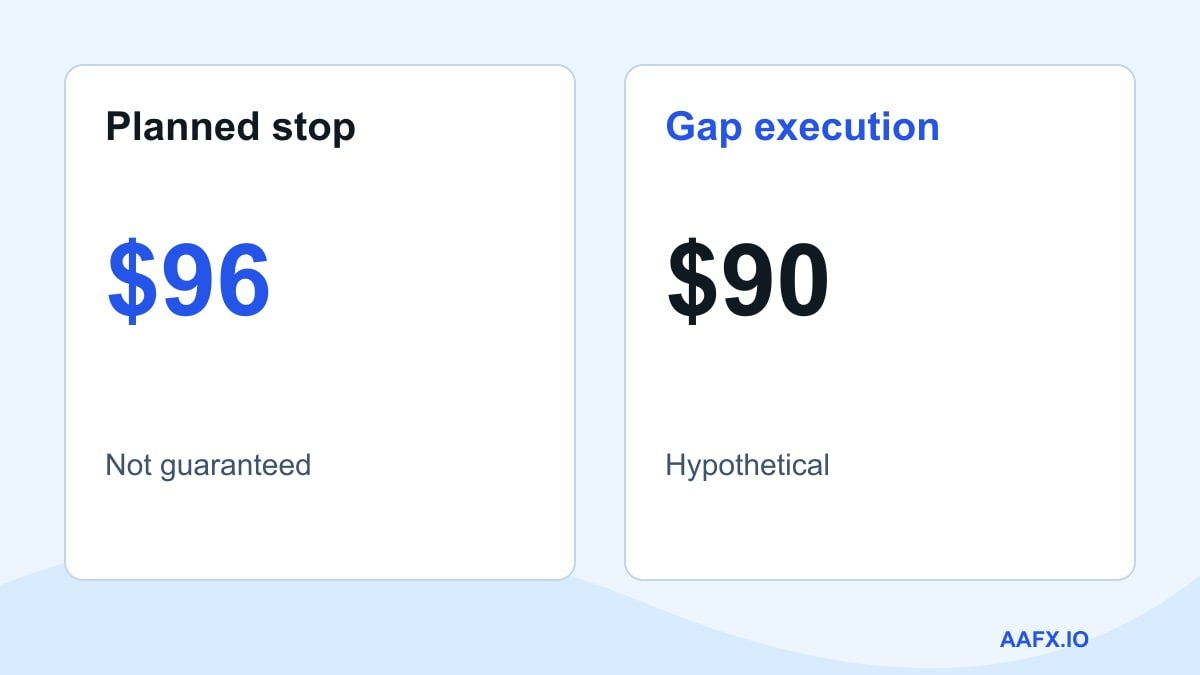
Assume an unnamed stock trades at $100. A hypothetical trader buys 10 shares with cash, committing $1,000 before fees. The planned exit if the thesis fails is $96, implying $40 of price risk: 10 × ($100 − $96). This is a calculation example, not a suggested risk allocation.
| Exit scenario | Gross result | Result after $6 total costs |
|---|---|---|
| Sell 10 shares at $108 | +$80 | +$74 |
| Sell 10 shares at $96 | −$40 | −$46 |
| Gap lower; sell at $90 | −$100 | −$106 |
The gap scenario shows why intended risk and realised loss differ. A standard stop order at $96 would not guarantee a $96 sale. A stop-limit order could avoid an execution below its limit but might leave the position unsold. Taxes, dividends and currency conversion are excluded from these examples.
If the account’s home currency differs from the share’s trading currency, exchange-rate changes can also affect the translated return. Record the conversion cost and the method used by the broker. Do not compare a dollar gain with a home-currency deposit without accounting for the conversion.
Calculate total costs in the account currency
Build a cost estimate in the account currency before comparing trades. Start with the expected spread and any commission, then add relevant conversion, custody or transaction charges. Record which charges are fixed and which depend on position value or holding period. The fee schedule for your own account is more useful than an advertisement for a different account type.
The hypothetical $6 round-trip charge in the example is an assumption, not a provider quote. If the trade remains open longer or needs another currency conversion, the realised costs may differ. Keep estimated and actual costs in separate journal fields so an unexpected charge is not silently treated as a change in the share price.
Common beginner mistakes to recognise early
- Buying a story without checking price: a popular product or exciting industry does not establish an attractive valuation.
- Confusing company quality with trade timing: even a strong business can suffer a sharp share-price decline.
- Using leverage to compensate for a small budget: leverage changes the loss profile and can force an exit before a thesis has time to play out.
- Ignoring earnings gaps: an event can move prices beyond the planned stop before an order executes.
- Measuring performance before costs: repeated small gains can disappear after trading and conversion charges.
- Overtrading correlated positions: several well-known stocks can still create one concentrated market bet.
Keep the event record specific: what was announced, which period it covered and when the information became public. Then compare the announcement with the expectation behind the original thesis. This prevents a later headline from being used to rewrite the reasons for entry. A journal should preserve the decision as it was made, including uncertainty.
Who should pause before placing a live stock order
Pause if the product description is unclear, the provider identity cannot be verified or a plausible loss would interfere with essential spending. A small starting budget does not justify adding borrowing merely to make the position look meaningful. Learning the workflow without submitting a live order can reveal gaps in understanding before money is exposed.
Also pause when the event calendar or research burden does not fit your available time. Our trading-styles guide explains differences in monitoring demands. A process that requires checking company news while you are unavailable may be impractical even if the business itself is familiar. Choose the level of participation only after understanding that constraint.
AAFX.IO: use a repeatable stock-research workflow
The workflow begins with the instrument and ends with a record of the actual trade. Between those points, connect the company evidence, price, position size and possible loss. Tesla, Nvidia and Apple illustrate different research questions; none provides a shortcut around the account and risk checks.
Return to the AAFX.IO trading foundations pillar and the linked guides on costs, products and position sizing. Educational videos are available on TikTok and Instagram. Review this workflow annually and after material changes to market access or account rules.
A stop-loss is a trigger, not a guaranteed fill. The SEC stop-order bulletin explains how a stop order changes after triggering.
Affiliate disclosure: Commercial links may generate compensation for AAFX.IO. No company mentioned is an automatic recommendation, and no trading outcome is guaranteed.
Educational disclaimer: General information only, not personal investment or legal advice. Check current disclosures and your own circumstances before making a decision.
Written and reviewed by Arslan Ali Butt
MPhil Behavioural Finance, MBA Finance, 10+ years in forex dealing and analysis.
Last reviewed: 28 October 2026.
How we reviewed this guide: We checked SEC margin, order and EDGAR guidance and the official investor-relations source pages for Tesla, Nvidia and Apple on 28 October 2026. Examples use hypothetical prices and charges. No live share-price forecast or provider-account test is claimed.
Frequently Asked Questions
Can a beginner buy Tesla, Nvidia or Apple shares?
Access depends on the provider, country, account eligibility and product offered. Availability alone does not establish suitability. Confirm the ticker and whether the instrument is an actual share, a fractional interest or a derivative. Then understand the costs, custody terms and possible loss. Being familiar with a company or its products is not enough to understand the account or trade.
Do I need to purchase a whole share?
Some brokers offer fractional shares while others require whole-share quantities. Read the specific execution, transfer, voting and corporate-action terms before assuming the arrangements are identical. A smaller unit can change how much cash is needed, but it does not remove company or market risk. Check how orders are handled and how the position could be transferred or closed.
Does a lower share price mean a cheaper company?
No. A share price needs to be considered with the number of shares and information about earnings, cash flow, assets and other valuation factors. A stock split changes the share count and price mechanically without itself creating business value. Compare valuation assumptions and the underlying business rather than treating a low nominal price as evidence that a stock is inexpensive.
Should I trade immediately before an earnings release?
An earnings event can move a stock sharply in either direction, including beyond a planned exit price. Even a favourable headline may disappoint expectations already reflected in the price. Decide whether the event belongs in your plan and whether the gap scenario is acceptable. There is no requirement to hold a position merely because an announcement is approaching.
Can a stock trade lose more than the initial deposit?
A fully paid long cash-share position can lose its purchase value plus relevant charges. Margin borrowing, short selling and derivatives have different loss profiles and can create obligations beyond an initial deposit. Establish which product and account you are using. Do not apply the cash-share example to a leveraged position simply because the same company ticker appears on screen.
Does a stop-loss guarantee the sale price?
No. A standard stop order becomes a market order when triggered, so the execution price may differ from the stop price. A price gap can make that difference material. A stop-limit order imposes a price boundary after triggering but might remain unfilled. Read the provider rules and include an adverse execution scenario when deciding how many shares to hold.
Where should I research company information?
Start with official annual and quarterly filings and the investor-relations materials published by the company. Check the reporting period, distinguish reported results from forecasts and read the risk factors alongside financial statements. SEC EDGAR provides a way to locate public filings. A presentation or social-media discussion can suggest questions, but it should not replace the underlying disclosures used to investigate them.
Does owning three famous companies provide diversification?
Not necessarily. Different tickers can share exposure to growth expectations, interest rates, investor sentiment and other market forces. Examine how the positions could lose money during the same event rather than counting names alone. Company-specific risks also remain. A portfolio review needs position sizes and underlying exposures, not just a list of brands that seem familiar or operate different businesses.
Are commission-free trades free of all costs?
No. Depending on the account and market, relevant costs may include the spread, currency conversion, custody charges, taxes, financing or stock-borrow fees. Check the schedule for the exact product and holding period. Calculate an illustrative round trip instead of comparing advertised commission alone. The numerical charges in this guide are hypothetical and do not represent a current provider quote.
How often should I review a stock-trading plan?
Set a review schedule that fits the intended holding period, and reassess when material new information changes the thesis or the account terms. Record what would invalidate the original reasoning before entry. Avoid changing a short-term trade into an indefinite investment merely to avoid recognising a loss. The evergreen workflow can be reviewed annually, while an actual position may require much more frequent monitoring.
Sources & Methodology
Primary-source standard: Market-moving facts should link to original data releases, regulator notices, company filings or official project announcements whenever available. Secondary reporting is used for additional context, not as a substitute for original evidence.
Page last reviewed: