Knowing how to check if a broker is regulated starts with the legal entity in your account agreement. Match that company to the relevant official register, inspect the current status and permitted activity, then compare its website and contacts independently. A licence number alone does not authenticate a website or salesperson.
This verification guide complements the AAFX.IO broker-selection pillar. It explains how to gather evidence, not how to rank providers or certify an individual broker.
Risk warning: Regulation does not guarantee returns or prevent ordinary trading losses. Provider protections and complaint routes depend on the actual entity and account terms. Resolve identity and permission discrepancies before sending money or personal documents.
Affiliate disclosure: AAFX.IO may earn a commission through links on this page. This does not change our editorial conclusions.
How do I check if a broker is regulated?
Read the legal entity named in the account agreement, then locate it through the relevant regulator’s official website. Check current status, permitted activities and restrictions. Compare the domain and contact details independently. A matching licence number helps identify a record, but it does not authenticate every website or person using that number.
Does a broker licence guarantee my money is safe?
No. A licence establishes a particular regulatory status and scope, not a guaranteed return or immunity from loss. Protections depend on the entity, product, jurisdiction and customer classification. Verify the account actually offered, then inspect custody, complaint routes and relevant scheme eligibility. Ordinary market losses can remain even when a provider is properly authorised.
Broker Licence Checks: Overview
- Identify the contracting entity before checking a licence
- Reach the appropriate official register independently
- Check current status, permissions and restrictions
- Detect clone websites and identity mismatches
- Understand the limits of regulatory protection
- Check warnings and keep a reproducible evidence record
- When to pause onboarding or avoid a provider
- AAFX.IO: verify identity before comparing the service
Identify the contracting entity before checking a licence
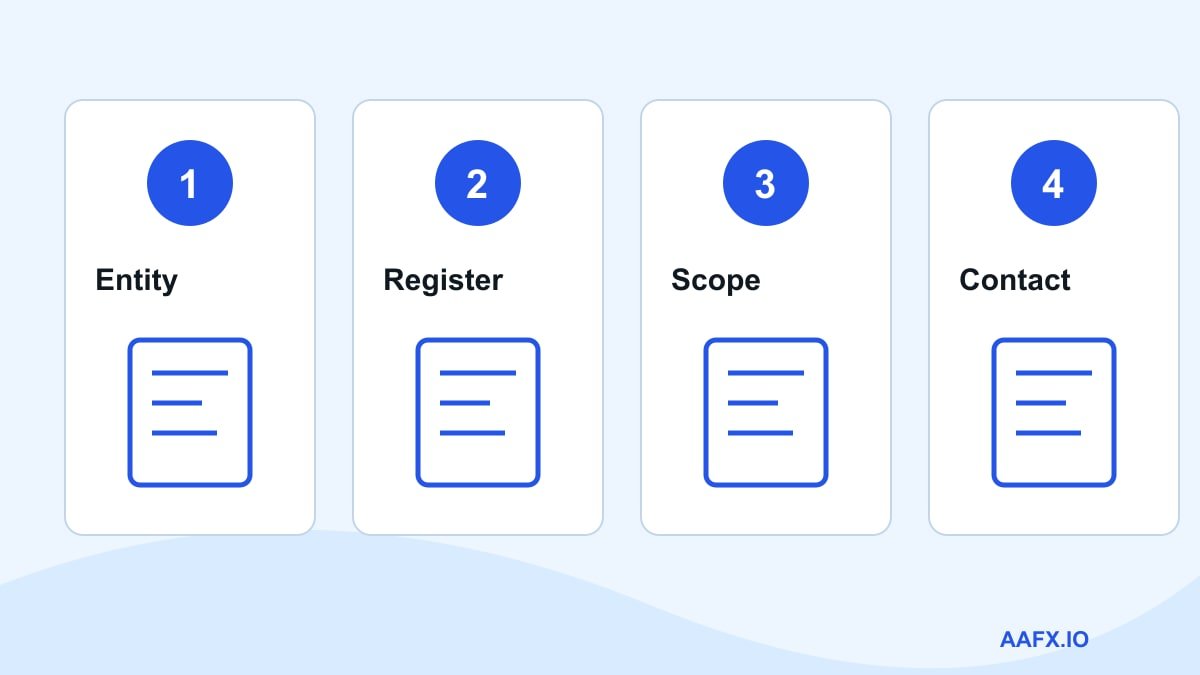
Start with the proposed client agreement and account-opening disclosures. Record the full legal name, registration or licence number, jurisdiction and website domain. A brand can operate through several companies. The entity serving a customer in one country may differ from the entity serving someone elsewhere.
Do not assume that a licence displayed on a group’s homepage applies to your contract. If the agreement names Company B but the advertised licence belongs to Company A, resolve that difference before proceeding. A shared logo or similar company name does not establish that the same permissions and protections apply.
Write the entity information down before searching. Include the legal name exactly as stated, any licence identifier, the account jurisdiction and the product being offered. If different documents name different companies, record that conflict. Resolving it is part of the verification work, rather than a minor detail to postpone until after funding.
A multi-country group can use similar websites while issuing different contracts. Check the document associated with your own application, not an agreement downloaded for another region. If a customer-service agent proposes changing the entity, repeat the checks for the replacement. The brand’s overall reputation cannot determine the legal terms of that new relationship.
Reach the appropriate official register independently
Use the regulator’s own website to reach its search tool. Avoid relying solely on a link sent by a salesperson, an advertising result or a screenshot. Record the official result’s address and the date you checked it so you can return to the same evidence.
| Jurisdiction or market | Official starting point | What to inspect |
|---|---|---|
| United Kingdom | FCA authorisation-checking guidance | Firm identity, current status, permissions and contact details |
| Australia | ASIC Professional Registers Search | Correct register, licence holder or representative, status and relevant authorisations |
| US futures and retail forex | CFTC registration-checking guidance and NFA BASIC | Registration category, membership information and background records |
This table is not a complete global directory. The appropriate register depends on the service, product, legal entity and customer’s location. For background on these distinctions, read the financial regulators guide.
Navigate from the regulator’s official homepage to the register rather than trusting a search advertisement. Check the address carefully and save the official result. Some authorities provide several search tools for different products or entity types. Follow their instructions about which tool fits the service you are checking.
The table gives starting points rather than a global approval list. A provider appearing in one database may still require other permissions for another activity. If the product crosses regulatory boundaries, establish which authorities and records are relevant. Our CySEC guide and ASIC guide explain additional jurisdictional context.
Check current status, permissions and restrictions
A matching company name is a starting point. Inspect whether its status is current and whether its permissions cover the service being offered. Read restrictions, requirements and any relevant notices. If the record refers to a representative, establish the principal and the scope of that relationship rather than assuming a separate full licence.
The FCA explains when to use its Firm Checker or Financial Services Register, including checking historical records and appointed representatives. Follow the regulator’s guidance for the situation you are investigating; not every register entry represents the same form of authorisation.
Registration for one activity does not automatically authorise another. For example, a corporate registration record establishes different facts from a financial-services licence. A claim to be “registered” needs a follow-up question: registered with whom, for what purpose, and under which legal entity?
Distinguish the status of a firm from the status of a specific service. The record may contain restrictions or qualifications that matter more than the headline registration category. Read supporting notices in their own context. If the information is ambiguous, obtain clarification through the official route before concluding that a permission covers the transaction.
Customer classification can also affect applicable treatment. Do not assume that protections described for one category apply after changing account status. Ask for the proposed classification and the reasons for it, then check the consequences. The KYC and AML guide explains identity checks; receiving those checks does not itself prove the provider is authorised.
Detect clone websites and identity mismatches
The FCA warns about clone firms that copy details of genuine authorised businesses. Check the domain carefully and compare contact details with the official record. Fraudsters may claim that the official details are outdated; that claim should not replace independent verification.
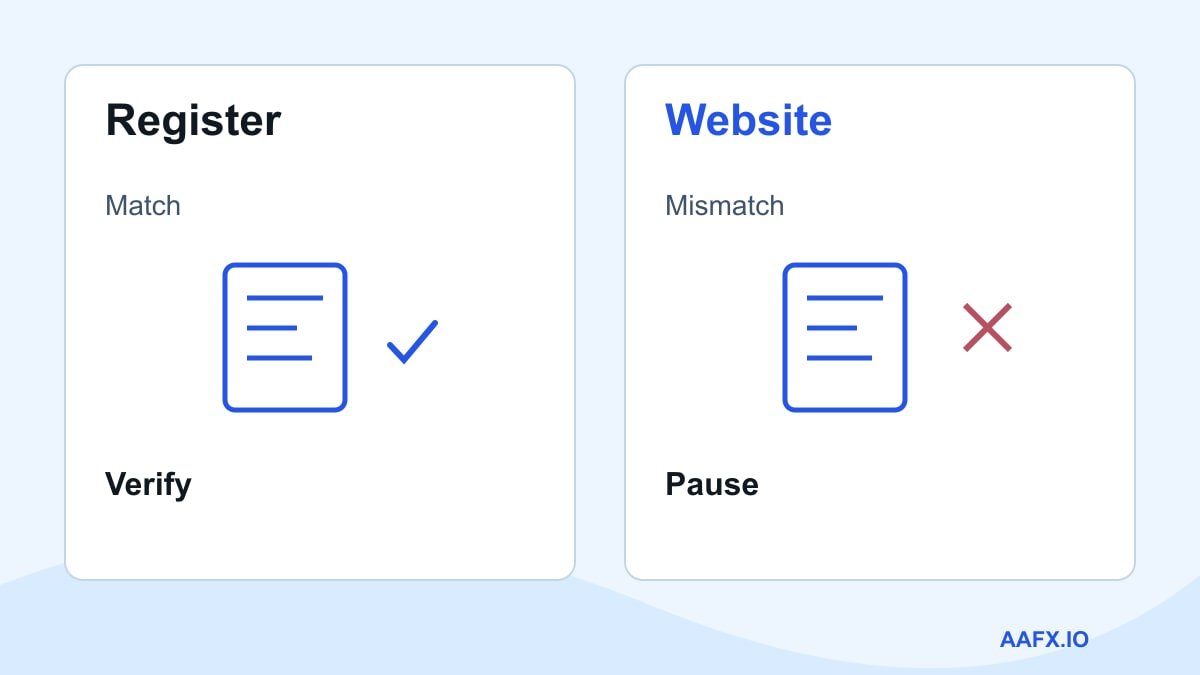
Consider a fictional example. “Example Markets Ltd” has a genuine register entry, but the person contacting you uses a different domain and asks you to pay an unrelated company. The real licence does not authenticate that person, website or payment instruction. Contact the genuine firm through independently verified details to resolve the mismatch.
Do not send identity documents or make a small “test deposit” merely to find out whether a suspicious contact is genuine. A successful small withdrawal would not establish the legality or safety of the wider arrangement.
Treat payment instructions as a separate identity check. Compare the recipient against the verified contract and documented funding procedure. A last-minute instruction to use a different company, private wallet or personal account needs independent resolution. Do not assume that familiarity with the salesperson makes a changed payment route authentic.
Keep the hypothetical example limited to the facts supplied. The mismatch does not establish guilt by the genuine firm whose name was copied. It means that the contact has not been authenticated. Separate the record of the real entity from the behaviour of the person or website claiming to represent it.
In this hypothetical evidence comparison, the genuine entry lists one domain while the proposed agreement or message supplies another. The useful output is an unresolved discrepancy, not a numeric safety score. A trader can stop at that point without sending a test payment to gather more evidence.
Understand the limits of regulatory protection
ASIC’s Moneysmart guidance states that an Australian financial services licence does not mean ASIC endorses the company, product or advice. More generally, regulatory status should not be presented as a promise of investment returns or protection against ordinary market losses.
Complaint routes, client-money treatment and compensation eligibility depend on the entity, service, customer classification and applicable rules. Do not apply a headline compensation limit to every account under a brand. Obtain the relevant disclosures and verify uncertain points with the official scheme or regulator.
Review the offshore broker guide if a provider proposes moving your account to another jurisdiction. The change may alter the contract and available protections even if the platform and brand stay the same.
A clear regulatory record is one input to provider selection. It does not establish that an instrument fits your circumstances, that execution will be favourable or that every charge is competitive. Compare the account agreement with the relevant product disclosure. Read the broker-role guide to distinguish access, execution and other services.
Keep ordinary trading risk separate from provider risk. Even where the entity and permissions are verified, a position can lose money. A stop-loss is a trigger, not a guaranteed fill, as explained by the SEC stop-order bulletin. The position-sizing guide develops those market-risk checks.
Consider a hypothetical fully paid share purchase through an appropriately authorised provider. A customer starts with $2,000 and spends $1,000 on 10 shares at $100 each. If all 10 are later sold at $95, the proceeds are $950. The gross price loss is 10 multiplied by ($100 minus $95), which equals $50.
Assume the total transaction charges are $4 and the remaining cash is unchanged. The net loss is $54, leaving $1,946 before tax. These invented figures explain the distinction between verified provider status and investment performance. They are not a fee quote, expected return or assessment of any particular compensation scheme.
The licence check answers whether the account provider has the relevant status and permissions. It does not predict the price of the shares or reverse this hypothetical loss. A claim that regulation guarantees a winning trade would therefore need to be challenged independently of the register entry.
| Calculation | Result |
|---|---|
| 10 shares bought at $100 | $1,000 purchase value |
| 10 shares sold at $95 | $950 proceeds |
| $50 price loss plus $4 assumed charges | $54 net loss before tax |
| $2,000 opening account less $54 | $1,946 remaining, if other cash is unchanged |
Check warnings and keep a reproducible evidence record
The CFTC directs customers to check registration and background information, including through NFA BASIC. Use the correct records for the market involved and read the details of any disciplinary information. A search result should be interpreted in context rather than reduced to a badge.
Search official warning lists for the name and domain. An absence from a warning list is not proof of authorisation: a newly operating or newly renamed firm may not yet appear. Conversely, distinguish a warning about an impersonator from the record of the genuine firm whose identity was copied.
| Record | Why it matters |
|---|---|
| Contracting entity and account jurisdiction | Connects the check to the account actually offered |
| Official register URL and check date | Makes the evidence reproducible |
| Status and relevant permissions | Shows what the registration does and does not cover |
| Website and contact comparison | Helps detect copied identities and clone domains |
| Unresolved discrepancies | Prevents a missing answer from being treated as a successful check |
Repeat the check before funding if time has passed, and after a proposed entity transfer or material contract change. Authorisation can change. Keep copies of the agreement and disclosures you relied on, without treating an old screenshot as proof of current status.
Use a written record that another reader could reproduce. Include which official site was used, which entity was matched and what remained uncertain. Separate observations from conclusions: seeing a name is an observation, while concluding that the offered activity is permitted requires the relevant scope check. Leave missing information explicitly unresolved.
A short record can also prevent repeated work. If a provider changes its legal entity, compare the new documents with the old record instead of assuming that the original check still applies. Retain relevant disclosures securely. Do not circulate account credentials or personal identity documents merely to demonstrate that verification was performed.
When to pause onboarding or avoid a provider
Stop the onboarding process while the discrepancy is unresolved. Contact the regulator or genuine firm using details obtained independently from the official source. Do not let urgency, a bonus deadline or a promise of guaranteed returns substitute for verification.
If you have already sent money and suspect fraud, contact your bank or payment provider promptly and use the relevant official reporting channel. Preserve communications and payment records. Be cautious of unsolicited recovery services demanding further payments to retrieve funds.
Once identity and permissions are verified, compare the actual service: broker fees, withdrawal terms, account requirements and execution models. A regulatory check is an essential foundation, not the entire due-diligence process.
Pause when the contact uses urgency to prevent independent checks. A bonus deadline or a claimed limited opportunity does not change the evidence needed to identify a regulated service. If the firm will not provide the contracting entity or a reproducible official record, the onboarding decision remains unresolved.
You should also pause when you cannot explain the product, costs or withdrawal terms even after the entity check succeeds. Verification is a foundation for further due diligence rather than a recommendation to trade. Compare the service with your needs and decide whether opening any account is appropriate.
AAFX.IO: verify identity before comparing the service
A useful licence check connects the actual account agreement to an official identity and a relevant permission. It also records mismatches and unresolved questions. That method is more informative than treating regulation as a single badge that makes every account or product equally suitable.
Continue with the AAFX.IO broker-selection pillar and the related guides linked above. Educational videos are available on TikTok and Instagram. Recheck official sources when the entity, service or contract changes.
Affiliate disclosure: Commercial links may generate compensation for AAFX.IO. This guide does not certify a firm, imply regulator endorsement or promise account protection.
Educational disclaimer: This material provides general information, not individual legal or investment advice. Verify the official rules and disclosures relevant to your own circumstances.
Written and reviewed by Arslan Ali Butt
MPhil Behavioural Finance, MBA Finance, 10+ years in forex dealing and analysis.
Last reviewed: 28 October 2026.
How we reviewed this guide: We compared the cited FCA, ASIC/Moneysmart, CFTC and NFA guidance and the SEC stop-order explanation. Source checks are dated 28 October 2026. The company mismatch example is fictional; no broker-account test or certification is claimed. Review annually and whenever material register guidance changes.
Frequently Asked Questions
Is incorporation the same as financial authorisation?
No. A company may be incorporated without having permission to provide the particular regulated service being advertised. A corporate register and a financial-services register answer different questions. Identify the account provider, activity and customer jurisdiction, then use the relevant official guidance. Treat an incorporation certificate as evidence of company registration rather than proof that the proposed brokerage activity is authorised.
Can a website copy a genuine licence number?
Yes. An impersonator can display a genuine firm name or number without being connected to that firm. Compare the exact domain and contact details, and resolve differences using an independently obtained official route. A familiar logo or a convincing document does not authenticate the sender. Never let a contact insist that independent verification is unnecessary because a number looks genuine.
Does a group licence apply to every subsidiary?
Do not assume it does. The company named in your agreement may be different from the company whose licence is promoted on the group website. Check that exact entity and the activities it may provide. A shared brand, platform or support team does not by itself establish identical client-money arrangements, complaint rights or eligibility for a compensation scheme.
What if a salesperson says the register is outdated?
Treat the statement as a discrepancy that needs independent resolution. Contact the regulator or genuine firm through details you obtained from the official source. A salesperson’s explanation should not replace the record you are checking. Wait until the entity, domain and relevant permissions can be established consistently before sending money or sensitive documents to the proposed provider.
What does an appointed representative entry mean?
It describes a particular relationship rather than necessarily a separate full authorisation. Read the relevant regulator guidance, identify the principal and check the activities covered. Do not infer unrestricted permissions from the presence of a name in a search result. Where the scope is unclear, ask the official source or principal through independently verified contact details before proceeding.
Does absence from a warning list prove legitimacy?
No. A warning list cannot be assumed to contain every suspicious website or newly operating business. Check positive evidence of the required authorisation as well as warnings. Read the details carefully because a warning may concern an impersonator copying a genuine firm. A missing warning and a matching name are not substitutes for verifying identity, status and scope.
How often should I repeat the licence check?
Repeat the check before funding when time has passed, and whenever the provider proposes a new contracting entity, jurisdiction or material service change. Keep the date and source of each result. An old screenshot records what was seen then; it does not prove present status. Ongoing monitoring should focus on the account relationship and relevant official notices.
Does a successful small withdrawal prove a broker is safe?
No. A small transaction shows only that the particular transaction occurred under those circumstances. It does not establish authorisation, ownership of a website or the treatment of a larger balance. Verify the legal entity and permissions independently. Do not use a deposit or identity-document submission as a way to test whether an already suspicious contact is genuine.
What should I do if I cannot find the firm?
Check the legal name and spelling against the proposed agreement, then consult the relevant regulator through its official contact route. Consider whether you searched the correct register for the product and jurisdiction. Until the discrepancy is resolved, do not treat a salesperson’s reassurance or a screenshot as equivalent to a verified entry covering the service offered to you.
What if I have already paid a suspected impersonator?
Contact your bank or payment provider promptly and use the relevant official fraud-reporting channel. Preserve the agreement, communications and payment details so the event can be investigated. Avoid further payments made only on a promise to release funds. Be cautious of unsolicited recovery services requesting fees, credentials or remote access while claiming they can guarantee that money will be recovered.
Sources & Methodology
Primary-source standard: Market-moving facts should link to original data releases, regulator notices, company filings or official project announcements whenever available. Secondary reporting is used for additional context, not as a substitute for original evidence.
Page last reviewed: