Forex vs crypto vs stocks is a comparison of different exposures, ownership rights and market structures. Forex compares currencies, actual stocks represent company equity, and crypto involves digital assets or contracts referencing them. Check the precise product before comparing possible gains, costs or risks.
Start with the AAFX.IO trading foundations guide. This article compares mechanics; it does not rank investments or recommend that everyone trades all three markets.
Risk warning: Prices can move against you, leveraged losses can develop quickly and access to an account can be disrupted. Custody, counterparty and operational risks also matter. Hypothetical examples are educational, not forecasts.
Affiliate disclosure: AAFX.IO may earn a commission through links on this page. This does not change our editorial conclusions.
What is the difference between forex, crypto and stocks?
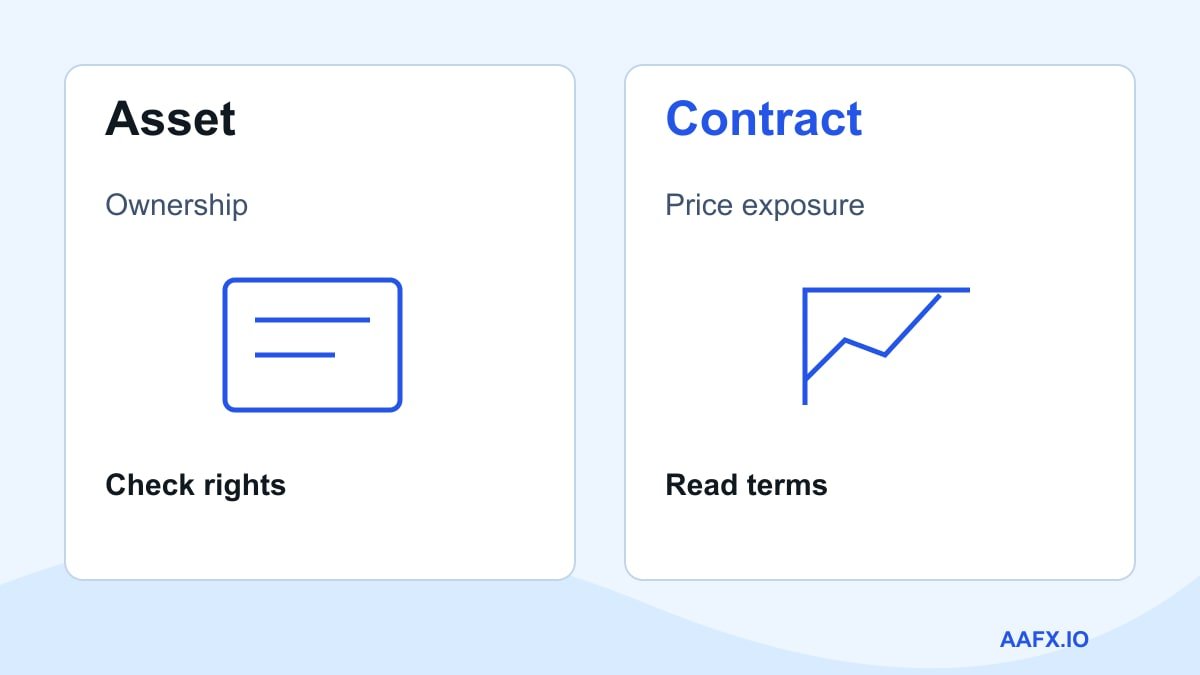
Forex compares one currency with another, stocks represent company equity when actual shares are purchased, and crypto involves digital assets or contracts referencing them. The practical differences include ownership, custody, market access, research and costs. Always identify the specific instrument, because a derivative linked to an asset does not necessarily convey ownership of that asset.
Which market is best for a beginner?
There is no universal best market for a beginner. Start with a product whose ownership, costs and loss scenarios you can explain. Compare the research required, your available time and the provider terms. Avoid choosing solely because a market is popular, continuously open or available with high leverage. Deciding not to trade is also valid.
Market Comparison: Overview
- Forex vs Crypto vs Stocks: compare the actual instrument
- Forex: relative currency values and contract structure
- Stocks: company ownership and share-price exposure
- Crypto: digital assets, contracts and custody
- Three hypothetical trades: compare exposure and costs
- Liquidity, volatility and dealing hours are separate
- Choose by product understanding and practical constraints
- AAFX.IO: start with the contract and a loss scenario
Forex vs Crypto vs Stocks: compare the actual instrument
| Feature | Forex | Stocks | Crypto |
|---|---|---|---|
| Core exposure | One currency against another | A company’s equity | A digital asset or token |
| Typical quote | EUR/USD: dollars per euro | Price per share | BTC/USD: dollars per bitcoin |
| Ownership question | Currency balance or a leveraged currency contract? | Actual shares or a share-price derivative? | Withdrawable tokens, a custody claim or a derivative? |
| Usual dealing window | Broadly weekdays across global sessions | Exchange and broker sessions | Spot venues commonly operate around the clock |
| Key research | Relative policy, inflation and growth | Earnings, balance sheet, valuation and industry | Token design, supply, network activity and custody |
| Costs to inspect | Spread, commission, financing, conversion | Commission, spread, conversion, margin or borrow costs | Trading spread/fees, withdrawal/network fees, derivative funding |
| Important extra risk | Leverage and dealer exposure | Company-specific loss and price gaps | Custody, technology, liquidity and token-specific risk |
These are general patterns, not universal platform terms. Holidays, maintenance, extended-hours arrangements and product restrictions can change access. A market being open does not mean your order can execute at a reasonable price.
Forex: relative currency values and contract structure
Forex is foreign exchange. A quote compares two currencies: in EUR/USD, the euro is the base currency and the US dollar is the quote currency. A higher EUR/USD means one euro buys more dollars. A trader buying the pair is taking exposure to a rise in the euro relative to the dollar; selling takes the opposite view.
Buying travel money, holding a foreign-currency bank balance and opening a leveraged retail forex position are different activities. Some products involve delivery of currency; others are contracts settled through gains and losses. Do not infer the contract from the currency symbol alone. The CFTC’s OTC forex advisory explains that off-exchange retail customers trade against their dealer, rather than through an open exchange. Its discussion is specific to that market structure.
Currency research is relative. Stronger growth in one economy does not automatically make its currency rise if investors already expected an even better outcome. Interest-rate expectations, inflation, capital flows and risk sentiment can all interact. Our major currency pairs guide explains common quotations, while the forex fundamentals guide covers economic catalysts.
Separate a currency view from the mechanism used to express it. A person expecting the euro to strengthen could hold a euro bank balance or use a currency contract, but settlement, leverage and counterparty exposure would differ. The same directional opinion does not make those account relationships interchangeable. Record the precise mechanism before comparing costs or possible outcomes.
Quotations also need care. Inverting a pair changes how the move is expressed, and an account held in another currency may require conversion when measuring the result. Use the contract size and quote convention in the actual account. A percentage change shown on a chart cannot replace those details.
Stocks: company ownership and share-price exposure
A stock is an ownership interest in a company. Buying actual shares gives exposure to the business, although voting and dividend rights depend on the share class and account arrangements. Dividends are not guaranteed. The SEC’s Investor.gov stock guide explains ownership and the possibility of losing money.
Stock traders study company announcements, revenue, margins, debt, competitive position and what the current price already assumes. A strong business can still be a disappointing trade if the entry price embeds unrealistic expectations. Conversely, a price bounce does not establish that a weak company has recovered.
Actual shares and stock CFDs are not interchangeable. A CFD normally tracks price changes under a contract with a provider; it does not make the holder a shareholder. Financing, corporate-action adjustments and counterparty terms also matter. Read our CFD versus stock trading comparison before using an app that lists both under similar company names.
Check what the broker records after the purchase. A cash-share holding, fractional interest and leveraged share-price contract may involve different rights or transfer arrangements. Read the account documents instead of inferring ownership from the buy button. Our long and short position guide also distinguishes a paid-for purchase from a borrowed-share short.
Research should separate the business from the trade. A company can report rising revenue while its shares fall because expectations were higher, costs increased or the valuation changed. Identify the information that would alter the thesis rather than treating a good product, familiar brand or recent price rise as sufficient analysis.
Crypto: digital assets, contracts and custody
Crypto trading takes positions in digital assets such as bitcoin or ether, or in contracts referencing their prices. A spot purchase and a perpetual futures position can have similar price charts but different obligations. Spot ownership may involve holding assets with a custodian or withdrawing to a wallet. A derivative may introduce margin, funding payments and liquidation.
Unlike a conventional company share, a token does not automatically confer ownership of a business or a claim on its earnings. Each asset has its own design and legal characteristics. Research issuance rules, token allocation, utility, governance and market depth rather than relying on a low unit price or a popular ticker.
Custody is part of the risk analysis. Holding on a platform creates dependence on its controls and contractual arrangements. Self-custody introduces responsibility for keys, backups and transaction accuracy. FINMA’s guidance announcement on crypto custody highlights technology and insolvency-related legal risks; it is not a guarantee for a particular platform. Our crypto broker versus exchange guide explains provider differences.
A useful custody question is what the customer can actually transfer. Check whether tokens can be withdrawn, which network is supported and what happens if an address or network is entered incorrectly. Do not send a transaction merely to test an arrangement you cannot explain. Read the provider terms and learn the operating process before committing assets.
For a derivative, establish how margin, liquidation and funding are calculated. A position that references bitcoin is not necessarily a bitcoin balance. A funding payment and a blockchain network fee arise from different mechanisms. Keeping these distinctions separate makes the comparison with shares and currency contracts more meaningful.
Three hypothetical trades: compare exposure and costs
The following examples exclude taxes and use invented entry and exit prices. They illustrate arithmetic, not forecasts or suggested trades. Assume the account is measured in US dollars.
Currency example
A long position representing €1,000 at EUR/USD 1.1000 has $1,100 of dollar-equivalent exposure. If it closes at 1.1110, the gross gain is $11: €1,000 × $0.0110. If it closes at 1.0890, the gross loss is $11. Financing, spread and commission change the net result. A small margin deposit does not reduce that underlying exposure.
Stock example
Buying 10 shares at $100 gives $1,000 of exposure. A move to $105 produces a $50 gross gain; a move to $95 produces a $50 gross loss. If total dealing costs are $6, the first result becomes $44 before tax, and the second becomes a $56 loss. Borrowing to finance the purchase would add another cost and risk.
Crypto example
A hypothetical spot purchase of 0.02 BTC at $50,000 per BTC costs $1,000. A sale at $52,500 produces a $50 gross gain. A sale at $47,500 produces a $50 gross loss. Trading fees reduce either result; transferring the asset can introduce additional costs. These spot calculations do not describe perpetual-contract funding or liquidation.
The stock and crypto examples both move 5% on $1,000 exposure. Their gross dollar results match even though their unit prices are very different. The currency example moves 1% on $1,100 exposure. This is why comparing the cash deposit or the nominal coin price alone is misleading. Use position sizing and understand leverage and margin before comparing possible returns.
The invented prices are deliberately simple so the arithmetic is visible. They are not current quotations or forecasts, and the examples do not imply that the same percentage move is equally likely in each instrument. A like-for-like comparison also needs a holding period and realistic costs for the actual provider.
Suppose a hypothetical leveraged contract provides $1,000 exposure against $100 collateral. A 5% adverse underlying move represents $50 before costs, equal to half that collateral. The same $50 price loss on a fully paid $1,000 asset is 5% of the purchase value. These simplified calculations exclude liquidation and illustrate why leverage changes account sensitivity.
| Example | Exposure at entry | Illustrated change | Gross result |
|---|---|---|---|
| EUR/USD long | EUR1,000, equivalent to $1,100 at entry | 1.1000 to 1.1110 | $11 gain before costs |
| 10 cash shares | $1,000 at $100 each | $100 to $105 | $50 gain before costs |
| 0.02 BTC spot | $1,000 at $50,000 per BTC | $50,000 to $52,500 | $50 gain before costs |
Liquidity, volatility and dealing hours are separate
Liquidity describes how readily orders can transact without substantially moving the price. Volatility describes the size and variability of price moves. Trading hours describe when dealing is available. These properties should not be treated as synonyms.
A liquid market can still move sharply after unexpected news. A continuously open crypto venue can have thin liquidity in a particular token. A widely followed stock can gap between sessions. In each case, a displayed quote is not a promise that a large order will fill at that price. Execution also depends on order type, size and available counterparties.
There is no dependable rule that one whole asset class is always the safest or most volatile. A small speculative stock, a major currency pair and a thinly traded token have different characteristics. The use of leverage can dominate the comparison: a modest underlying move can have a large effect on a highly leveraged account.
Plan around the hours you can actually monitor. A weekday currency contract, a share outside its main session and a continuously traded token can each produce conditions that are difficult for a particular trader. Review when announcements occur, whether orders remain active during outages and how the provider handles unusual conditions.
Use order controls with their limits in mind. A stop-loss is a trigger, not a guaranteed fill, as explained by the SEC stop-order bulletin. A price gap or insufficient liquidity can change execution. A limit order controls an acceptable price but may remain unfilled.
Choose by product understanding and practical constraints
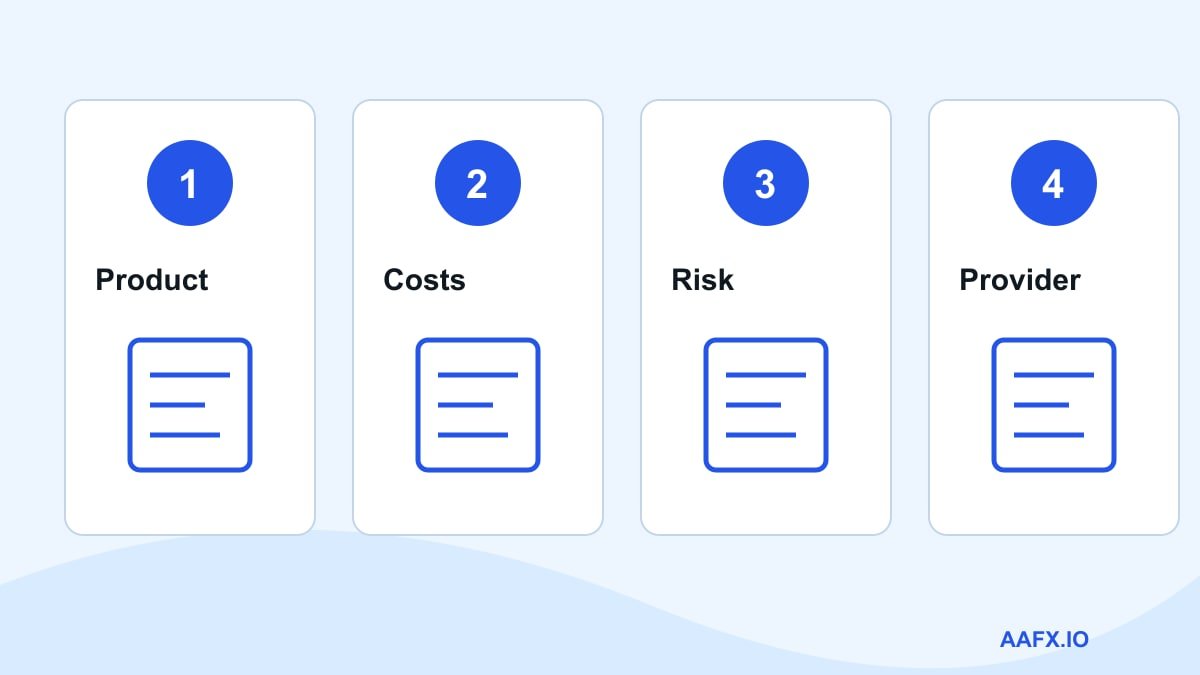
- Identify the instrument. Write down whether it is an asset, a custody claim or a derivative, and how gains and losses are settled.
- Identify the provider. Check the contracting legal entity and applicable permissions. A brand operating in several countries may serve accounts through different entities.
- Calculate the full cost. Include the spread, commissions, financing, conversion and any withdrawal costs relevant to your holding period.
- Test a loss scenario. Calculate a routine adverse move and a gap beyond the intended exit. Check margin close-out and negative-balance terms where relevant.
- Match the research burden. Decide whether you can follow the necessary company, macroeconomic or token-specific information.
- Check operational access. Learn order handling, custody, withdrawals and what happens during outages before placing a meaningful position.
Our broker-selection guide develops the provider checks. If your objective is long-term ownership rather than frequent transactions, compare trading with investing first. There is no obligation to trade all three markets, and deciding that none suits your circumstances is a valid conclusion.
Skip a product when you cannot explain its contract, custody or exit process. Also pause if the research burden exceeds your available time or a plausible loss would compromise money needed for essential expenses. A simpler market label is not a substitute for understanding the actual account. You do not need positions in all three markets to learn the differences.
Keep a written comparison with the same headings for each instrument. Note what is owned, when orders can execute, how costs accrue and what could prevent access to funds. Leave uncertain information unresolved. The purpose is to make a reasoned decision about participation, rather than to force a winner from three broad market categories.
AAFX.IO: start with the contract and a loss scenario
Compare the instrument first, then the account and provider. Ownership, custody and leverage explain more about a position than the broad category on a platform menu. Use the hypothetical examples to check your arithmetic, then replace their invented inputs with verified terms for the product you are researching.
Return to the AAFX.IO trading foundations pillar and the linked market guides for the next steps. Educational videos are available on TikTok and Instagram. Review the comparison annually and after a material product or regulatory change.
Affiliate disclosure: Commercial links may generate compensation for AAFX.IO. This comparison does not guarantee returns, certify a provider or establish individual suitability.
Educational disclaimer: General information only, not personal investment or legal advice. Verify the product and provider terms relevant to your circumstances.
Written and reviewed by Arslan Ali Butt
MPhil Behavioural Finance, MBA Finance, 10+ years in forex dealing and analysis.
Last reviewed: 28 October 2026.
How we reviewed this guide: We compared SEC stock and stop-order explanations, the CFTC OTC forex advisory and FINMA crypto-custody guidance. Primary sources were checked on 28 October 2026. Prices and charges in the examples are hypothetical; no provider account test is claimed.
Frequently Asked Questions
Is forex trading the same as crypto trading?
No. Forex takes exposure to relative currency values, while crypto involves digital assets or related contracts. Similar charts and paired quotes do not make the underlying rights identical. Compare the legal product, custody arrangements, dealing venue and cost schedule. If either position uses leverage, calculate exposure and an adverse scenario before comparing the size of the initial deposit.
Does buying a stock CFD make me a shareholder?
No. A stock CFD is a contract linked to a share price rather than direct ownership of the company. Dividend adjustments, financing and corporate-action treatment follow the contract terms. Actual shares may carry shareholder rights depending on the class and account arrangement. Read the product disclosure so a familiar company name on an app does not obscure the instrument.
Can I trade these markets without leverage?
Suitable providers may offer fully paid cash shares or unleveraged spot assets, but availability and terms vary. Confirm that borrowing, margin or a derivative is not embedded in the product. An unleveraged purchase can still lose substantial value, and custody or platform risks remain. The absence of leverage changes the mechanics; it does not guarantee a safe investment.
Does 24-hour trading make crypto safer?
No. Longer access does not guarantee sufficient liquidity, stable prices or continuous platform availability. A thinly traded token may be difficult to sell even while its venue is open. Constant access can also make monitoring more demanding. Check the specific venue, order rules and operational arrangements rather than treating an opening-hours label as a measure of safety or quality.
Is one whole asset class always more volatile?
No dependable rule ranks every instrument in one asset class above every instrument in another. A small speculative share, a major currency pair and an illiquid token can behave very differently. Compare the actual instrument, relevant period, available liquidity and position size. Leverage can turn a modest underlying move into a large account change regardless of the market label.
Why should I compare exposure rather than deposit size?
A deposit may represent the full purchase cost or only collateral for a larger position. Comparing deposits alone can therefore compare different economic exposures. Calculate the units held, contract multiplier where relevant and price change needed to create a given gain or loss. Then include costs, financing and currency conversion before drawing conclusions about the effect on account equity.
Do crypto tokens pay company dividends?
A conventional token does not automatically provide a claim on company earnings or shareholder dividends. Each asset has its own design and legal characteristics, which need separate investigation. A promised yield may involve a different arrangement, counterparty or contractual risk. Read the actual rights rather than interpreting the word income as equivalent to a dividend on an ordinary share.
Are spreads the only trading cost to compare?
No. Depending on the product, relevant charges can include commission, currency conversion, overnight financing, securities borrowing, derivative funding and withdrawal or network fees. Their importance changes with position size and holding period. Use the provider schedule for the exact account and instrument, then calculate an illustrative round trip. A narrow advertised spread does not establish the lowest total cost.
Can the same news affect all three markets?
Yes. Changes in interest-rate expectations, liquidity or risk appetite can influence several markets, although the direction and magnitude are not guaranteed. Company-specific announcements and token-specific developments can add different effects. Do not assume that holding instruments with different labels creates diversification automatically. Examine what drives each position and how their losses could combine during an adverse scenario or market disruption.
What should I check before choosing a provider?
Identify the contracting entity, relevant permissions, account product and custody arrangement. Read the execution, funding, withdrawal and complaint terms, and resolve discrepancies through independent official sources. A familiar trading interface does not establish identical protection across accounts or jurisdictions. Provider verification complements product understanding; neither check alone proves that an instrument or account is suitable for your circumstances.
Sources & Methodology
Primary-source standard: Market-moving facts should link to original data releases, regulator notices, company filings or official project announcements whenever available. Secondary reporting is used for additional context, not as a substitute for original evidence.
Page last reviewed: