
The U.S. Dollar Index (DXY) extended its recovery on Friday, climbing toward 101.80 during Asian trading after rebounding from its lowest level since late September. Despite the advance, the index remained on track for a modest weekly decline as investors positioned themselves ahead of October’s U.S. employment report. Recovering Treasury yields, renewed inflation concerns and expectations of another Federal Reserve interest-rate increase provided support for the Greenback. However, geopolitical uncertainty surrounding the U.S.-Iran conflict and shifting political expectations continued to complicate the Dollar’s outlook.
US Jobs Report Puts Dollar in Focus
The U.S. Dollar Index, which measures the Greenback against six major currencies, advanced to approximately 101.80 as traders awaited the October Nonfarm Payrolls (NFP) report.
Economists expected the U.S. economy to add 65,000 jobs in October, recovering from September’s weaker increase of 29,000. The unemployment rate was forecast to remain unchanged at 4.2%.
Investors will also examine average hourly earnings because wage growth provides important information about inflationary pressures and household purchasing power. Stronger wage increases could reinforce expectations that the Federal Reserve will maintain restrictive monetary conditions.
The key employment indicators include:
- Nonfarm Payrolls: Forecast at 65,000, compared with 29,000 previously.
- Unemployment Rate: Expected to remain at 4.2%.
- Average Hourly Earnings: Closely watched for evidence of persistent wage inflation.
The figures could influence expectations for the Federal Reserve’s December policy meeting and determine whether the Dollar’s latest recovery gains momentum.
Fed Rate Bets and Iran Risks Support USD
A recovery in crude oil prices overnight revived concerns about energy-driven inflation, providing another source of support for the U.S. Dollar. Higher energy costs can complicate the Federal Reserve’s efforts to bring inflation toward its 2% target.
According to market pricing cited in the original report, traders assigned approximately a 70% probability to another Federal Reserve rate increase in December. This expectation helped U.S. Treasury yields recover following their midweek decline after the U.S. midterm elections.
Geopolitical developments also supported demand for the safe-haven U.S. Dollar. President Donald Trump issued fresh warnings toward Iran on Thursday, while disagreements over Tehran’s nuclear program and the strategically important Strait of Hormuz continued to complicate diplomatic efforts.
Meanwhile, Senate Democratic leader Chuck Schumer called for an end to the Iran conflict, adding uncertainty over Washington’s future approach. Nevertheless, the possibility of renewed diplomatic progress could limit demand for defensive currency positions.
DXY Technical Analysis: 101.84 Resistance
The hourly technical outlook shows improving bullish momentum as the DXY trades above its 100-hour Exponential Moving Average (EMA) at 101.62. The index has also reclaimed the 38.2% Fibonacci retracement at 101.69, indicating stronger near-term buying interest.
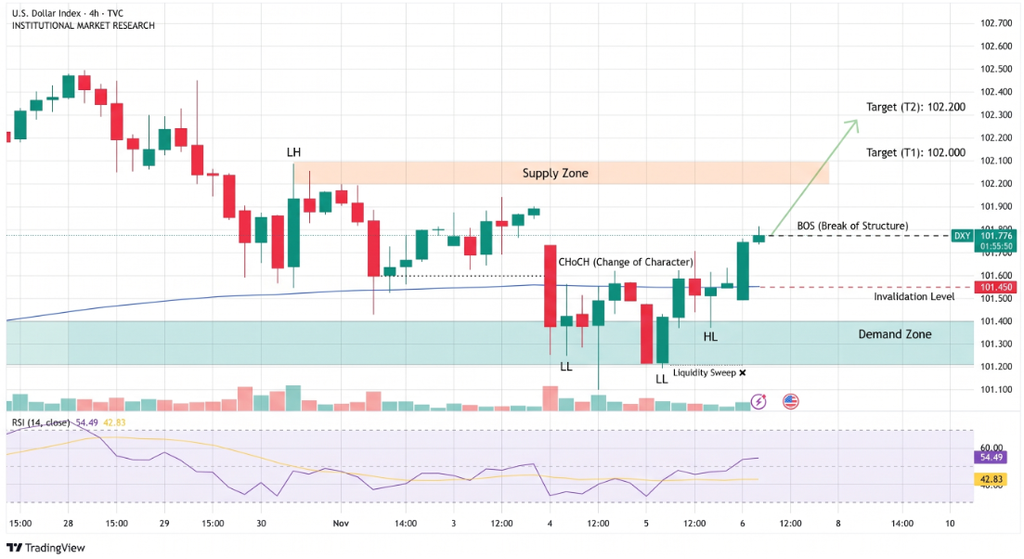
Immediate resistance stands at 101.84, corresponding to the 50% Fibonacci retracement. A sustained break above this level could expose the next barriers:
- 101.99: 61.8% Fibonacci retracement.
- 102.21: 78.6% Fibonacci retracement.
- 102.49: Recent cycle-high resistance.
On the downside, 101.69 represents initial support, followed by the 100-hour EMA at 101.62. Additional support appears at 101.50 and the broader structural floor near 101.20.
Conclusion
The DXY’s recovery toward 101.80 reflects stronger Treasury yields, persistent inflation concerns and expectations of tighter Federal Reserve policy. However, the October employment report remains the immediate catalyst. Strong payroll growth and wage increases could extend the Dollar’s rebound toward 101.99 and 102.21, while weaker figures could renew selling pressure toward 101.50 and 101.20. The 101.84 resistance level is particularly important for determining whether the recovery can develop into a sustained bullish move.
Sources & Methodology
Primary-source standard: Market-moving facts should link to original data releases, regulator notices, company filings or official project announcements whenever available. Secondary reporting is used for additional context, not as a substitute for original evidence.
Page last reviewed: