
Bitcoin fell on Monday, extending last week’s losses as uncertainty over U.S. cryptocurrency regulation and heavy institutional fund withdrawals weighed on investor sentiment. The world’s largest cryptocurrency dropped 2.4% to $74,112.20 by 05:44 ET (10:44 GMT), after losing approximately 2% over the previous week. The decline followed a Democratic sweep of Congress in the U.S. midterm elections, raising concerns that lawmakers could pursue tighter oversight of digital assets and complicate efforts to pass industry-backed legislation.
Regulatory Concerns Pressure Bitcoin
The change in political control has introduced uncertainty over the future direction of U.S. crypto policy. Several Democratic lawmakers have called for stronger anti-money-laundering requirements, tighter risk-management standards and greater scrutiny of cryptocurrency businesses.
Senator Elizabeth Warren, a prominent critic of the crypto industry, is widely viewed as a leading contender to chair the powerful Senate Banking Committee. If she takes the position, she would gain significant influence over congressional oversight of financial institutions and digital-asset markets.
Her potential leadership could increase pressure on crypto exchanges, stablecoin issuers and other companies operating in the sector. It could also make negotiations over industry-backed legislation more difficult.
The election results have raised questions about the prospects for crypto-friendly bills that advanced during the previous two years with substantial Republican support. A Democratic-controlled Congress does not automatically rule out bipartisan legislation, but the industry may need broader support to move its proposals forward.
Bitcoin ETFs Record $1.28B Outflows
Institutional investment flows have added to the pressure on Bitcoin. U.S. spot Bitcoin exchange-traded funds (ETFs) recorded $1.28 billion in net withdrawals last week, marking their second consecutive week of outflows and the largest weekly withdrawal total since late June, according to SoSoValue.
The withdrawals indicate that investors reduced their exposure through regulated investment products during the market decline. They also suggest that institutional demand was not strong enough to offset selling pressure elsewhere in the market.
The outflows limited Bitcoin’s ability to participate in a broader recovery across financial markets, including technology stocks. According to The Block, the withdrawals also pushed U.S. spot Bitcoin ETFs into approximately $914.1 million of net outflows for 2026.
Ether, XRP and Altcoins Extend Losses
Selling spread across the wider cryptocurrency market as investors reduced risk exposure. Ether, the second-largest cryptocurrency, dropped 5.8% to $2,106, while XRP declined 6.4%, approaching the psychologically important $1 level.
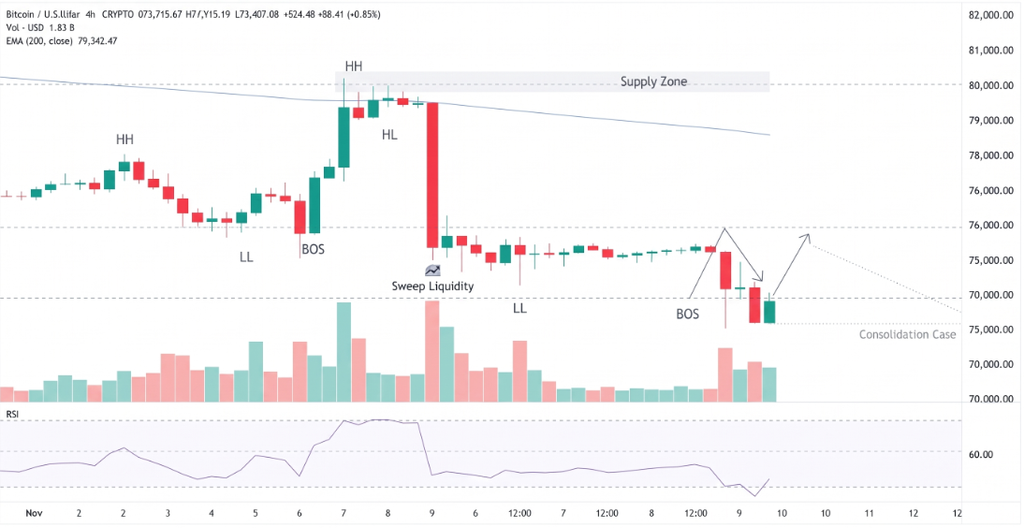
Other major digital assets also moved lower:
- Solana (SOL): Down 3.6%.
- Cardano (ADA): Lost 2.4%.
- BNB: Declined 2.5%.
- Dogecoin (DOGE): Fell 3%.
- TRUMP: Dropped approximately 3%, remaining above its record low from the previous week.
The broad decline indicates that weakness is not limited to Bitcoin. Smaller cryptocurrencies and speculative tokens remain vulnerable when institutional demand weakens and regulatory uncertainty increases.
Conclusion
Bitcoin’s fall to $74,112 reflects a combination of political uncertainty, institutional withdrawals and weakening sentiment across digital assets. The $1.28 billion in weekly ETF outflows highlights the scale of recent selling, while the prospect of tougher congressional oversight adds another source of uncertainty. A sustained recovery will likely depend on renewed institutional demand and greater clarity over the direction of U.S. cryptocurrency policy.
Sources & Methodology
Primary-source standard: Market-moving facts should link to original data releases, regulator notices, company filings or official project announcements whenever available. Secondary reporting is used for additional context, not as a substitute for original evidence.
Page last reviewed: