
The US Dollar Index (DXY) traded near 101.70 on Tuesday as investors assessed conflicting signals surrounding the Iran conflict and awaited the latest U.S. inflation figures. The dollar maintained support from safe-haven demand and growing expectations of another Federal Reserve interest-rate increase in December. However, traders remained reluctant to establish fresh positions ahead of the Consumer Price Index (CPI) report, which could influence expectations for the central bank’s next policy decision and determine the dollar’s near-term direction.
Iran Conflict Keeps Safe-Haven Demand Alive
The US Dollar Index, which measures the greenback against a basket of six major currencies, consolidated around 101.70 during Tuesday’s Asian trading session.
Geopolitical developments remained an important influence on currency markets as Washington and Tehran delivered contrasting assessments of potential peace negotiations. U.S. President Donald Trump indicated that progress toward ending the conflict was encouraging and suggested that renewed military strikes were unlikely. He also described the war as effectively over.
However, Mohsen Rezaei, Secretary of Iran’s Supreme National Security Council, rejected reports of active negotiations as false and maintained that Washington must accept Tehran’s seven conditions for ending the conflict.
The conflicting statements have prevented markets from fully removing geopolitical risk from asset prices. Continued uncertainty surrounding the Middle East has supported demand for traditional safe-haven currencies, including the U.S. dollar.
Investors are particularly sensitive to developments that could threaten energy supplies, disrupt international trade or increase volatility across global financial markets. Any deterioration in diplomatic conditions could strengthen defensive demand for the greenback.
Fed Rate Hike Bets Support the US Dollar
Monetary policy expectations have provided another source of support for the dollar. The latest US Nonfarm Payrolls (NFP) report, published last Friday, showed stronger employment conditions than expected, reinforcing concerns that the U.S. economy remains resilient despite restrictive borrowing costs.
The stronger labor-market performance has encouraged investors to reassess the Federal Reserve’s interest-rate outlook. According to the CME FedWatch Tool, markets are assigning more than an 80% probability to another interest-rate increase in December.
Higher interest rates generally support the dollar by improving the relative return available on dollar-denominated investments. They can also increase demand for U.S. Treasury securities as investors adjust their portfolios to changing yield expectations.
Nevertheless, traders are reluctant to increase bullish dollar positions before the upcoming inflation release.
US CPI Data Becomes Next Major Catalyst
The US Consumer Price Index, scheduled for release on Tuesday, is expected to provide fresh evidence about the direction of inflation and the Federal Reserve’s monetary policy.
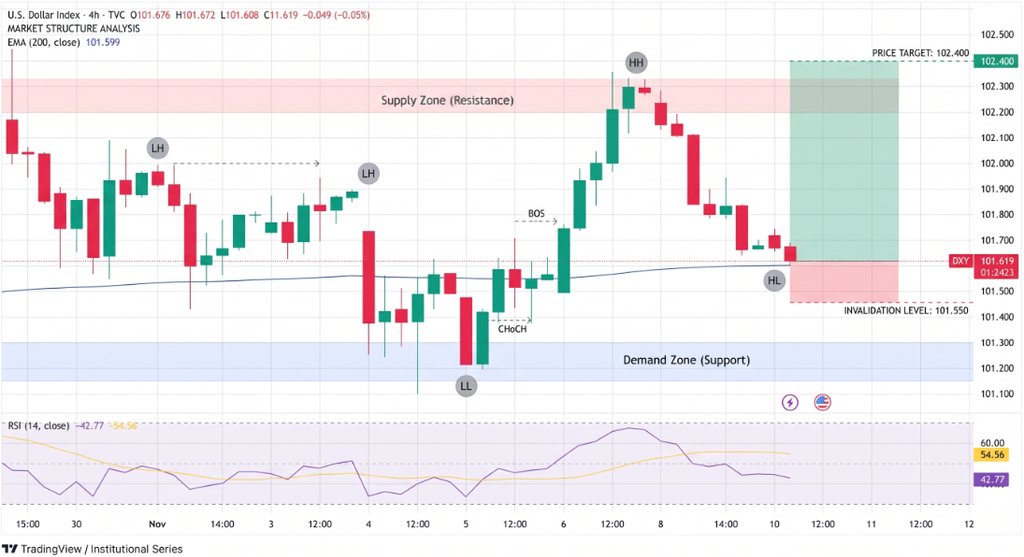
A stronger-than-expected inflation reading could reinforce expectations of another December rate increase, potentially pushing Treasury yields and the dollar higher. Conversely, softer inflation could weaken the case for additional tightening and encourage investors to reduce bullish dollar exposure.
Markets will also monitor geopolitical headlines for further direction. The following factors are particularly important for the DXY:
- Inflation: Stronger CPI figures could strengthen rate-hike expectations.
- Employment: Continued labor-market resilience may support restrictive monetary policy.
- Iran negotiations: Diplomatic progress could reduce safe-haven demand, while renewed tensions may support the dollar.
Conclusion
The US Dollar Index remains supported near 101.70 by geopolitical uncertainty and expectations of tighter Federal Reserve policy. However, the upcoming CPI report represents a critical test for bullish momentum. Strong inflation could extend the dollar’s advance, while a softer reading and progress toward an Iran peace agreement could weaken its safe-haven appeal. Until clearer signals emerge, the DXY may remain sensitive to economic data and developments in the Middle East.
Sources & Methodology
Primary-source standard: Market-moving facts should link to original data releases, regulator notices, company filings or official project announcements whenever available. Secondary reporting is used for additional context, not as a substitute for original evidence.
Page last reviewed: