
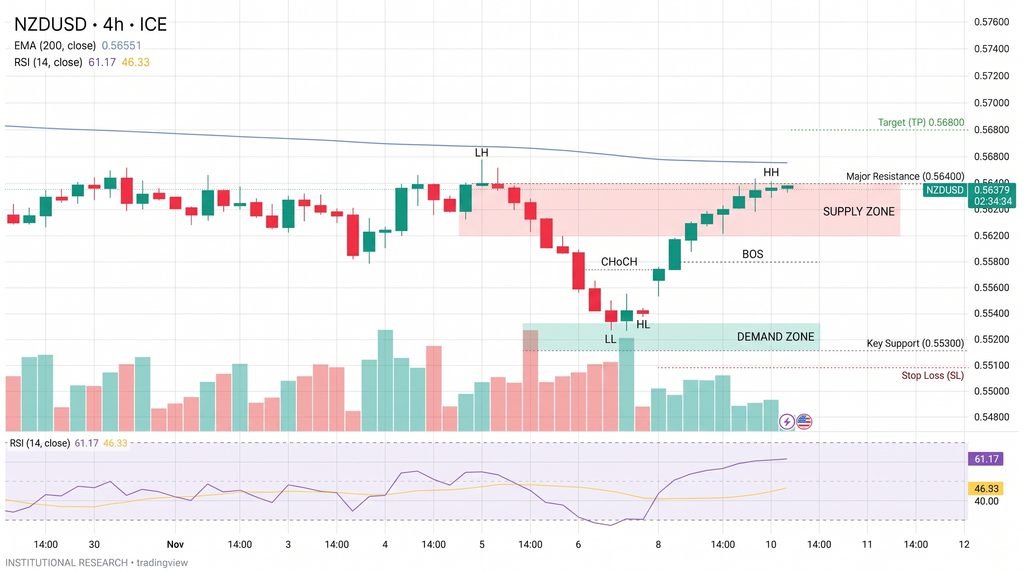
The New Zealand dollar traded near 0.5630 against the U.S. dollar on Tuesday, struggling to extend the previous session’s gains as a firm Greenback offset optimism over possible progress in U.S.-Iran negotiations. Falling oil prices reflected hopes of easing Middle East tensions, but expectations of another Federal Reserve interest-rate increase continued to support the dollar. Investors also awaited October U.S. inflation data, while uncertainty surrounding New Zealand’s election result added another domestic factor for the currency pair.
US Dollar Strength Limits NZD/USD Gains
The NZD/USD exchange rate remained confined to a narrow range during Asian trading after advancing in the previous session. The U.S. dollar retained support as investors assessed economic conditions and the possibility of further monetary tightening by the Federal Reserve.
Geopolitical developments offered mixed signals. Oil prices fell to their lowest levels since August as markets considered the prospect of a diplomatic breakthrough between Washington and Tehran. U.S. President Donald Trump described the conflict as militarily effectively over, although he maintained that American forces remained prepared to respond if necessary.
Lower crude prices can ease inflation pressures and reduce expectations for higher interest rates. However, the dollar continued to find support from expectations that U.S. monetary policy could remain restrictive.
The next major catalyst is the October Consumer Price Index (CPI), scheduled for release on Tuesday. Economists expected headline inflation to increase to 3.9% annually from 3.7%, while core inflation was forecast to rise to 2.8% from 2.6%.
Market expectations for a December Fed rate increase also strengthened. The CME FedWatch Tool showed an estimated 84% probability of a quarter-point hike, compared with 76% a day earlier. Higher U.S. interest rates generally support the dollar by improving the relative return on dollar-denominated assets.
New Zealand Election Adds Political Uncertainty
Domestic political developments are also influencing sentiment toward the Kiwi. Preliminary results from New Zealand’s November 7 general election gave Prime Minister Christopher Luxon’s National-led coalition, including ACT and New Zealand First, 67 seats in the projected 131-seat Parliament.
That represents a narrow one-seat majority, leaving the governing bloc vulnerable to changes when outstanding ballots are counted. Approximately 399,365 special votes, including overseas ballots, remain part of the official counting process.
According to New Zealand’s Electoral Commission, final results are scheduled for November 27. The incumbent administration will continue as a caretaker government while the outcome is confirmed and coalition arrangements are settled.
RBNZ Inflation Mandate Supports the Kiwi
The election also matters for monetary policy. Analysts at Brown Brothers Harriman have highlighted the National-led coalition’s support for maintaining the Reserve Bank of New Zealand’s focus on price stability.
The RBNZ has operated with price stability as its sole primary monetary-policy objective since December 2023, after the employment objective was removed. Labour had proposed restoring a dual mandate, making the election outcome relevant to expectations about the central bank’s future framework.
The RBNZ most recently held its Official Cash Rate at 2.75% on October 28, in a divided 4-3 decision.
Conclusion
NZD/USD remains under pressure near 0.5630 as expectations of tighter U.S. monetary policy support the dollar. Falling oil prices and New Zealand’s political developments provide competing influences, but neither has yet generated sustained buying in the Kiwi. The U.S. CPI release could determine the pair’s next move: stronger inflation may reinforce Fed rate-hike expectations, while a softer reading could weaken the dollar and give NZD/USD room to recover.
Sources & Methodology
Primary-source standard: Market-moving facts should link to original data releases, regulator notices, company filings or official project announcements whenever available. Secondary reporting is used for additional context, not as a substitute for original evidence.
Page last reviewed: